

Brought to you by…Brex

Every board is asking how the company is leveraging AI. At first they just wanted to make sure the company was using AI, but now they want to know:
What are you doing that actually adds value for customers?
What are the best use cases for internal work?
Are you moving faster and/or more efficiently yet?
Brex’s The CFO Guide to AI Strategy is a great resource for CFOs to see where other finance teams are finding the best AI use cases right now. I have implemented most of this myself…
Your Pricing Model Is Killing You
Pricing and COGS management have never been more critical to the success of a company. They are strategic decisions that impact both your revenue growth and profitability potential.
I asked my friend, Gokul Rajaram, to share his thoughts on AI pricing and COGS management. Gokul is an investor at Marathon, product leader (previously at Google, Facebook, Square, DoorDash), writer at Signalful (go check it out), and also just a super nice guy. He has invested in 700+ companies as either an angel investor or GP at his firm (companies like Airtable, Deel, Figma, Supabase, Vercel). He also currently serves on the boards of Coinbase and Pinterest.
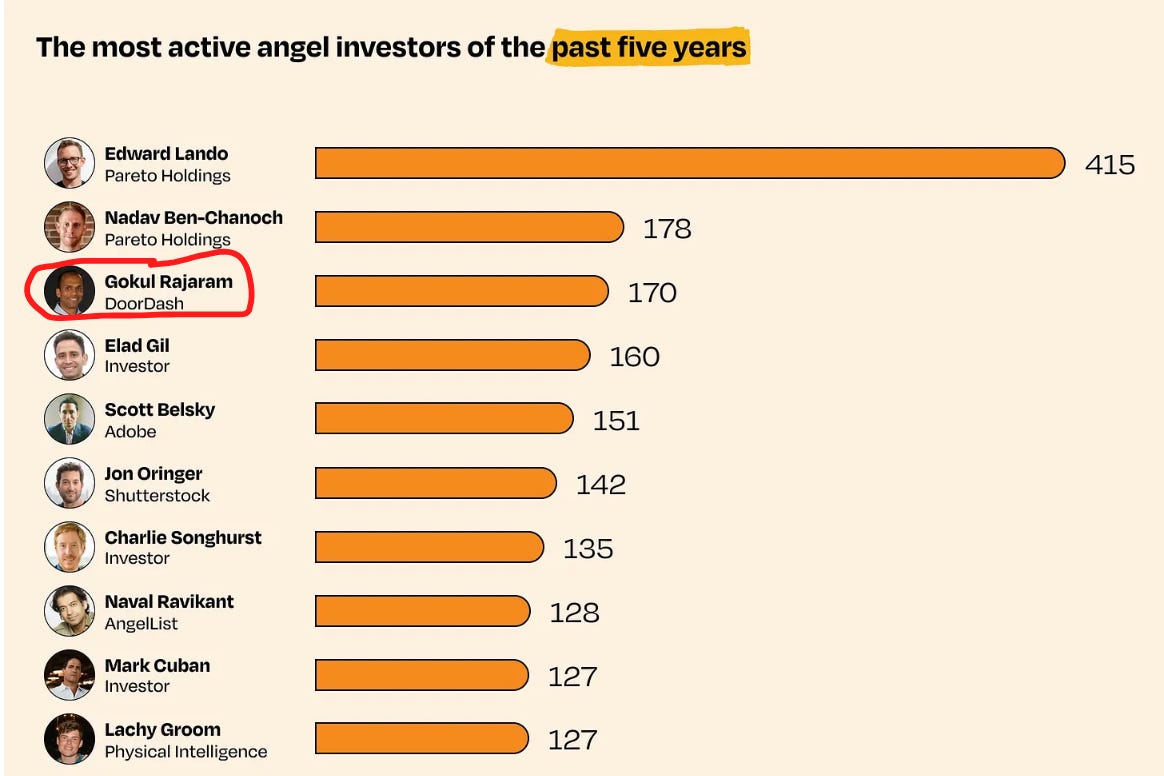
Lenny’s 2024 analysis shows Gokul as one of the most active angel investors in the world… so he has seen lots of pricing examples, including what works and what doesn’t.
7 Ways to Handle Your AI Gross Margin Problem
—A guest post by Gokul Rajaram
A few quarters ago I wrote on X that AI founders should price on a metric they control.
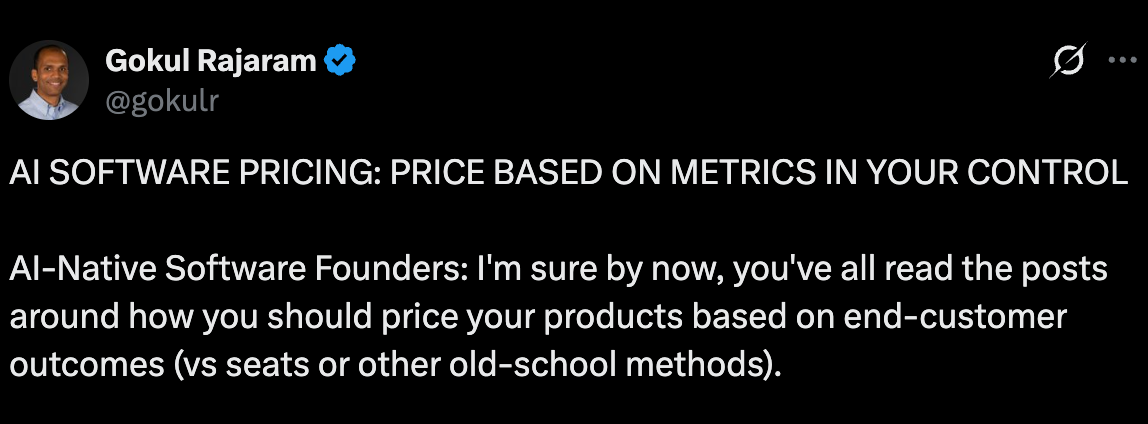
I’d add another requirement today: know what delivering each unit costs you.
An AI SDR might charge per personalized email while a support agent might charge per resolved question. Those are units customers understand. But the token cost behind each of those units can be hard to predict and vary widely. Two resolutions may create the same amount of revenue but have very different gross margins.
Companies need to make two primary decisions:
what the customer pays for
how to manage the cost of delivering it
There’s no single right answer to these decisions. For example, the following two companies have answered in opposite ways:
GitHub: GitHub recently started billing for the tokens it uses. Its old plan billed a quick chat and a long autonomous run the same.
Vanta: They do the opposite. Vanta eats its token costs and takes lower margins so more customers use its agent.
My view: Choose a unit your product controls that gets as close as possible to the result customers care about. Then meter the work behind it before deciding how much usage to include, cap or charge for separately.
What Customers Pay the Most For
tl;dr Charge based on things you can control, but try to continuously get closer and closer to things that your customers actually care about.
AI SDR Agent Example:
Customers care about qualified meetings, but the agent can execute well and still fail to book one. The seller’s offer, the prospect’s timing and competing alternatives all affect the result. A personalized email is a unit the agent can deliver more reliably. Start there, then move toward qualified meetings as your product takes responsibility for more of the outcome.
Google made the same call with search ads. It had the conversion data to charge per conversion. It charges per click. The advertiser’s product, offer and website decide whether a click converts, and Google controls none of them.
But don’t stop at activities. Customers pay the most for results they care about. Ask what they would measure six months from now to know your product worked. Then move your pricing unit toward it as you gain control over more of that result.
The unit can differ by customer. Smaller customers generally don’t like paying for software, so their pricing can be close to all usage. Enterprises push per-unit fees down hard, so they need a fixed platform fee on top. I’ve seen founders relieved to learn they aren’t trapped in one pricing model.
Once you know the unit of pricing, the question is who pays for the tokens behind it.
Meter Every Run First
Before choosing who pays for the tokens, measure what each run costs. Metering gives you the evidence to evaluate every strategy that follows.
Vinay Seshadri, senior director of product management at Chargebee, says every AI company can chart its revenue, but few can chart their margins. One agent run for the same user can cost 10 times more one day than the next. A month-end bill spread across all customers hides that. Telecom solved the same problem about 40 years ago with a shared record of each call. Chargebee’s open standard copies the idea. It joins what the app, the agent software and the model router each know, so you can see what each run cost.
Connect those runs to the unit you sell and the customer who buys it. A cost per run tells you what happened; cost per billable unit tells you whether your pricing can support it.
Who Pays for the Tokens?
There are seven approaches (which can be combined in various ways) to managing the token bill:
1. Eat the cost
Christina Cacioppo, CEO of Vanta, says customers ask a blunt question:
If you try to charge people based on tokens, they are very quick to say, 'Oh, you've just marked up a Claude token 4X. Are you 4X as good as Claude?’
You actually put yourselves in a competitive position against the models that probably no application really wants to do.
We're eating the token cost right now. We're taking lower margin. This is a usage phase and a deployment phase of this technology, and just go nail that, and you can figure out commercialization after.
So Vanta takes lower margins to push usage. About 25% of customers use its agent flow, and Christina believes that expanding it to 75% would materially improve retention.
2. Cut the cost
Notion: The Head of AI at Notion said an agent that writes the same SQL query every morning doesn’t need a model to reinvent it. Notion ships those fixed steps as plain code on CPUs.
Vercel: Harpreet Arora, lead for agentic infrastructure at Vercel, says enterprises explore on frontier models and move each proven workflow to a cheaper open-weight model. By October, more than a quarter of the AI dollars on Vercel’s gateway went to open-weight models.
Silvia: Anthony Pompliano, chairman and CEO of the personal finance AI company Silvia, says Silvia replaced most frontier models with its own router and fine-tuned models on its own hardware. Work that cost about $5,000 on a frontier model now costs about 97% less. Cutting takes engineers, though, and Pompliano says many businesses don’t have them.
3. Charge by usage
Workday: The CEO of Workday said that they will keep pricing HR by employee but will price agent work by consumption.
GitHub: GitHub moved every Copilot plan to usage-based billing, and developers complained they would get less and pay the same.
Intercom: Intercom charges $0.99 per qualifying Fin outcome. Usage pricing gives customers a clear unit to buy, but it does not necessarily pass through the token bill. Charging per resolution still leaves the vendor carrying the difference between the price and the cost of each resolution.
4. Cap it
Anthropic: Keep the flat price and ration the usage. In July 2025 Anthropic added weekly limits to Claude Code to rein in a small group of power users running it around the clock. A cap works best when a few customers burn most of the tokens. It fails when those customers are the ones who love the product most.
Grok: Elon tweeted that the cost of serving Grok Bot was unsustainable in response to complaints about unexpectedly exhausted usage allowances as SpaceX tightened Grok usage limits.

5. Let customers bring their own key
GitHub & JetBrains: The customer plugs in its own contract with OpenAI, Anthropic or Google, and that contract pays for the tokens. GitHub offers this for Copilot Business and Enterprise, and JetBrains offers it too. Large enterprises like it because they already have lab contracts. The vendor gives up the token revenue and control of which model runs.
6. Move the work onto the customer’s device
Perplexity: Aravind Srinivas, CEO of Perplexity, says short chat is about 30 times cheaper in a data center. For agents that read about 100,000 tokens and run all day, that advantage falls to roughly 3 times, or even 1.
Apple & Google: Apple Intelligence and Google’s Gemini Nano already run some tasks on the phone, where the customer pays for the chip and the power.
7. Wait for the price to fall
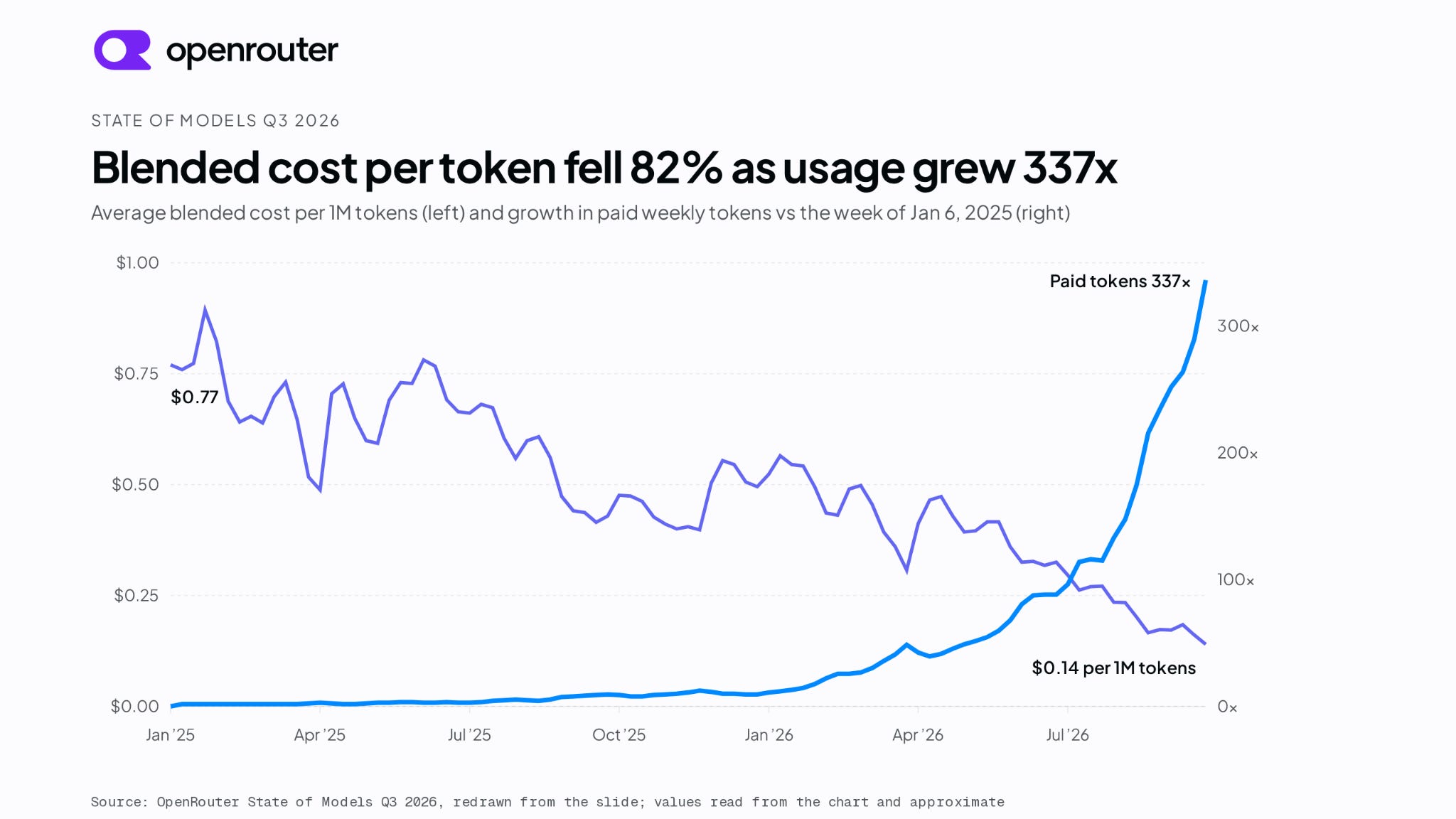
Srinivas says competition among the labs keeps lowering prices.
OpenRouter’s data shows that the blended cost per 1M tokens fell by 82% between January 2025 and September 2026! Lower costs come from a variety of things such as price competition, open weight models, better cost controls, etc
How to Combine Them
Metering supports every combination. Three I’d look at first:
Cap + usage pricing: a flat plan with a ceiling.
Include a defined allowance, then charge for usage above it. GitHub’s Copilot plans use a monthly allotment of credits with more for sale. If you bill per unit of work rather than per token, keep measuring the token cost behind each unit.
Eat + cut: absorb the cost while a workflow is new, then reduce it as the work becomes repeatable.
Arora describes enterprises exploring on frontier models and moving proven workflows to cheaper open-weight models. Use evals to check that the cheaper approach still delivers the result customers pay for.
Bring your own key + usage pricing: offer different arrangements to different customers.
Large buyers with their own model-provider contracts can pay for tokens directly and pay you for the software. Other customers can buy units of work with model costs included. Meter both arrangements so you know what each customer costs to serve.
Make the Unit Economics Work
Before setting a price, look at your last thousand runs. Group them by the unit you intend to sell and examine how much delivery costs vary across customers.
If heavy usage makes that unit unprofitable, change the workflow, the included allowance or the price before encouraging more of it.
Price on a unit your product can deliver and your customer values. Know what each unit costs. As you gain control over more of the customer’s outcome, move your pricing closer to it.
Footnotes:
*Thank you, Gokul, for the great breakdown on AI pricing! It’s such an important topic for building companies today. And it can literally break your company if you get it wrong.
Talk to my friends at Brex for a true AI-native spend platform
I just opened up 2027 sponsorships - email onlycfo@onlycfo.io
Subscribe and share the OnlyCFO newsletter with your teams
*Nothing in this article constitutes legal, tax, or investment advice

Always a fan of any Gokul advice