
Brought to you by…Brex

Every board is asking how the company is leveraging AI. At first they just wanted to make sure the company was using AI, but now they want to know:
What are you doing that actually adds value for customers?
What are the best use cases for internal work?
Are you moving faster and/or more efficiently yet?
Brex’s The CFO Guide to AI Strategy is a great resource for CFOs to see where other finance teams are finding the best AI use cases right now. I have implemented most of this myself…
🚨 Sponsor OnlyCFO in 2027 - I am opening up 2027 for sponsorships! Reach 38K finance and other tech leaders. There are several ways to work together to make your marketing dreams come true.
$300M Disappears: Poppi vs Pepsi
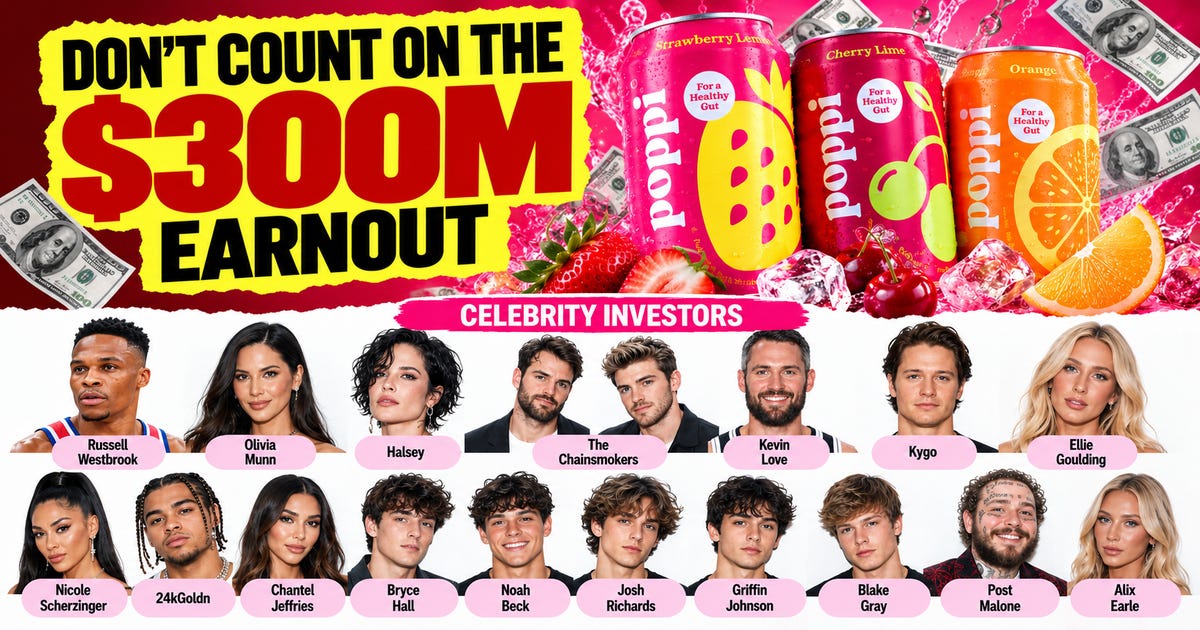
Poppi, a prebiotic soda brand, was acquired by Pepsi in May 2025 for $1.95B upfront cash + $300M earnout.
Like many drink brands, Poppi had a long list of celebrity investors… Many of them will be surprised to learn that the $300M piece will likely never come.
The $1.95B piece is guaranteed and paid on closing of the acquisition. The earnout? Well…that is contingent on performance.
Pepsi’s recent financials showed that the $300M potential “earnout” has been marked down to just $12M (down from a high of $278M). Accounting rules require companies to estimate the fair value for this estimated payment each quarter (more on earnout accounting further below).
Changes in the earnout valuation show up in the fair value disclosure:

While the earnout was most recently valued at $12M, it’s very likely that Poppi will see $0 from the earnout because the structure seems to be all or nothing.
Under the terms of the arrangement, we will be required to make a payment of $300 million if certain performance milestones are achieved by the third quarter of 2027; otherwise, no payment will be made.
$12M out of $300M (4%) target earnout basically means Pepsi believes there is very little chance of the targets being met…
What’s an Earnout?
Earnouts are often used to bridge valuation expectation gaps between the buyer and seller. So the buyer says, “OK, if growth is X% over the next two years then we will pay the rest of what you think you are worth”.
Earnout: A piece of the purchase price in an acquisition that only gets paid out if agreed targets are hit over some period of time post-acquisition.
Time period: The most common measurement period is 1-2 years post-acquisition. Anything >3 years is stupid and you shouldn’t agree to it.
Measurement: In my world (software/AI), the most common target metric is ARR/revenue. Although I recently saw an AI deal that was based on gross profit because COGS was so variable from the AI costs. Any profitability metric further below that (like EBITDA) would be very unusual unless it’s a large established and profitable business that will maintain standalone financials from the buyer.
Payout: Terms often include some minimum threshold and then a sliding scale based on performance (eg. <80% of target gets $0 earnout and then scales linearly to 100%). Or it could be all or nothing if the targets are met. Or it could have additional payouts for over performance (usually with a cap).
Earnout Benchmarks
Only about 25% of recent deals include earnouts.
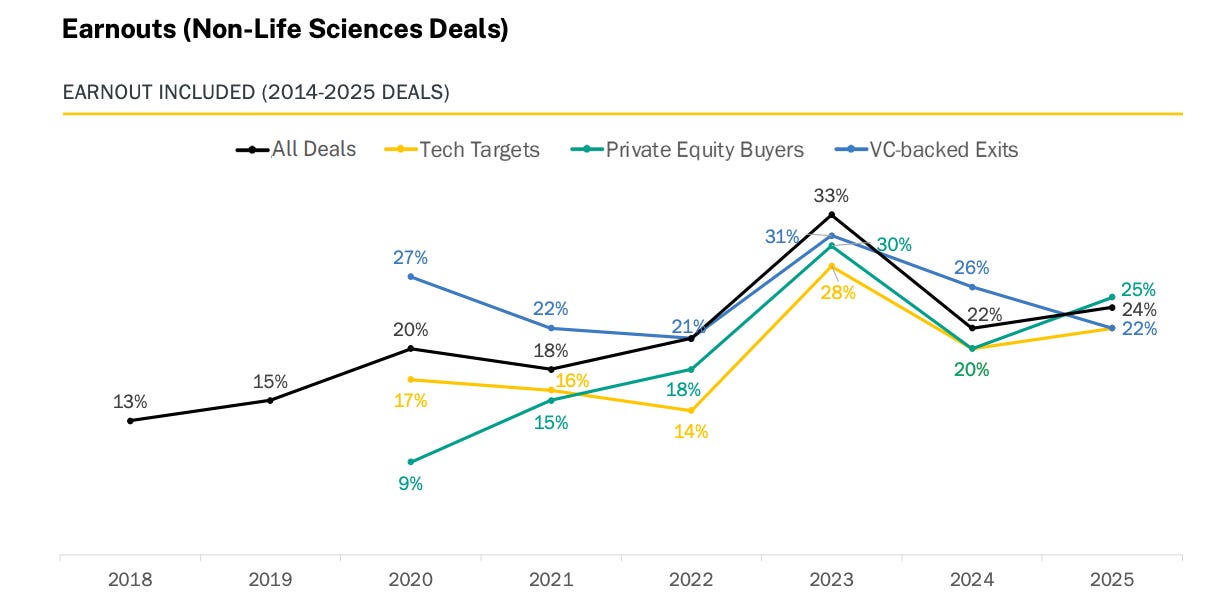
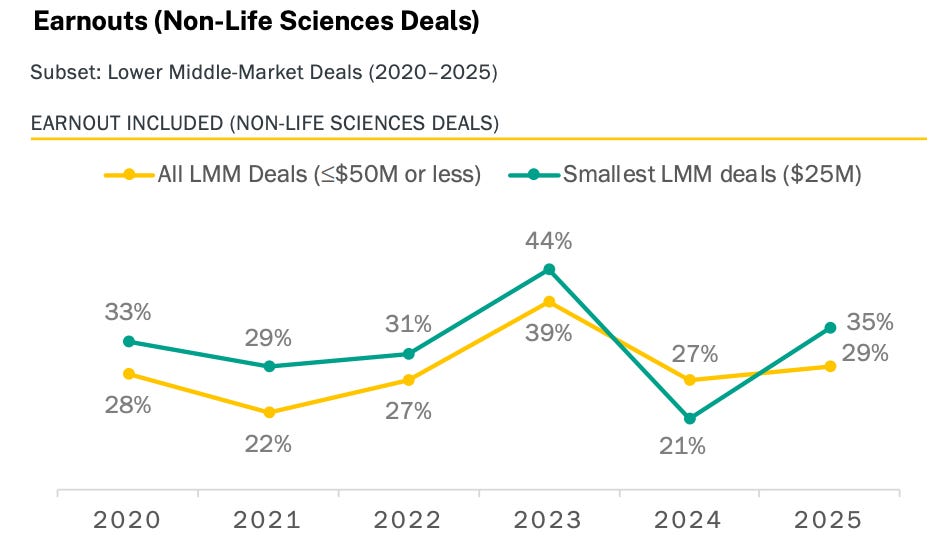
Earnouts are much more common in smaller deals. Usually because the seller wants credit on an NTM revenue basis, but the buyer doesn’t trust their forecasts given their size and more unknowns. So the earnout is theoretically the bridge in those expectations.
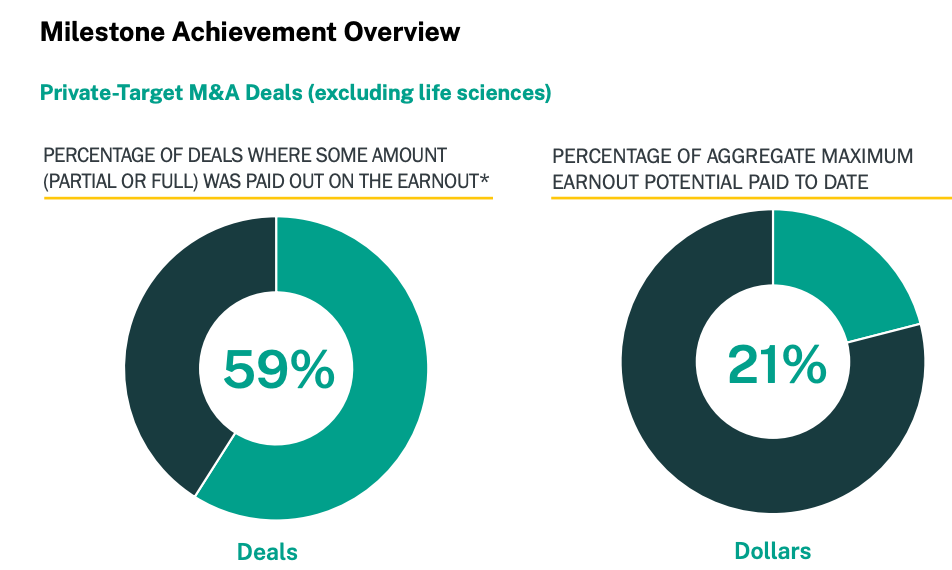
41% of deals with an earnout received $0 of the earnout. Ouch! And only 21% of max earnout has actually been paid so far…
The sellers contested the earnout in 28% of all these deals 🤯
And only 17% of the deals that were contested saw an increase to the earnout (buyer usually wins)
Why Do Sellers Hate Earnouts?
Because so many sellers fully expected to get the earnout (ie “I can achieve those targets!”) to only feel like the rules changed later and the earnout money was stolen from them.

But are earnouts a scam?
It’s a nice idea to say “always get all the cash upfront”, but if that was an option then they obviously would!
Sellers are taking it because it feels like the best deal (or maybe it’s the only deal on the table). Based on the earnout data above though, sellers should value upfront dollars a LOT more than earnout dollars if they are able to take more upfront dollars versus earnout dollars.
Why Earnouts Don’t Get Paid
Seller No Longer Controls the Outcome
Once the deal closes, the seller loses control. The buyer is the one setting hiring plans, marketing budgets, how to incentivize reps (or not to), etc.
There usually isn’t malicious intent (“let’s screw the seller!”), but things change…
Priorities change, budget for acquired product decreases, sales reps aren’t incentivized to sell the new product etc. All of a sudden the earnout targets are MUCH harder to hit.
Can the seller sue for this?
They sometimes try, but usually unsuccessfully. Most of these contracts are written so buyers have discretion on where budget goes (they have to have that)
Having been on the buyer side with earnouts though, I really want the earnouts to get paid! This is usually true for software/AI companies. We aren’t buying to take out a competitor, but rather buying adjacent products that I hope succeed.
Disagreement on Definitions
Wait…how are we defining ARR? Or, what is included in the gross margin calculation? That shouldn’t count as churn!
Buyers almost always win in these arguments unless it’s very clear in the agreements. This is incredibly common to have these types of disputes, especially around ARR since no one really knows what it means.
This can create a lot of contention and what the seller originally assumed was an achievable target becomes significantly harder.
Tips to Protect Your Earnout
You need legal counsel experienced with earnouts, or your chances of getting paid will fall significantly. Here are a few tips based on my experience:
Add covenants around product budgets (sales, R&D, etc). If proper budget isn’t given, then X happens. Examples: if the product is shut down then full earnout is paid, proportional adjustments when budgets decrease, etc.
Clearly define target metrics before closing. If it’s not clear, then the buyer’s definition wins
Require a monthly/quarterly earnout tracker. This is pretty standard, but make sure the buyer calls out any changes or adjustments to past periods
The shorter the measurement period the better. 1-2 years is pretty normal. But >3 years? Don’t walk…run away!
Ask about their prior acquisition earnouts. What percentage of the maximum earnout did sellers of prior acquisitions actually receive?
Define the treatment of acquisitions, cross-selling, and synergies. Does revenue generated from the buyer’s existing customers count? How is ARR calculated in bundles with buyer’s products? Especially bundles where you heavily discount seller’s product? What if buyer changes how seller’s product is priced? etc
Try to get more upfront cash even if you have to trade more earnout potential. If on average only 21% of maximum earnout dollars get paid out, then you should be willing to trade a lot of potential earnout dollars for the guaranteed upfront cash. This is even more important if you can’t get them to agree to the other points above.
Accounting For Earnouts
There are two ways companies might account for earnouts:
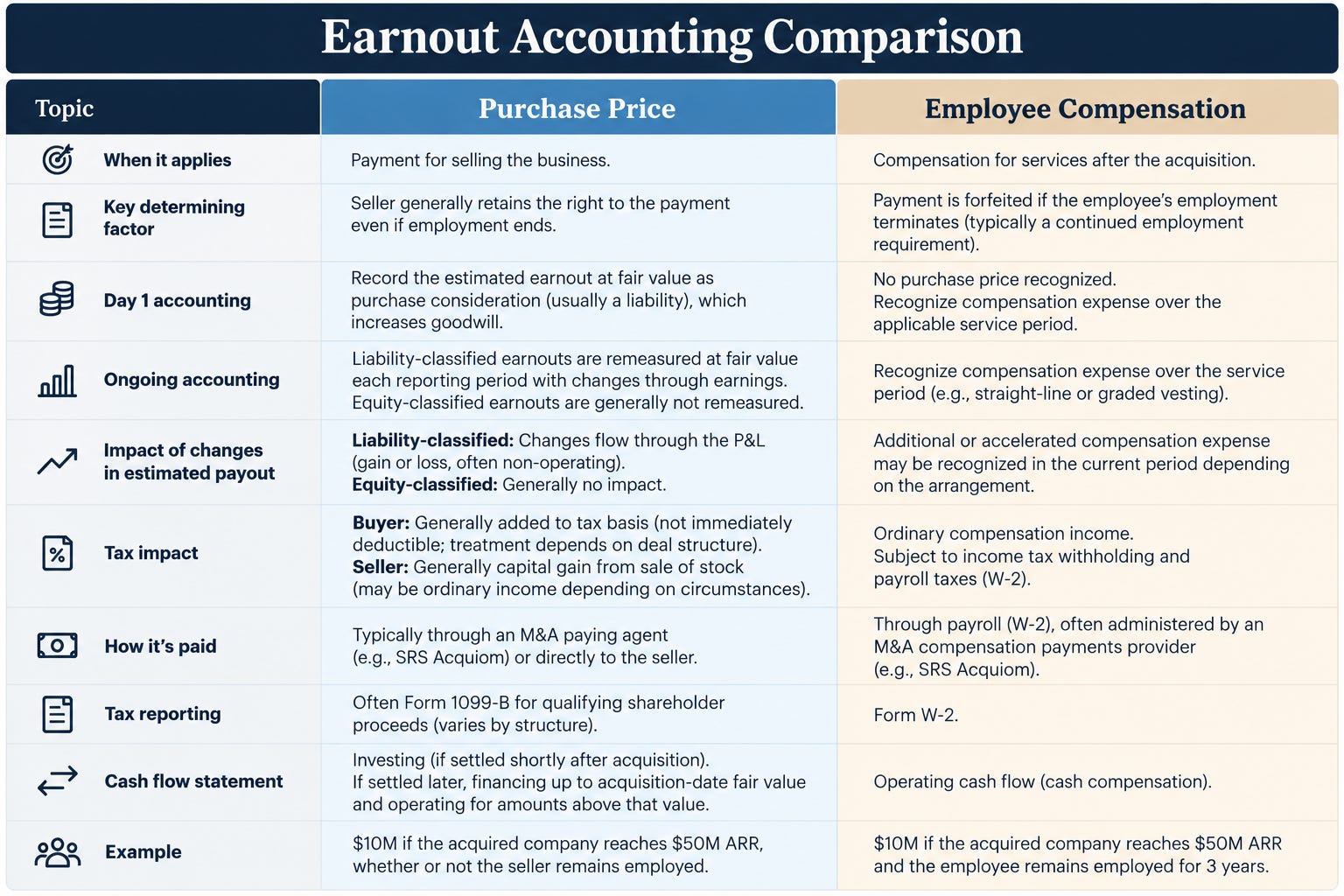
Purchase Consideration: When the earnout is for simply being a stockholder (and not paid out because of their employment). The fair value is determined by the buyer based on likelihood of the payment and some more complex valuation techniques.
Initial Earnout Fair Value - Impacts goodwill only (no P&L impact).
Subsequent Fair Value changes - Hits P&L as expense or gain
Employee compensation - if the payment is deemed employee compensation then that portion all hits the P&L with no goodwill impact. If the payment can only be earned if they are an employee then it’s employee comp.
Accounting for Poppi’s Earnout:
Acquisition Close Date: Pepsi recorded $226M of fair value for the earnout as purchase consideration, which means it doesn’t hit the P&L but only impacts goodwill (goodwill is higher by $226M)
Measurement Period Adjustment: Later disclosures show that the “acquisition date fair value” was $180M, so it decreased by $46M. If this is what happened (made some assumptions based on the disclosures), then the $46M decrease didn’t flow through the P&L either. Companies have a one-year measurement period to adjust the original fair value based on facts that existed at the time of the acquisition closing date (not subsequent performance).
If you have ever done an acquisition then you know that you often can’t finalize all the accounting by the time you need to report financials so GAAP gives you one year to finalize and make adjustments directly to acquisition date fair value, which will impact goodwill (and not the P&L)
Subsequent Fair Value Adjustments: All fair value adjustments of the earnout that is based on post-acquisition performance flow through the P&L. If Pepsi has to pay the entire $300M earnout, then they would record a total of $120M expense ($180M is already a liability). And if the earnout targets aren’t met, they don’t have to pay anything so they would recognize a cumulative $180M gain through the P&L (since that is the acquisition date liability).
Pepsi increased the earnout fair value to $278M in Q4 2025 ($98M of expense hit the P&L)
And then the fair value dropped to $162M ($116M gain in Q1 2026)
And then dropped again to $117M ($45M gain in Q2 2026)
And most recently dropped to $12M ($105M gain Q3 2026)
$98M of expense in 2025 and a $266M gain in 2026 ($168M net gain). And it will be $180M if/when the remaining $12M fair value is never paid out.
I don’t know what the milestones/targets are, but even with one year left in the earnout period, it seems very unlikely they will be hit given the $12M out of $300M fair value…
But Pepsi’s P&L will look $180M better because of it. They get to recognize a gain because they don’t have to pay the earnout!
Here is a little accounting summary for earnouts.
Final Thoughts
Don’t count on the earnout!
Just assume the upfront consideration is what you will get and any earnout is a nice bonus.
If the earnout is significant, then make sure you get smart M&A counsel reviewing it to maximize your potential of getting it.
Footnotes:
Talk to my friends at Brex for a true AI-native spend platform
I just opened up 2027 sponsorships - complete the form!
Subscribe and share the OnlyCFO newsletter with your teams
*Nothing in this article constitutes legal, tax, or investment advice