
Brought to you by…Remote

Every global hiring pitch sounds the same until you ask the right questions. Here are three I’d ask:
Who legally employs our people in each country?
What will we actually pay beyond the quoted price?
Do they have local compliance experts who can help when issues come up?
Not all EORs are created equal… Remote’s checklist covers 8 questions to ask an employer of record (EOR) before you sign.
Capital Allocators Need to Understand AI Economics
AI-related costs are quickly becoming (if not already) the largest expense on the P&L:
Maybe AI features are killing your gross margins
Everyone is using expensive frontier models (across all departments)
Your legacy software is now embedding AI that costs more
AI engineers are expensive
Good capital allocators (the CFO’s job but also all leaders) need to understand the data, trends, and insights around AI so they can make better decisions with the fastest growing and likely the largest expense.
I asked my favorite data story-teller, Peter Walker, to share what he is seeing in his new role at OpenRouter as Head of Insights. OpenRouter is an AI gateway and marketplace that gives you access to hundreds of LLMs through one account. So they got tons of interesting data from all the AI usage that flows through their platform
The Current State of AI Tokenomics

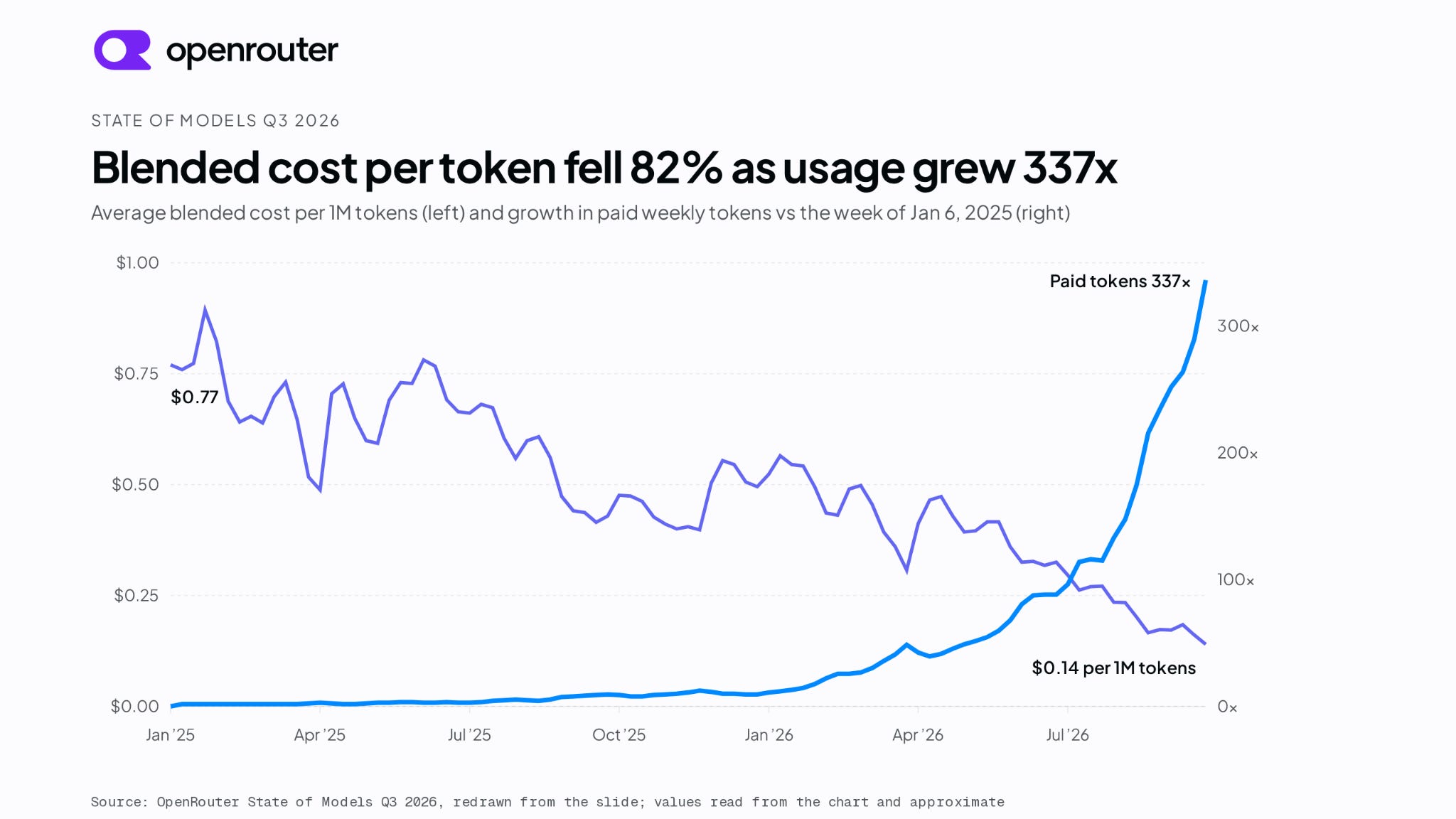
In January 2025, OpenRouter processed about half a trillion tokens a week. By late September 2026 it was 164 trillion. Over the same stretch, the average price paid for a million tokens fell from $0.77 to $0.14.
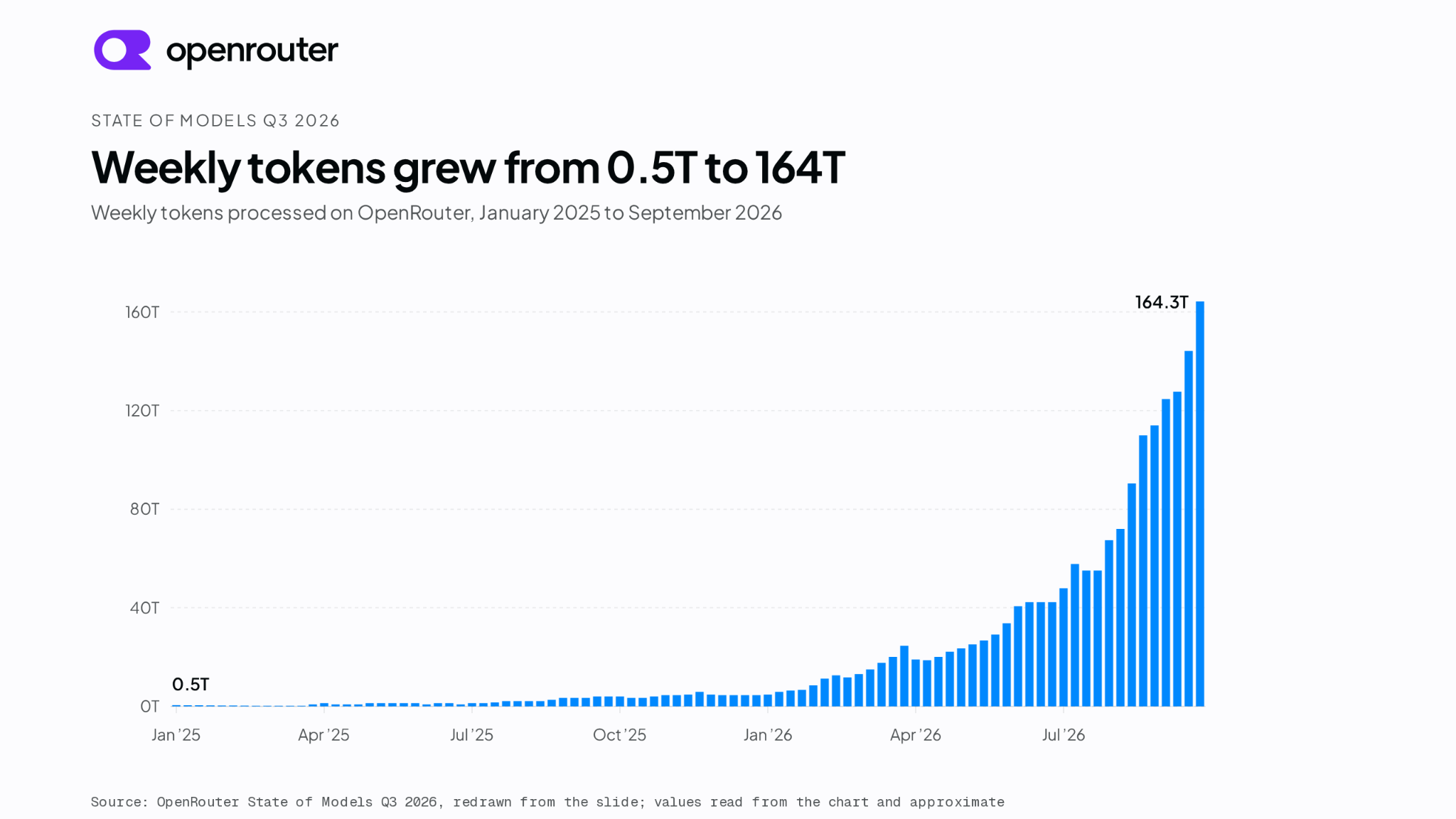
This sort of usage growth coupled with a massive decrease in cost is pretty rare. Finance leaders have treated AI thus far as a line item like any other, albeit with significant variance. We think that approach is out of date. AI spend will become the single largest cost for most enterprises and managing it will require an understanding of marketplace dynamics.
Most companies still buy AI the way they buy software. They pick a vendor, sometimes negotiating an annual commit, and re-evaluate at set milestones. The data says inference behaves much more like a commodity input, with falling unit costs, rising volume, and a best supplier that changes every few months.
Four forces reshaping the market
1. Supply exploded
862 models have launched on OpenRouter since the start of 2024. 362 of them launched in 2026 before October, more than all of 2025. The pace of new model creation is unlikely to flag in the coming months and years.
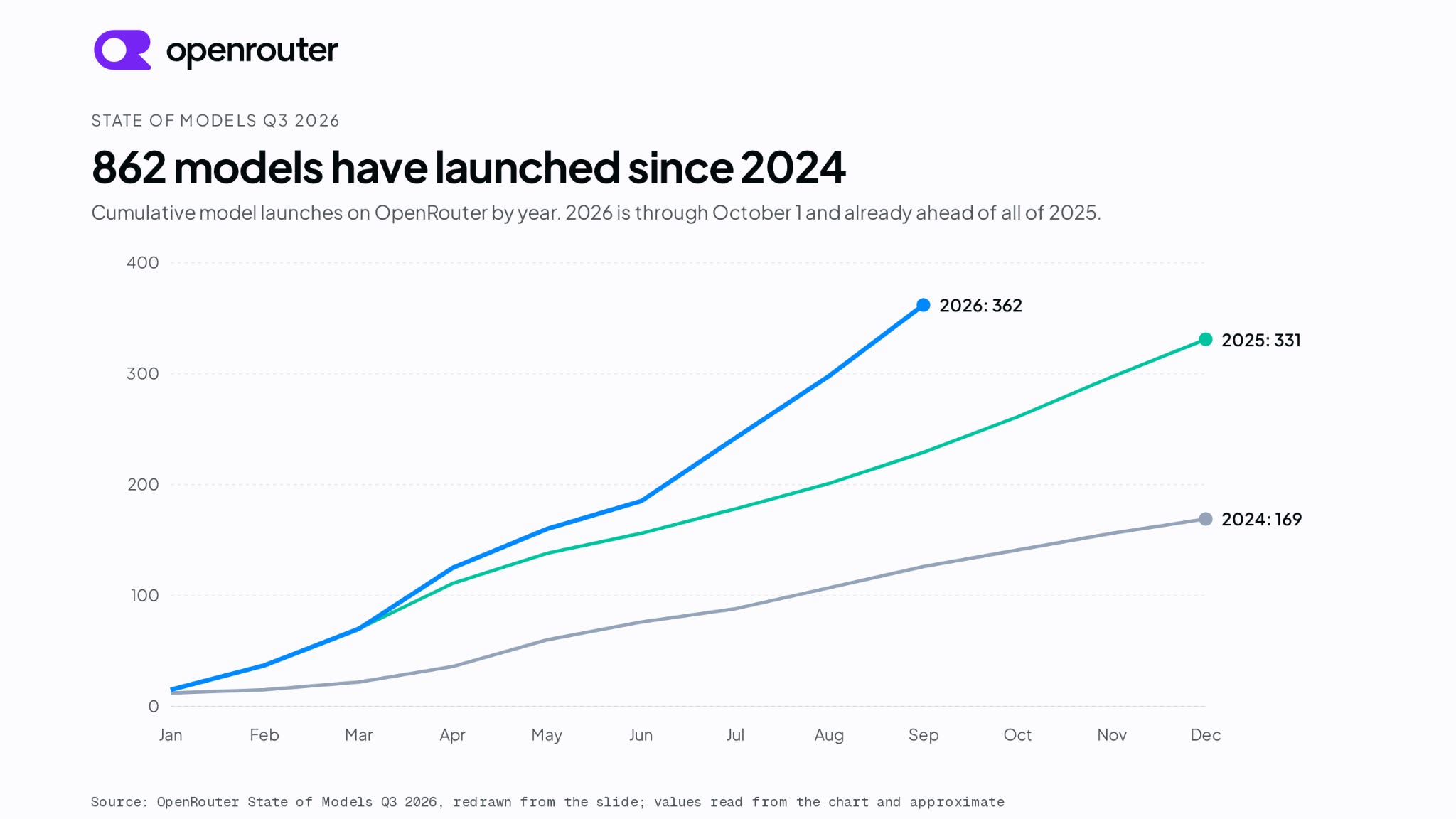
Sure, some of these new models will come and go without making an impact. But the number of models handling more than a trillion tokens a week went from 3 to 27 over just the last 6 months. Models have become both more general (at the frontier) and more specialized (in the line behind the frontier). Just keeping up with the changes is a full-time job.
2. Open-weight models have taken major token share
Open-weight models now carry about 60% of weekly tokens on OpenRouter but only 26% of spend. A large share of everyday work (classification, extraction, coding subtasks, agent steps) has moved to models that cost a fraction of the frontier.
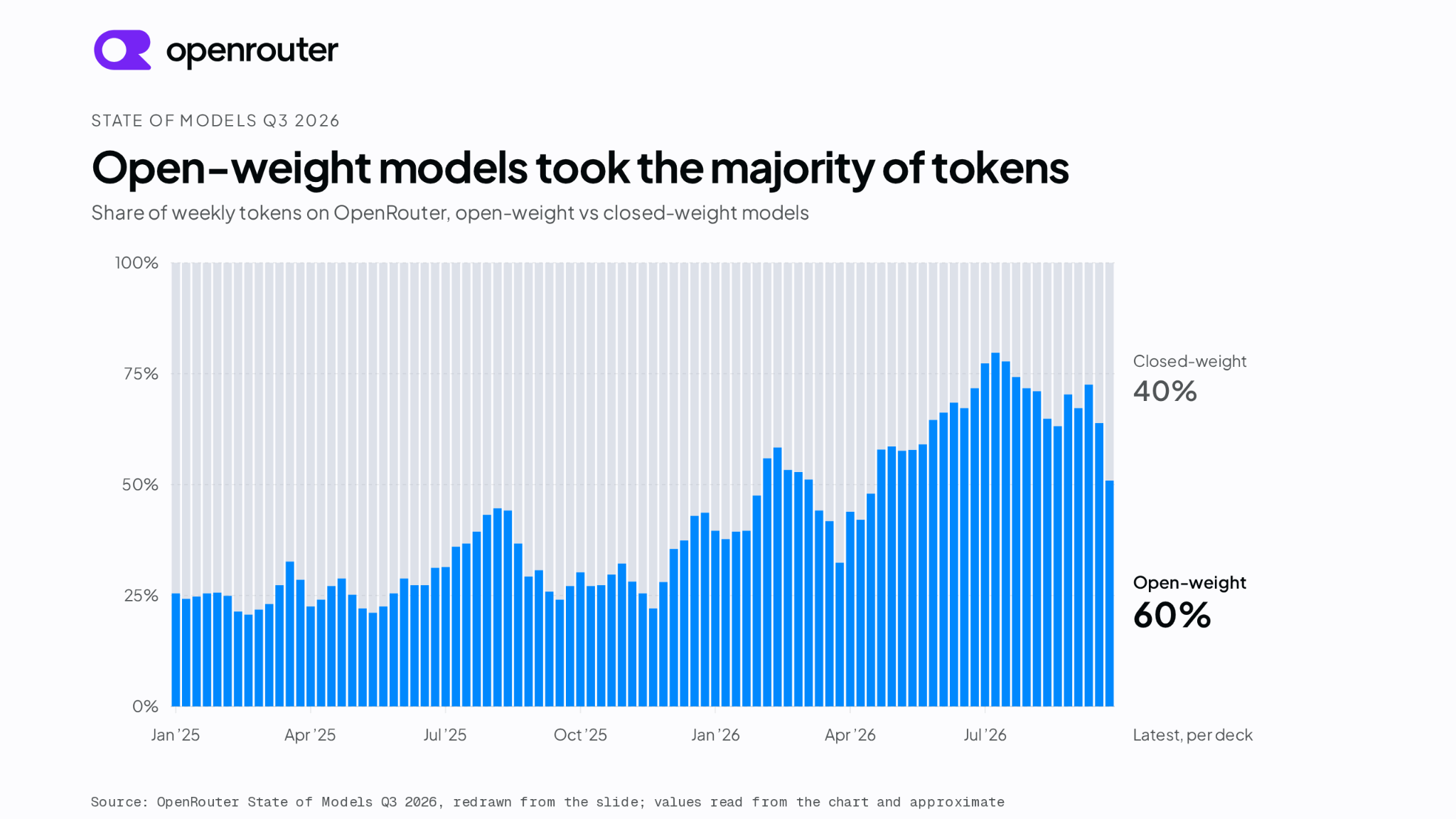
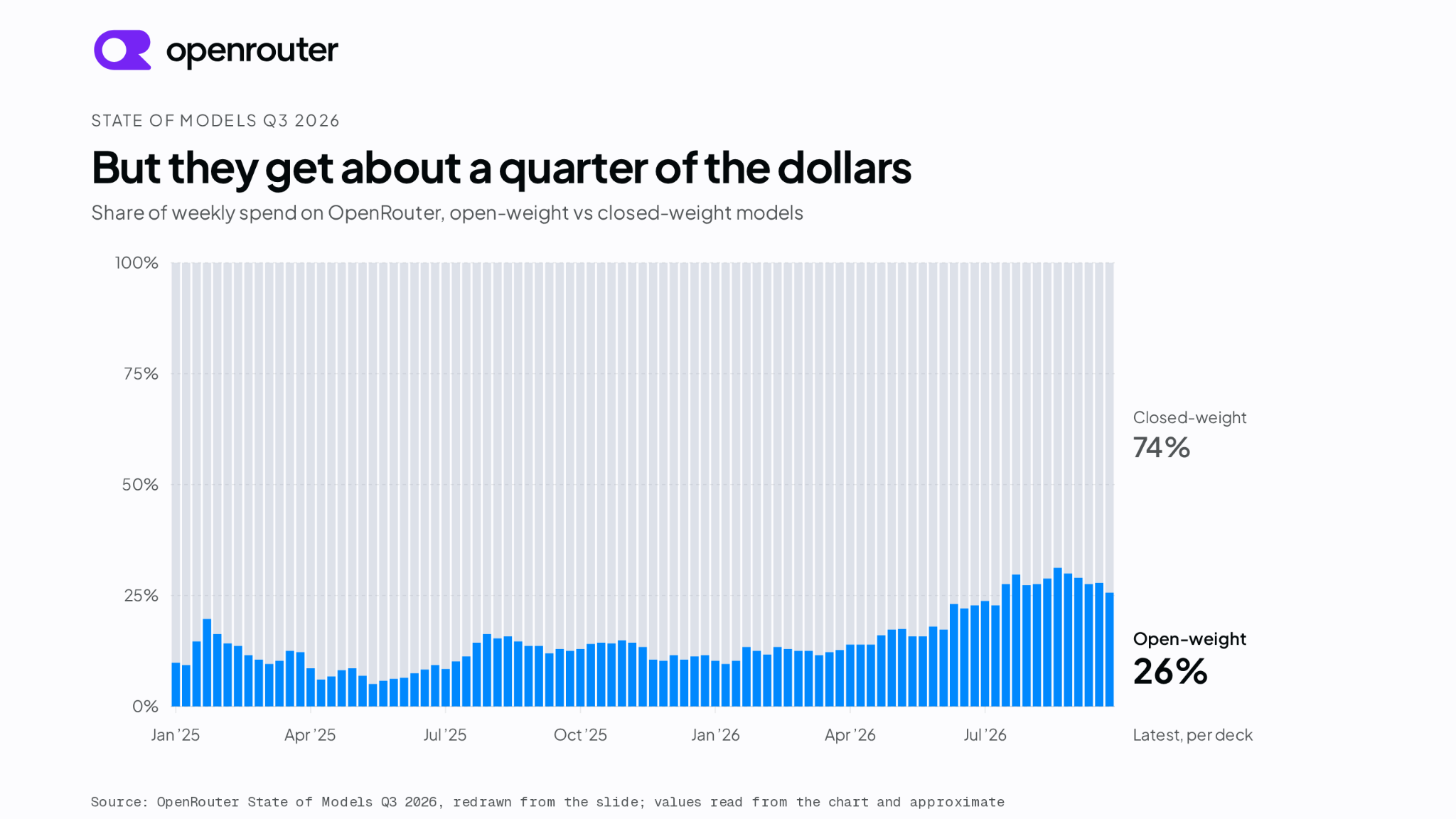
About two thirds of open-weight tokens run on models from Chinese labs, which raises an obvious procurement dilemma. However, where a model was built and where it runs are separate decisions. 44% of tokens on Chinese-built models are served by US-headquartered providers, so the model can be chosen on price and quality while hosting is chosen based around privacy concerns.
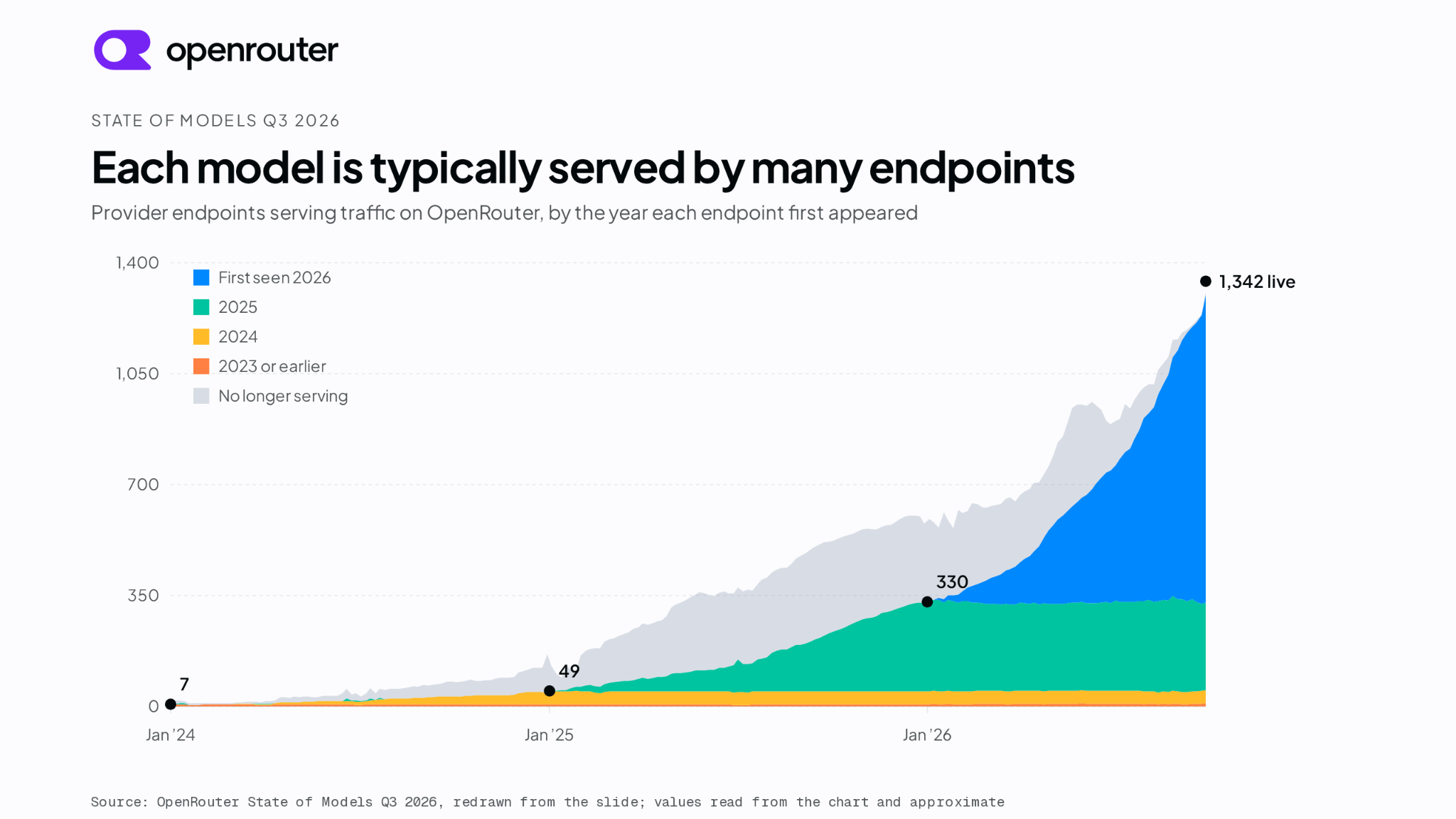
Almost every model is now served by several inference providers, and the number of provider endpoints serving traffic grew from about 330 at the start of this year to 1,342. An endpoint in this chart represents a combination of model x provider (so DeepSeek V4 Flash on Coreweave, for instance).
3. Agents arrived, and agents run on cache
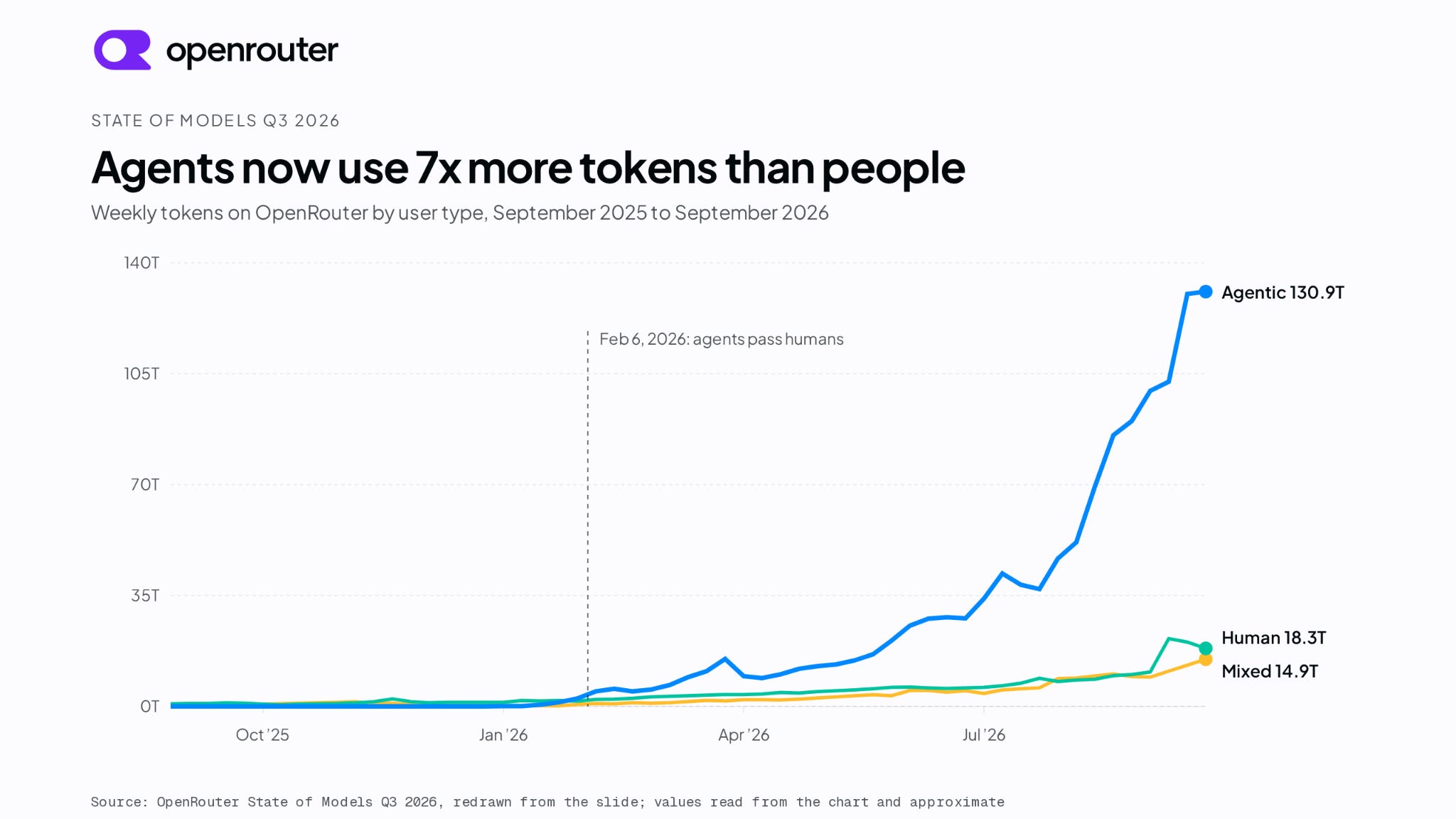
On February 6 this year, software agents passed humans as the main source of tokens on OpenRouter. By late September, agentic workloads made up about 131 trillion tokens a week, against 18 trillion from human users.
It’s reasonable to assume that agents will use far more tokens than humans from now on.
Beyond the volume difference, there is a crucial distinction between agents and humans in token traffic. Agents resend the same long context on every step, which makes prompt caching the most important pricing feature in AI. A cached input token typically bills at a small fraction of the normal price.
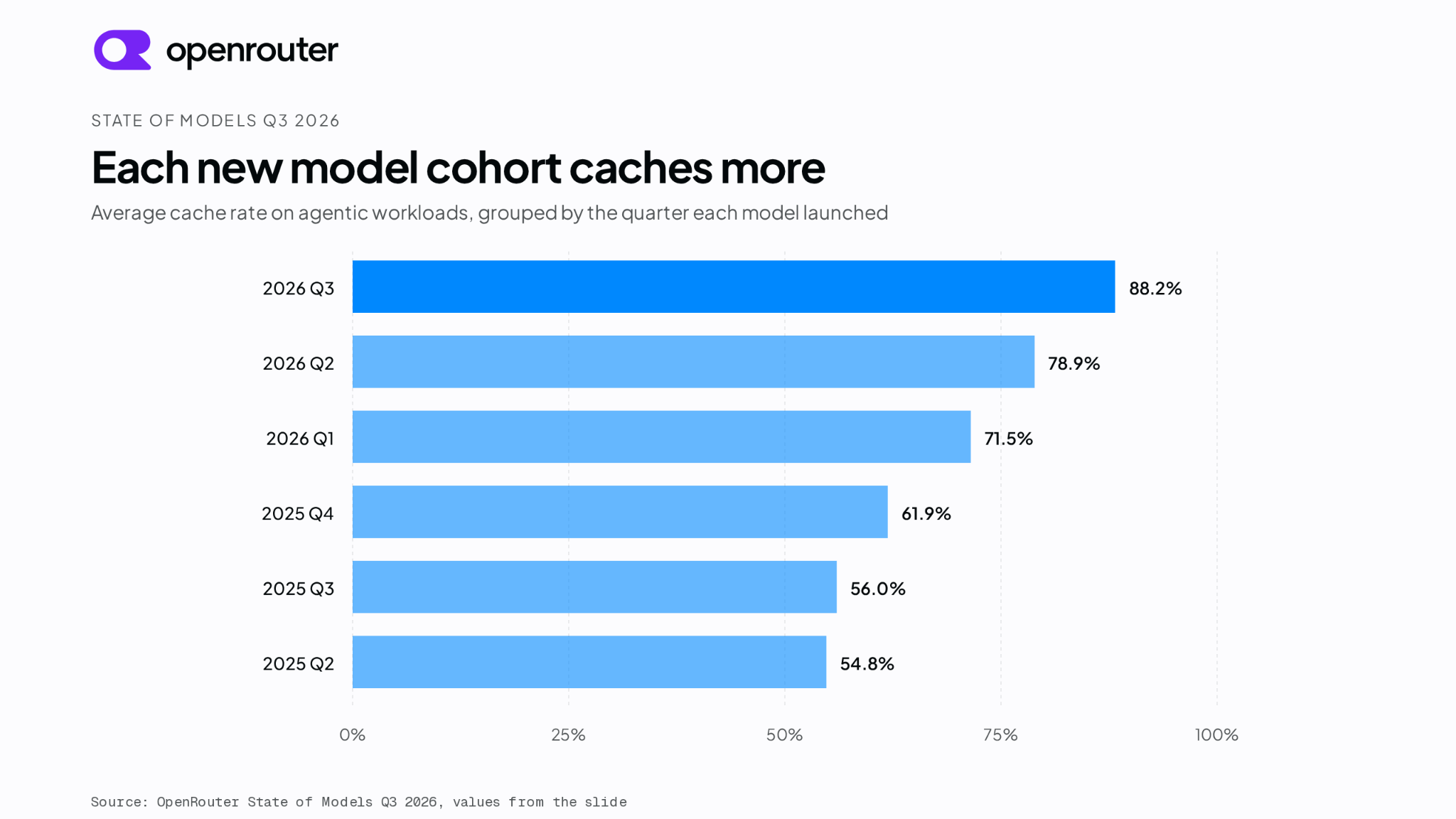
So share of cache tokens is the canary in the cost coal mine. Newer models cache far more of their agentic traffic: 88% for models launched this quarter, against 55% for models launched in spring 2025. Inference providers themselves are competing fiercely on cache rate specifically. The number of providers caching more than 90% of their agentic traffic went from 2 of 35 in January to 11 of 54 in September.
4. The best model keeps (and will keep) changing
The top lab by tokens on OpenRouter has changed five times in eight quarters, and the share for the leader fell from about 40% to 21%. At the start of 2026, Anthropic took about 80% of the combined Anthropic and OpenAI spend. By September the split was close to even.
Headlines love to focus on these battles for points of share, but it’s important to keep in mind the massive underlying growth in the ecosystem broadly. A small share of a massively growing pie can still be an economically useful market (no comments on any or all upcoming IPOs!)
The price of a token
Put those forces together and you have a market where usage and spending have decoupled. Among AI-native startups that spent at least $100 on the platform in September 2025, tokens grew 18x and spend 5.1x. Among large organizations, tokens grew 5.1x and spend 2.4x.
While the gaps may be wider or smaller, users across all segments on OpenRouter saw tokens increase faster than spend in 2026.
Many others have explained the reasons behind the explosion in tokens. But what is driving the continued decrease in price?
First, cheaper models became more capable. Certain tasks don’t need Opus 5.5 and its high list prices, they can be served perfectly well by Kimi K3 or DeepSeek V4 Flash.
Second, agentic cache rates are being optimized across most providers and given most of the new tokens are agentic that has a tumbling effect to price per token. Remember, the same model can cost very different amounts depending on which provider serves it and how much of your traffic that provider caches.
For three popular open-weight models, what customers actually paid varied 43% to 89% below the list-price equivalent AND the provider with the lowest list price was often not the cheapest to use. This market moves by the minute, not the quarter.
Third, the frontier labs (OpenAI and Anthropic) have both released highly capable but much cheaper models in recent months. Luna and Haiku are new entrants in different Pareto points that satisfy many routine tasks.
Buying on landed cost
About 77% of requests on OpenRouter go to models served by more than one provider, so most traffic involves a supplier decision for each request. In prior years, our default routing made that decision mostly on input token price. With our upgraded routing algorithm, default routing prices each request on what a finance team would call “landed cost”: the effective price after cache discounts + the cost of waiting + the cost of retries.
The retry piece is simple. A request that costs $1.00 and succeeds 80% of the time costs $1.25 per successful answer. A provider can look cheaper on paper but actually be more expensive in the end based on poor quality (expressed as fails or rate-limited responses).
This has major implications on the supply side of the market. Once traffic follows landed cost, providers will compete on speed and reliability as well as price.
What matters beyond price
Of course landed cost is not the only buying criteria CFOs should consider these days.
Data. Zero-data-retention endpoints are available for models that make up 93% of tokens on OpenRouter, including 18 of the top 20. While different organizations may make slight allowances on ZDR, by and large it is a default requirement.
Uptime. No single provider is up all the time. In samples of 60 million requests in early October, 92.8% succeeded on the first provider tried and 96.9% succeeded after automatic failover. During one capacity crunch, the 15 hardest-hit providers succeeded on as few as 18% of attempts, while requests routed through OpenRouter still completed 97.3% of the time.
Takeaways for CFOs
If AI is a market, the finance leader of today needs to treat this as a volatile input to any company model they’re building. A few suggestions that fall out of this thinking:
Using more tokens ≠ always spending more. Hundreds of companies on OpenRouter have successfully decreased spend on tokens while using many more tokens per month. Many more have slowed spending growth while massively expanding usage.
Open-weight models are not monolithic. Providers vary widely while serving the same open-weight model. Locking yourself into a single provider can have upsides and downsides across speed, quality, and reliability.
Guardrails are your friend. Most CFOs will insist (correctly!) on zero data retention. But what does your organization require in terms of in-region routing, spend limits by function, fallback during outages, and a number of other aspects?
Expect more change. Looking back even 6 months feels like a different era. The rate of change is, if anything, increasing. The best CFOs will prepare to rip up best-laid plans.
The model your company will love most may not have even launched yet. Only companies with a culture of experimentation, with a finance perspective to match, will be able to stay at the frontier in terms of applied intelligence. But it is clear now that the future will involve many kinds of models and that competition will help companies control costs.
Footnotes:
Thanks, Peter, for the incredible data! Check out his OpenRouter blog for more insights.
If you are expanding globally, check out Remote’s 8 questions to ask potential EORs (today’s sponsor)
Subscribe and share the OnlyCFO newsletter with your teams
*Nothing in this article constitutes legal, tax, or investment advice