
Brought to you by…Remote

Every global hiring pitch sounds the same until you ask the right questions. Here are three I’d ask:
Who legally employs our people in each country?
What will we actually pay beyond the quoted price?
Do they have local compliance experts who can help when issues come up?
Not all EORs are created equal… Remote’s checklist covers 8 questions to ask an employer of record (EOR) before you sign.
The Anthropic S-1 Is Here!!!
The long-anticipated Anthropic S-1 dropped today. Looks like they are really going public soon (likely in about 3 weeks)!
The reason this IPO is so important is because it’s not just about Anthropic. Its effects will extend well beyond just Anthropic. Maybe more so than any other IPO in history:
What do Anthropic’s numbers tell us about the broader AI trade?
What do they mean for the chips, data centers, and power infrastructure behind the AI boom?
What do Anthropic’s results reveal about the application layer and more traditional SaaS companies?
Will AI take our jobs, create more jobs, or kill us all?
I read the entire Anthropic S-1. Well…I skimmed a lot of the boring stuff (there were 94 pages of risk factors!)
Below are some of the most interesting things I found 👇
Financials
Revenue
Anthropic’s revenue growth is obviously insane. Whether they IPO at $1.5T or $2T, what they have accomplished is incredible
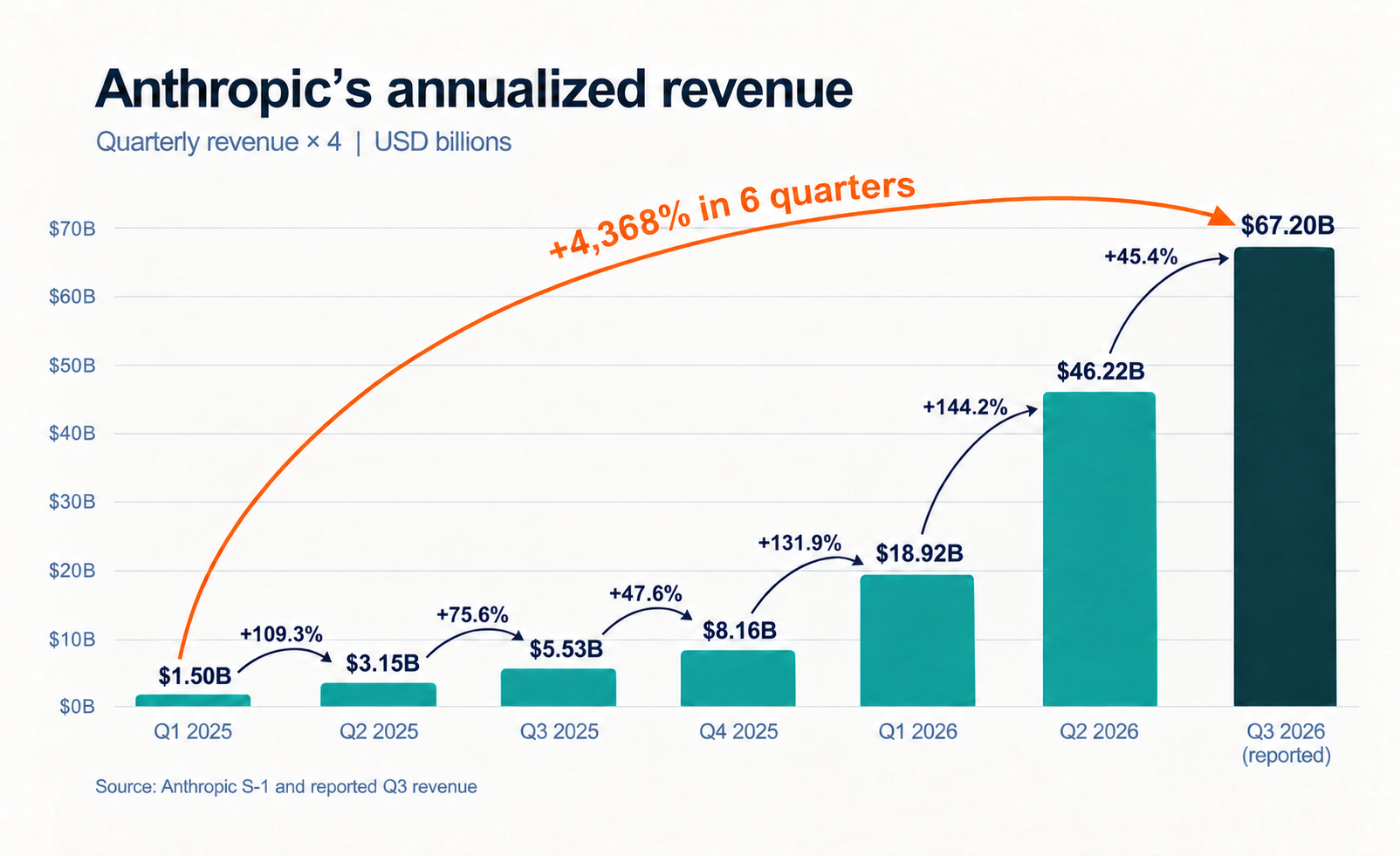
I laughed when I saw Jamin’s revenue growth benchmark for Anthropic compared to the public software companies. So…you’re saying Anthropic has pretty good growth?
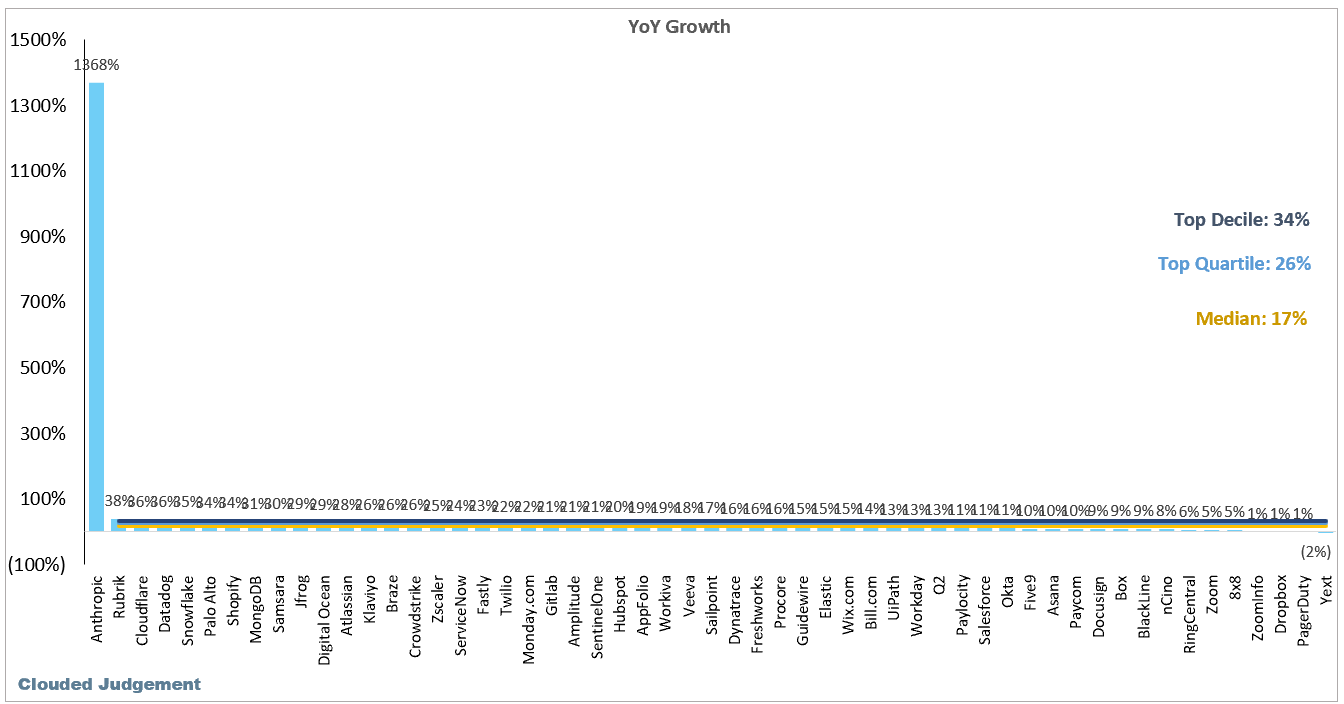
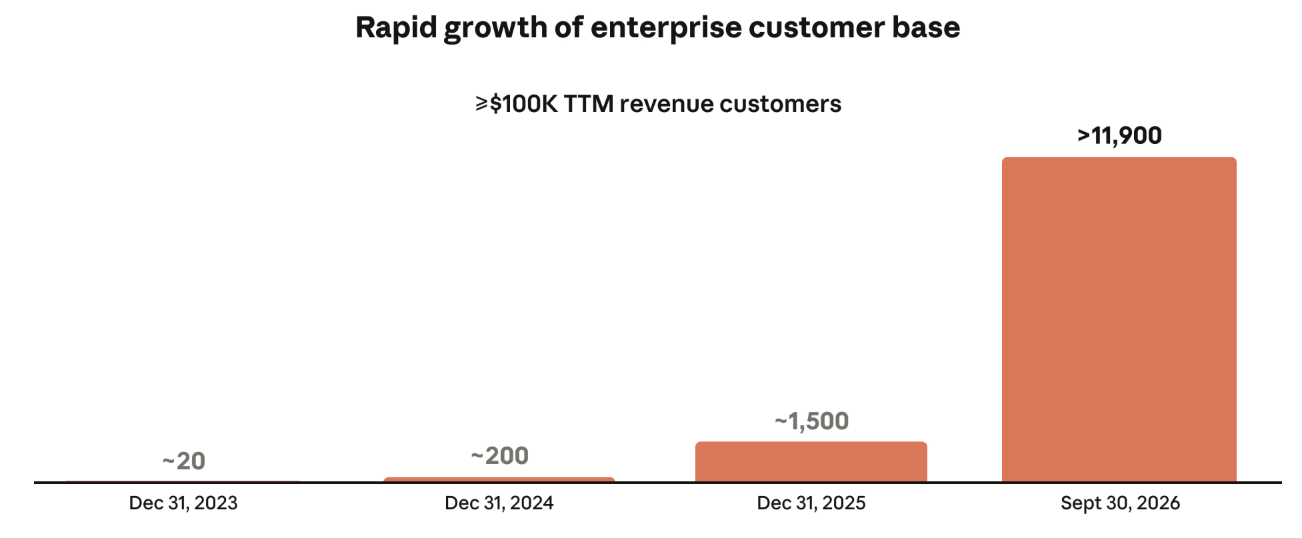
The number of customers generating at least $100K in TTM revenue has exploded. 900% NRR (see below) has definitely helped here
Net Revenue Retention (NRR)
Every CFO deeply feels Anthropic’s 900% NRR…Obviously great for Anthropic, but spending on Claude (and AI overall) has quickly become the largest expense line at every company. That’s OK if those customers are also seeing their revenue growth rate rapidly improve (or costs come down), but…not sure most of them are.
And no…900% NRR isn’t normal. And also a reminder why you should use metric medians and not averages :)


Gross Margins
Anthropic’s gross margin improvement is unprecedented…
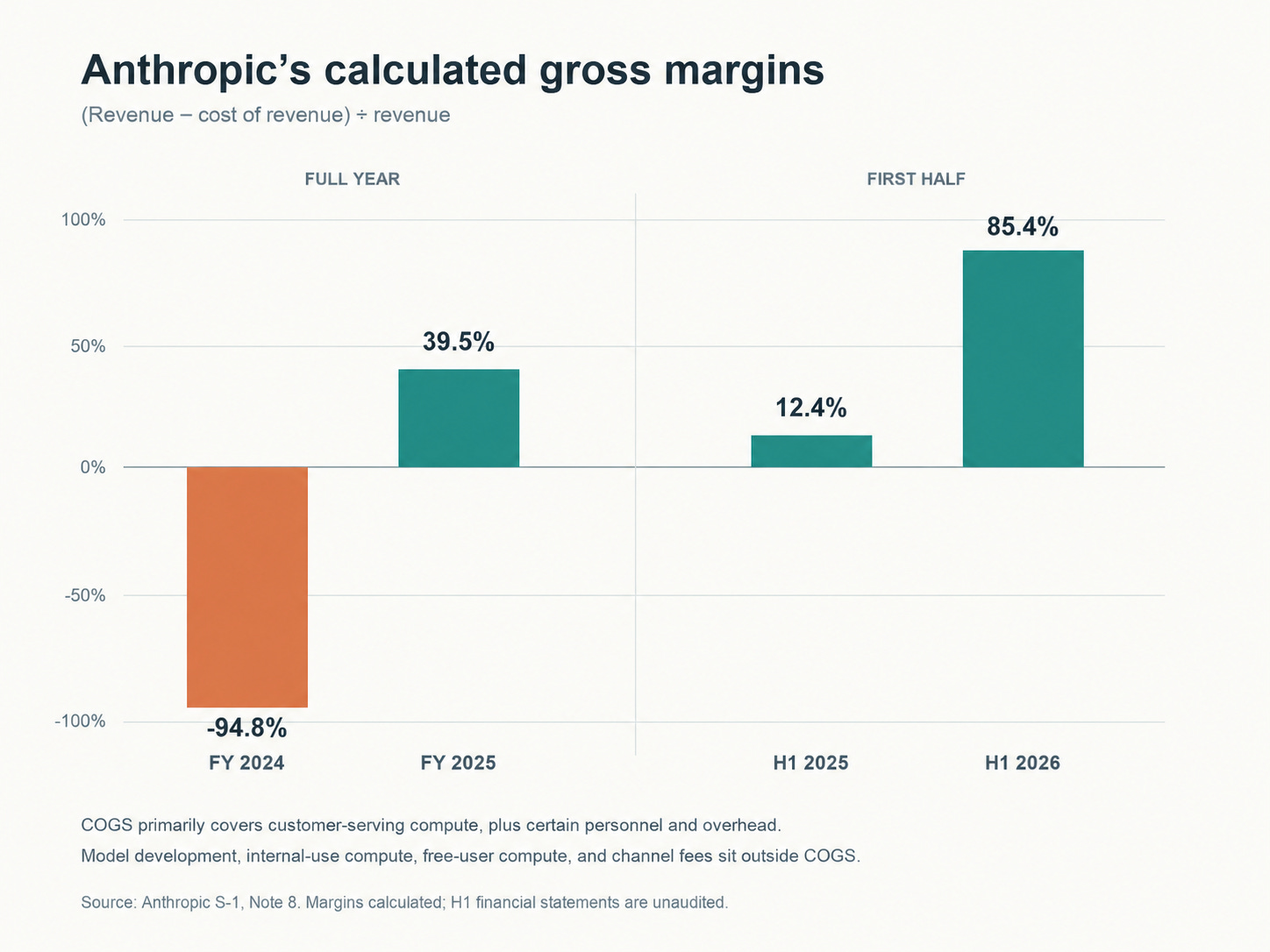
Jamin showed two lines in his benchmark analysis - the lower one is LTM and the higher one is L6M (gross margins are rapidly improving!)
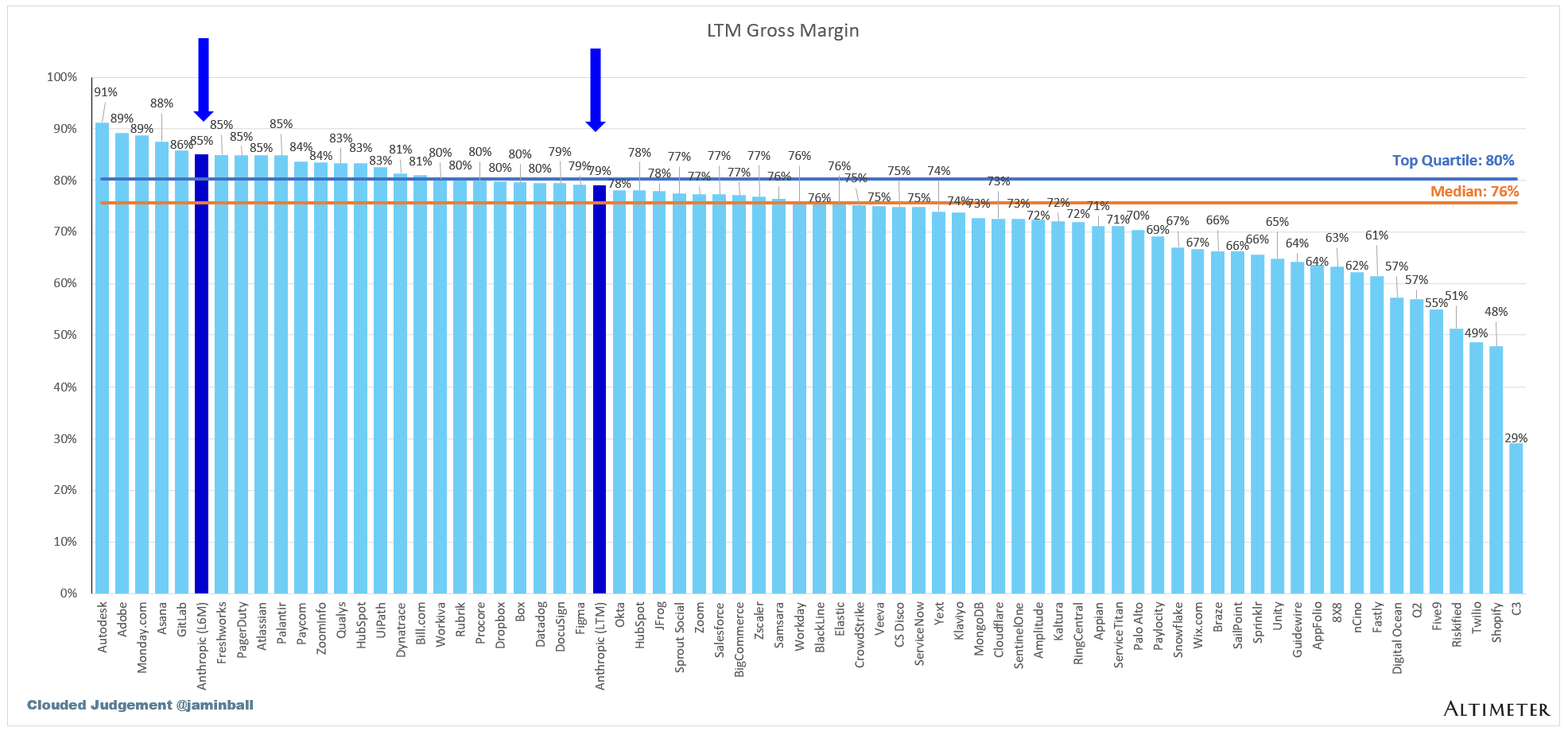
I don’t think most people thought the AI model companies could have gross margins this high.
But before you get too excited…let me explain why this isn’t necessarily apples-to-apples. Anthropic disclosed:
Model versions released in the six months ended September 30, 2026 accounted for over 80% of our revenue for the three months ended September 30, 2026.
Model development sits in R&D (not in COGS). Typical software companies are similar. Essentially all software development costs go into R&D (with the exception of sometimes a small amount of capitalized software that hits COGS). But software companies have historically built something and then could benefit for several years from that original development. Anthropic is saying that 80% of their revenue is dependent on the very latest models.
It raises the question of how much ongoing R&D is needed to sustain today’s revenue. R&D spend is very high at Anthropic…
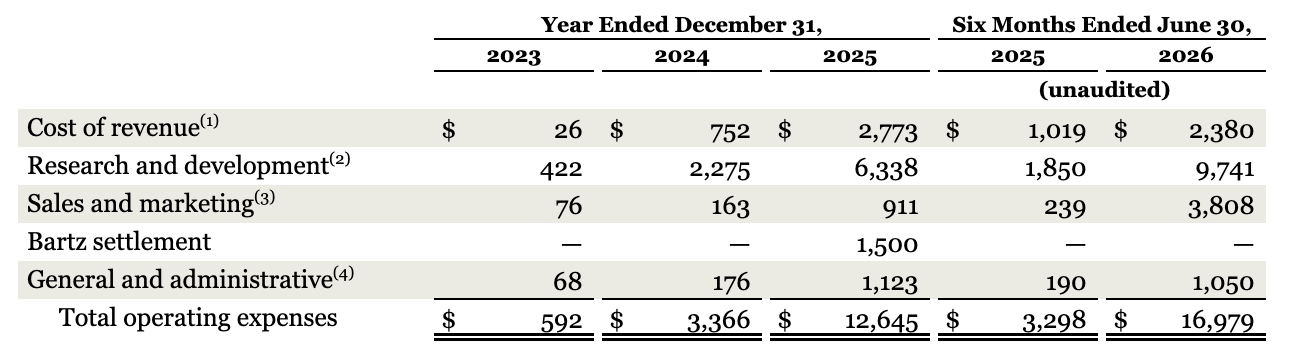
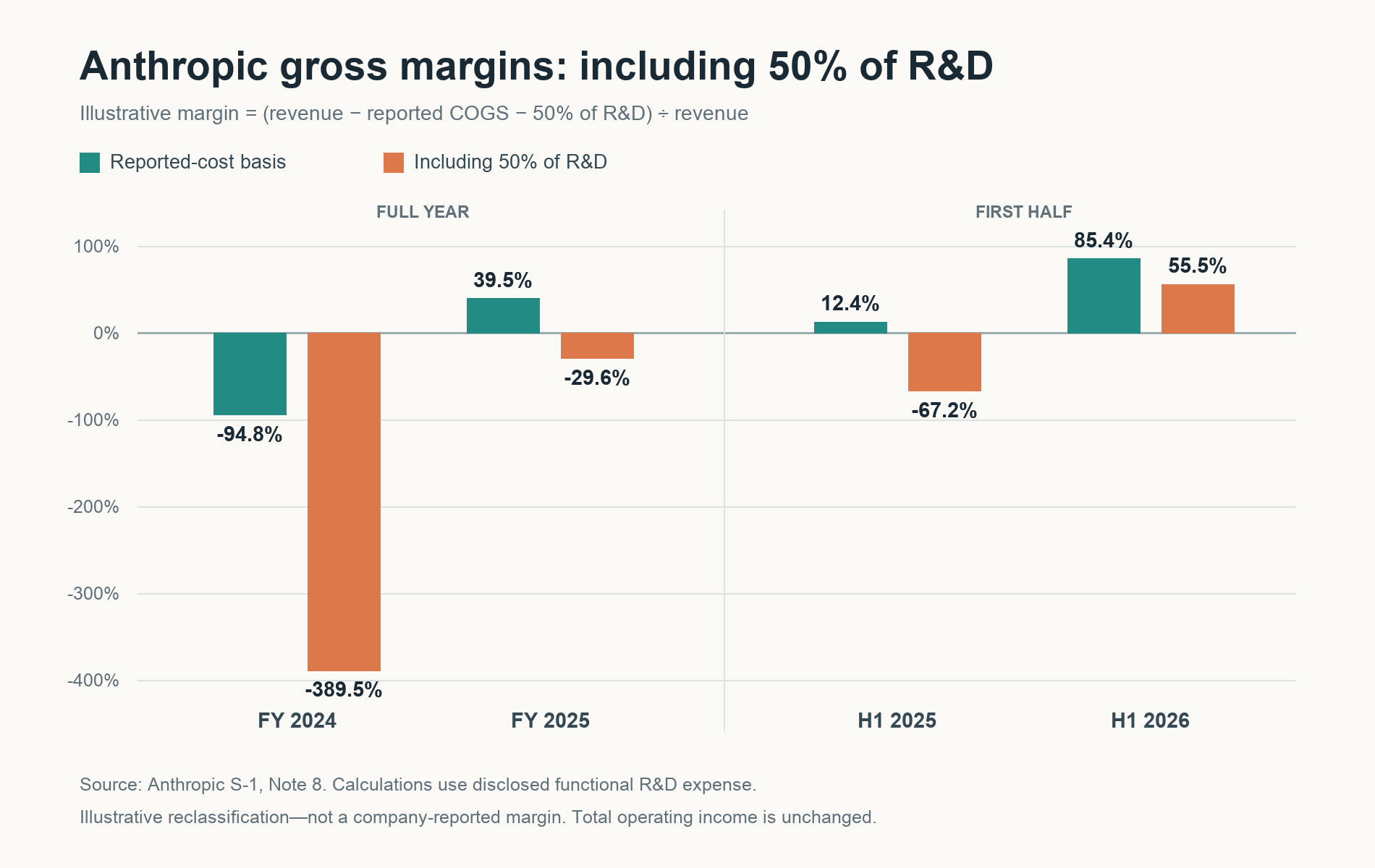
For illustrative purposes…below is what gross margins would be if you included 50% of R&D in COGS (arbitrary amount to show sensitivity).
With 50% of R&D included in COGS, H1 2026 gross margin would be about 55.5%. Still pretty good tho. The point is that I don’t think the stated gross margins are very comparable to most other companies given the shelf-life on models. But if they do achieve recursive model training and need less R&D to build the new models….then…maybe it doesn’t matter anyway.
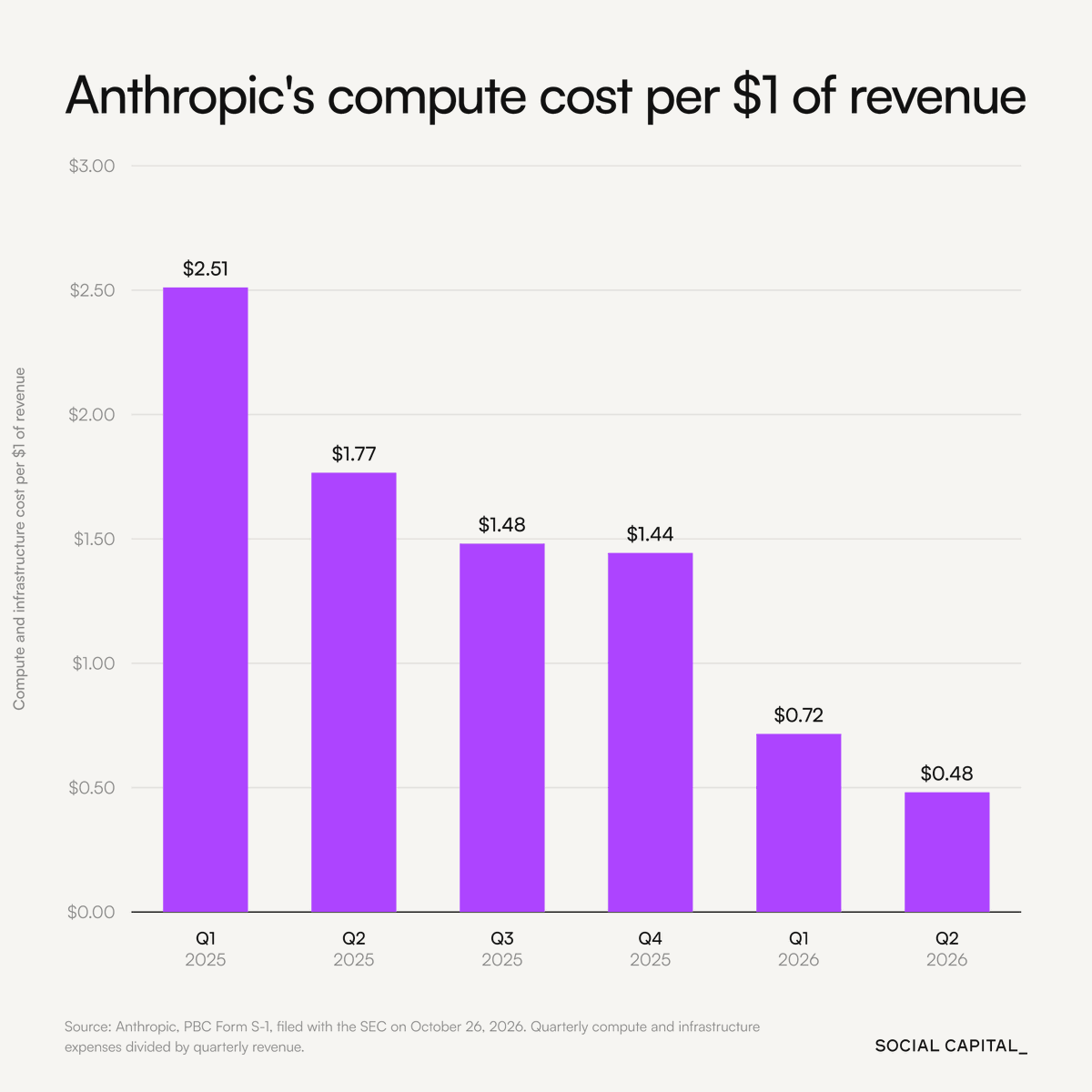
Compute and infrastructure expense per dollar of revenue fell 81% from Q1 2025 to Q2 2026.
Profitability
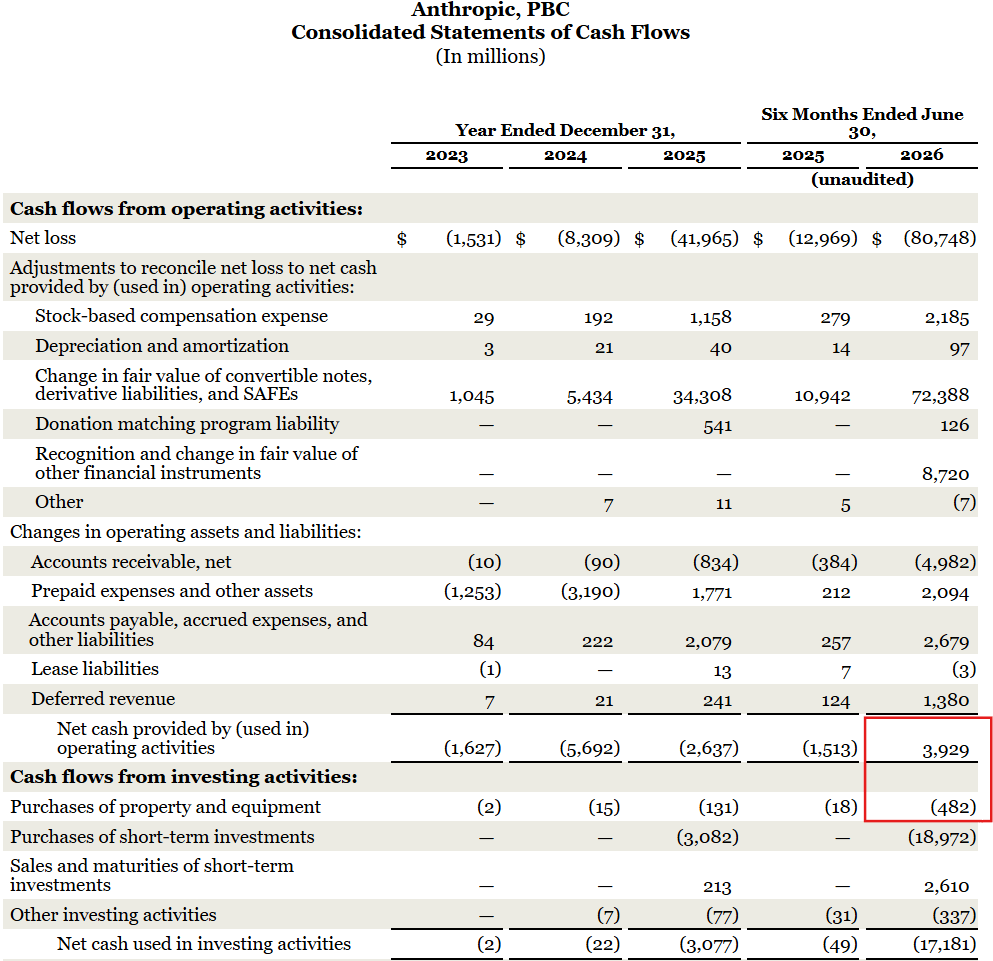
In H1, Anthropic had positive FCF of $3.4B, which is $3.9B of operating cash flow less $482M of capex.
And before the SBC crowd comes out to say “what about SBC?!?!”….SBC was “only” $2.2B. So even after subtracting SBC, FCF was positive.
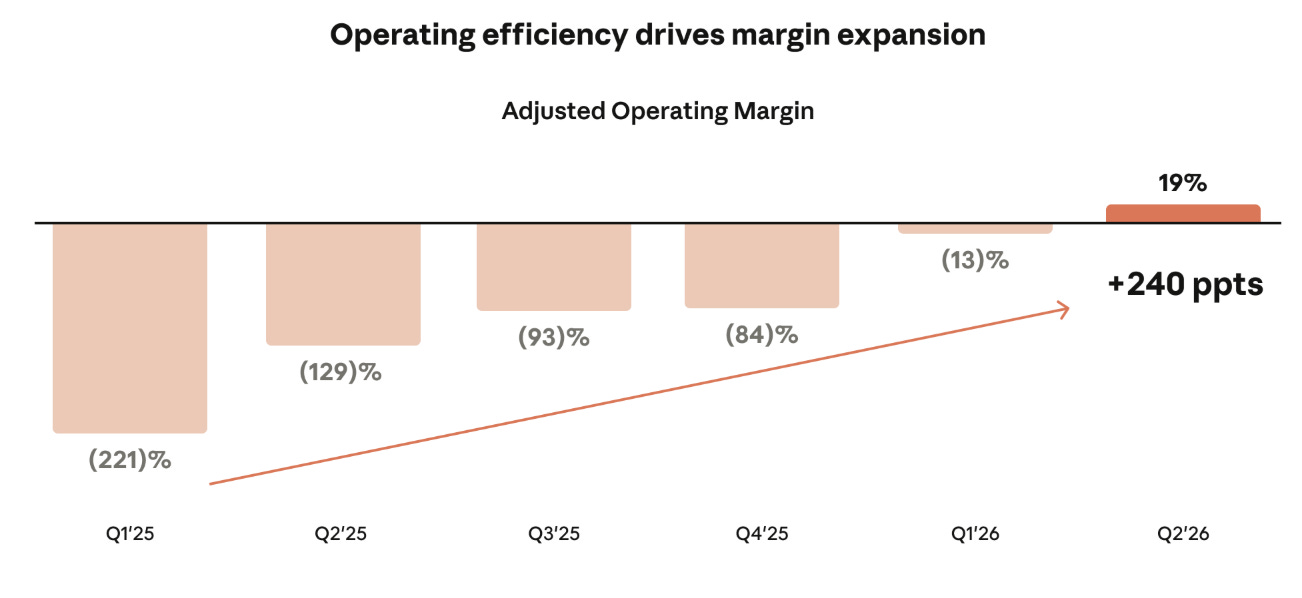
Adjusted operating margin goes from very negative to positive very quickly.
Revenue/FTE: Revenue per employee is $6.6M, up from $1.4M a year earlier 🤯
Other Interesting Learnings
Competitor Revenue Concentration Risk?
Anthropic disclosed that 5-7% of their YTD revenue comes from companies using their products in violation of their policies.
Applying the 6% midpoint to Q3 estimated ARR is ~$4B of ARR coming from current/future competitors 🤯
What does this mean? This is primarily usage from other companies using Anthropic to “distill” their models so they can improve their own AI models. In other words…this is a “future/current competitor revenue concentration risk” lol
Regular Customer Concentration Risk?
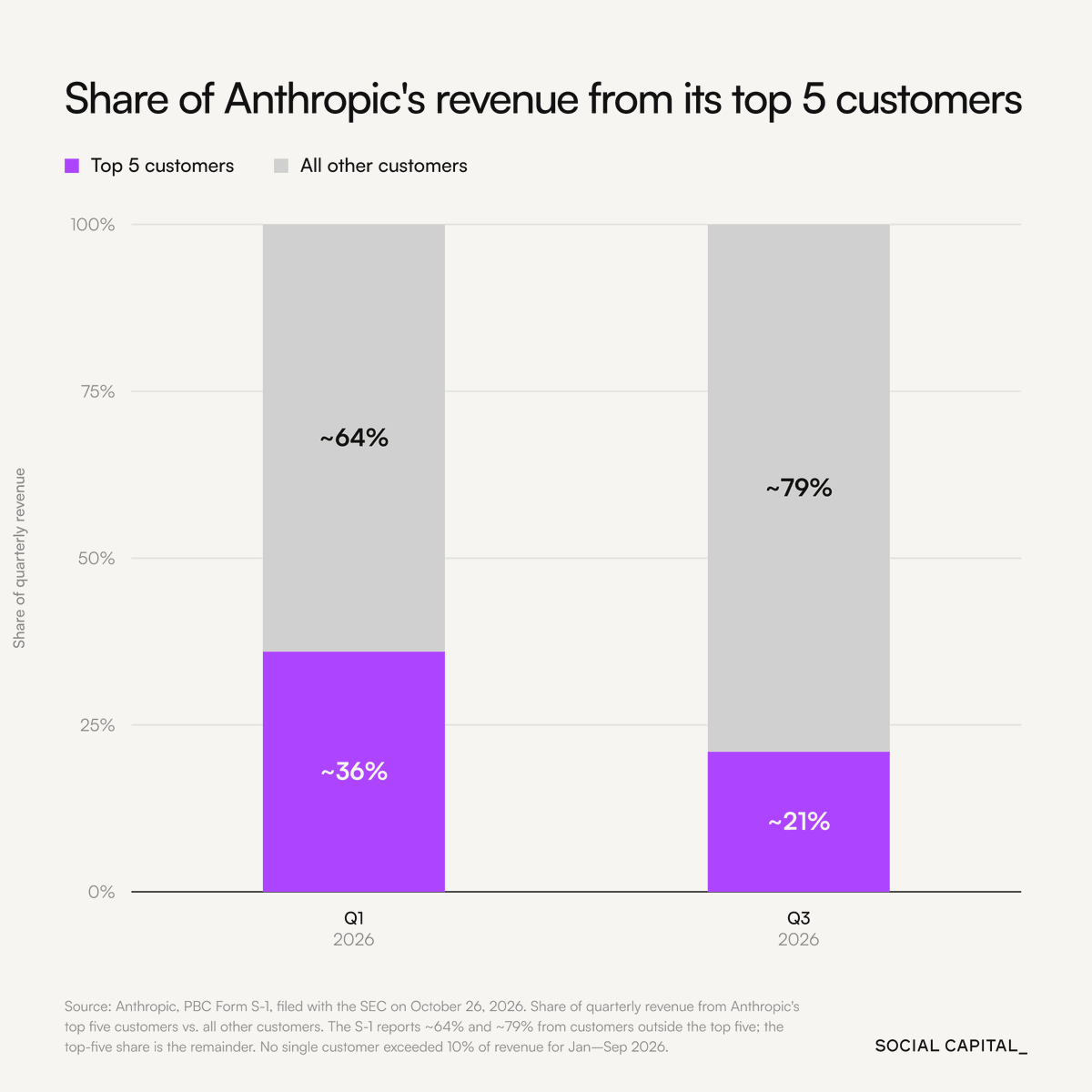
Just two customers accounted for 24% of revenue in 2025. Both were below 10% in H1 2026, while customer C accounted for 11%.

While the prior top 2 customers fell below 10% of total revenue, the top 5 customers still represent 21% of total revenue in Q3 2026.
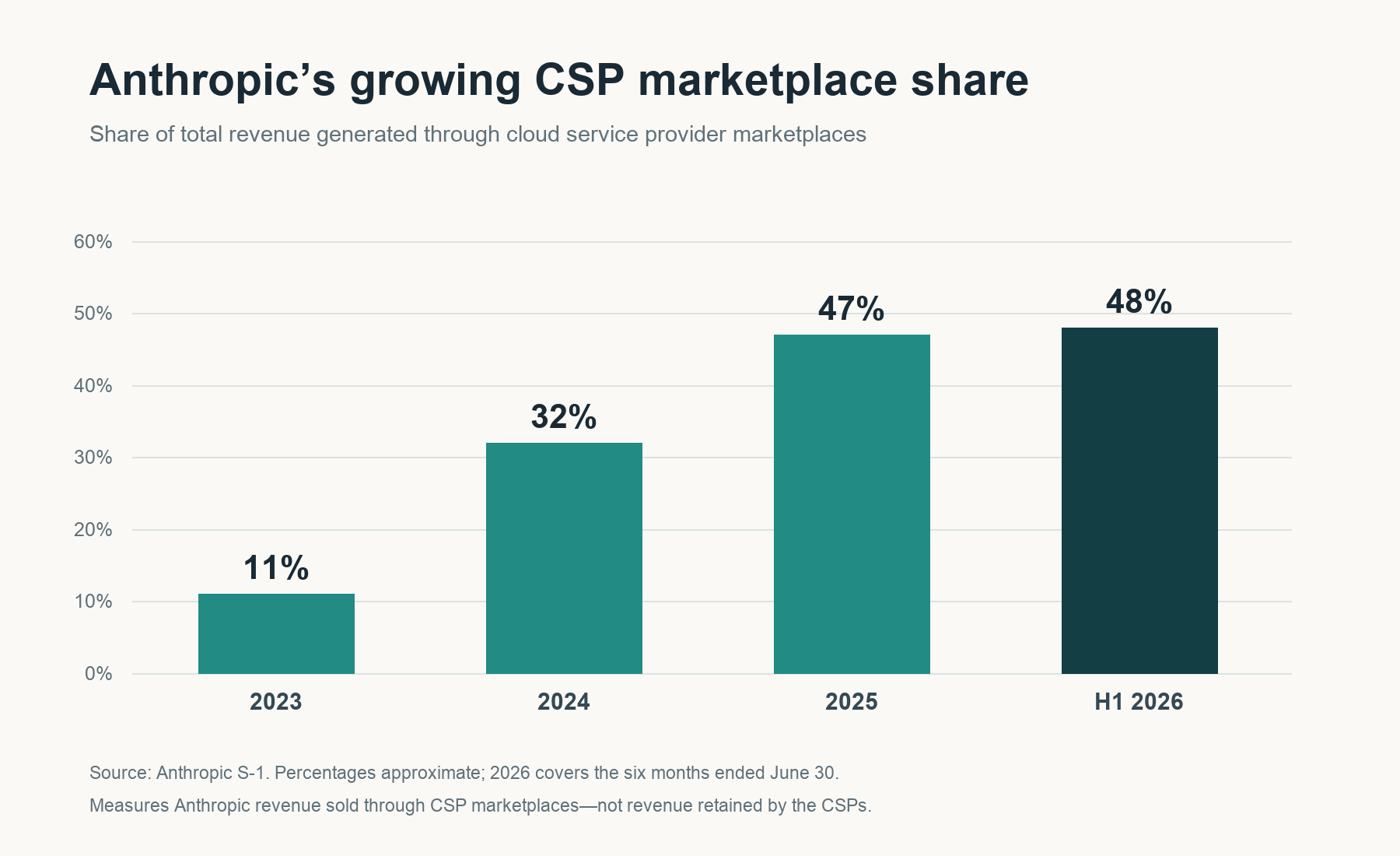
Channel Risk
So much revenue flows through the 3 primary CSPs (AWS, Azure, and Google Cloud)
2nd Tier Auditors
If Anthropic can use a 2nd-tier audit firm (Grant Thornton) through a year before a $2T IPO, then your little software company that has <0.05% of the valuation doesn’t need to use a Big 4 firm…

I have been pushing this for a long time.
Most of you will never IPO. And the ones that do will take much longer than you expect. Many VCs push Big 4 auditors. And founders (especially first-timers) feel like it’s a signal that you’re a big deal if you have Big 4 auditors. It shouldn’t be…. They cost more money, take a lot more time, and your financials are rarely more accurate because of it.
AI Pricing
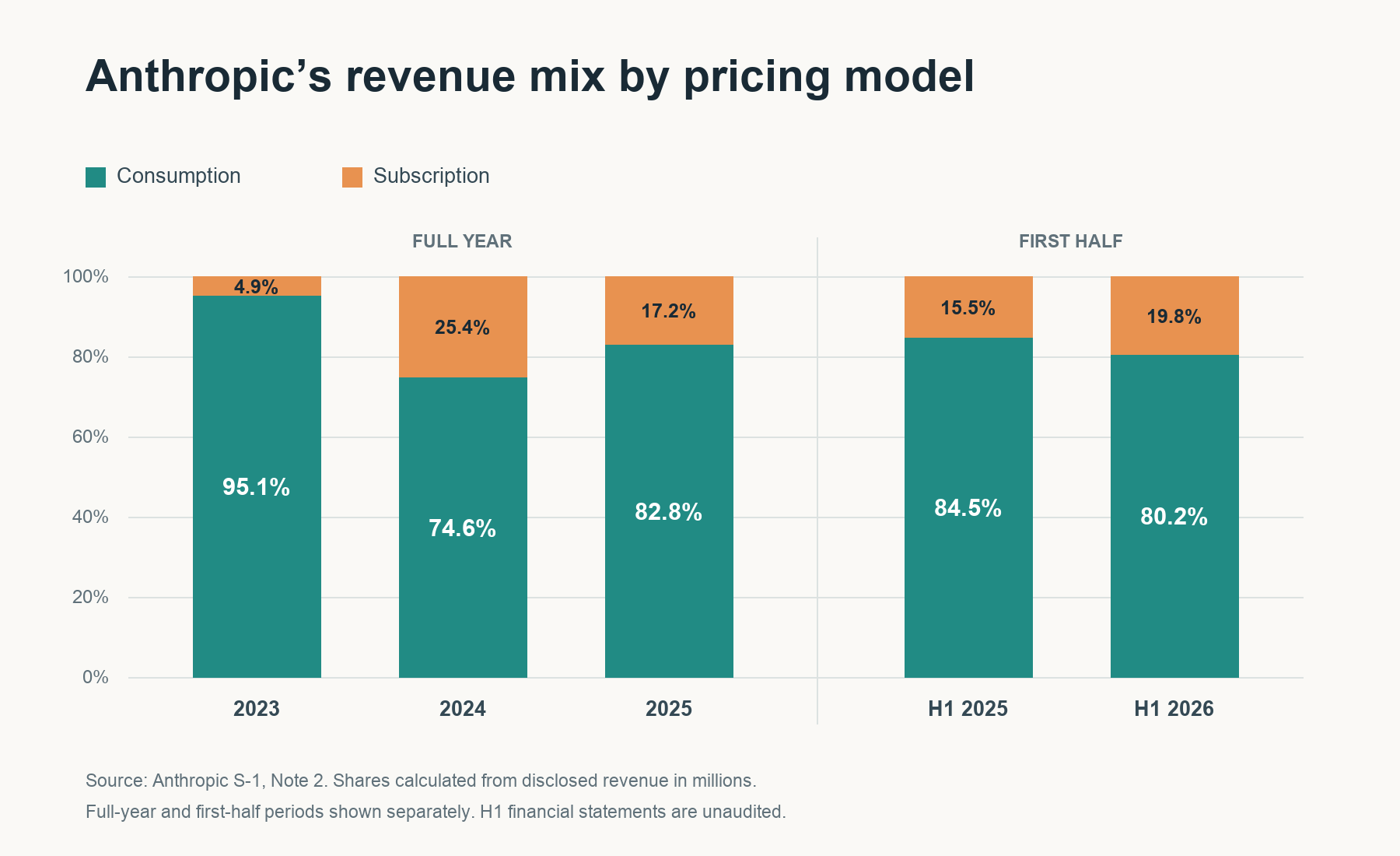
Anthropic’s revenue is generated based on two pricing models:
pay-for-intelligence pricing (consumption)
subscription-based pricing
Consumption pricing rules for most AI products.
Definitions:
Net Revenue Retention
Reflects customer expansion, contraction, and churn as of a measurement date. We calculate Net Revenue Retention by dividing the Qualified Customers’ Current Period revenue by their Base Period revenue. A Qualified Customer is a customer with at least $1 of revenue during the Base Period, excluding subscribers to our Claude Pro and Max plans, whose fixed-price subscriptions do not reflect the expansion and contraction behavior this metric is intended to capture. The Base Period is the three months ending a year prior to the measurement date. The Current Period is the three months ending as of the measurement date.
Run-Rate Revenue
I’ve heard several companies recently adopting this definition (28 days * 13)
An operating metric that refers to the estimated annualized value of our revenue-generating activity as of a measurement date, calculated as the sum of (i) our consumption-based fees during the trailing 28-day period ended on the measurement date, multiplied by 13, and (ii) our aggregate monthly subscription fees as of the measurement date, multiplied by 12. For purposes of calculating Run-Rate Revenue, consumption-based fees and subscription-based fees are derived from customer usage and active subscriptions.
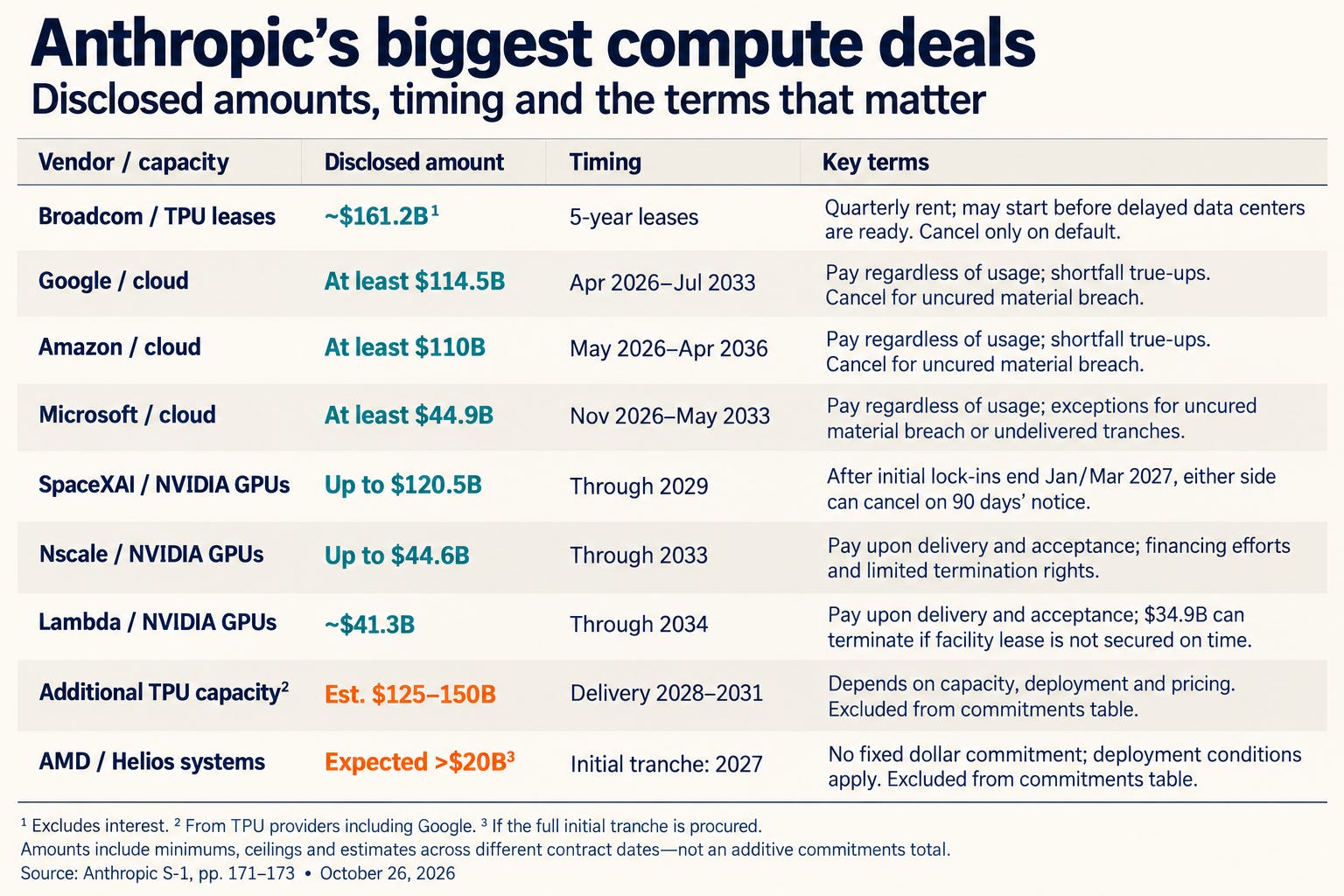
Compute Commitments
Anthropic has made enormous compute commitments. It might be the right decision but it’s certainly a risk. Customers can reduce spending much faster than Anthropic can reduce its infrastructure obligations.
Weird Structure
Their voting structure is weird.
They created a “Long-Term Benefit Trust” which is a committee that selects 4 of the 7 board members. These are “financially disinterested trustees with expertise spanning AI safety, national security, public policy, and social enterprise”.
A separate founder-held share carries 50.1% of voting power on matters submitted to common stockholders. This is a single share (that controls common stock majority vote) that is controlled by 7 people. So even if the founders sold 98% of their stock, they would still have majority control (filing says they will be removed if they don’t hold >2% of their IPO-date holdings).

Final Thoughts
How Anthropic’s IPO performs and every subsequent earnings release will move entire markets (software and AI companies especially).
I have no idea if Anthropic should be valued at $1.5T, $2T, or even $2.5T. The next 6-12 months are probably going to be very bumpy for the stock.
I look forward to watching…
Footnotes:
If you are expanding globally, check out Remote’s 8 questions to ask potential EORs (today’s sponsor)
I just opened up 2027 sponsorships - hit me up (onlycfo@onlycfo.io)
Subscribe and share the OnlyCFO newsletter with your teams
*Nothing in this article constitutes legal, tax, or investment advice
Really good stuff, my friend. Thanks for distilling a lot of this before I could actually get to the doc.
On the OpEx side I found the massive increase in S&M — $2.6B increase in the first 6 months - pretty curious.
Digging in… It appears that most of the increase was paid to the channel — likely mostly to Amazon and Google — as opposed to Sales commissions.
So they’re paying those firms on both sides — for the compute AND for the distribution. (although Anthropic does establish direct customer relationships with such customers).
Big question is whether those heightened S&M costs due to these channel costs will continue and at what marginal cost.
Elsewhere they reference an increase in channel fees in H1 of $2.7B so about 75% of total S&M.