
Starting January 1, 2027, California is going to tax software. What once was a sales tax haven for software companies avoiding sales tax on all the software they purchased will soon have the highest statewide sales tax rate in the country at 7.25%. And this is just the base rate…depending on the local jurisdiction, it might be as high as 10%+!
This will have a pretty massive impact on a lot of tech companies.
Vendor Spend: If your HQ is in California, then chances are you are paying 0% in sales tax on all your software/AI spend. But starting next year, most software/AI spend will be at least 7.25% higher than you were expecting.
Company Invoices: Starting next year, your invoices to California customers (tech companies sell to a significant number of CA headquartered companies) will be at least 7.25% higher.
That’s a significant price increase for both you and your customers!
Does this apply to all software? And…AI token spend?
The change applies to “prewritten computer software” (ie SaaS) transferred electronically or accessed remotely. But it excludes several categories, including “custom computer software” and “digital infrastructure”. The bill defines “digital infrastructure” as certain cloud-based services that let users create, deploy, scale, or run their own software (eg AWS, Azure, etc).
You will want to confirm the category your SKUs fall into. Especially as we get more definitions from California.
This will capture your Claude/ChatGPT/etc spend that is currently at 0% if you are in California. So your fastest growing (and maybe your largest) vendor spend is getting at least 7.25% more expensive next year. Ouch
FP&A Team Takeaway:
Budgeting: Make sure to add these additional costs to your budgets. This might be a material surprise cost in 2027. Pro tip: keep reading for how you might be able to reduce this sales tax liability.
Churn Impact: You also need to consider if/how this will impact your customer churn forecasts. This additional expense may be the breaking point for some of your customers.
What I am doing: Create a list of all your customers that will be impacted. Make sure to communicate the change with sales and customer success. And then consider the impact of any planned price increases next year. Maybe you want to keep prices more flat for those customers next year so it decreases churn?
Accounting Team Takeaway:
Collecting Sales Tax: If you have any decent sales tax software then you shouldn’t have to do anything with one important caveat…. I know some companies that don’t turn on states that don’t collect sales tax so they don’t have to pay additional software and filing fees. Make sure California is turned on if you have nexus there!
Do I have Nexus? Build a good nexus tracking process. I was once at a company that only updated it quarterly and then we sent out a ~$250K invoice that shouldn’t have included sales tax but didn’t because we hadn’t refreshed our nexus yet. We ended up eating about $18K in sales tax because we didn’t want to go back to the customer once we discovered it. More on this below.
What You Should Know About Sales Tax
Do I have nexus?
Nexus: level of connection between a business and a taxing jurisdiction that triggers a sales tax collection obligation.
There are two ways a company can establish nexus:
Physical presence. Typically gets triggered when you hire an employee in the state or local jurisdiction. Contractors and large amounts of inventory can also trigger it.
Economic nexus. Triggered when a certain $ level of sales and/or number of transactions to customers in the state. Below is a great visual for these different thresholds
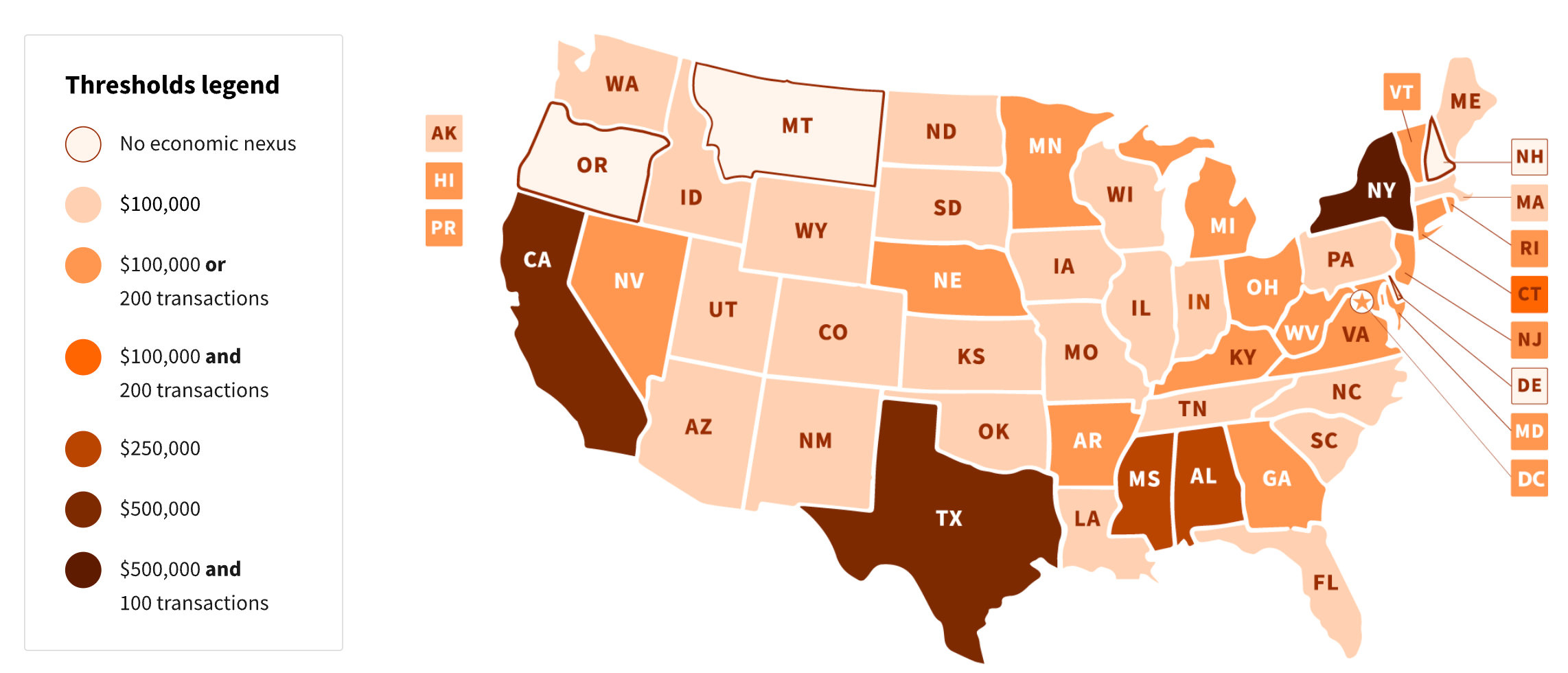
California’s economic nexus threshold is $500K of sales in the current or prior calendar year, with no transaction-count threshold. So if you are a software company then you will trip this quickly.
Sales vs Use Tax
There are two primary types of indirect taxes in the U.S. Both are taxes on the same thing, but differ on who is responsible for paying it:
Sales Tax: Collected by and responsibility of the seller because of their nexus in the state.
Use Tax: Responsibility of the customer. Seller doesn’t have nexus (or at least didn’t charge sales tax) but the goods/services are subject to sales/use tax.
Idea is you can’t circumvent the tax by using out-of-state sellers to avoid the tax.
So in theory, the customer should be paying the tax either way so it should be included in total expense forecasting.
Where is Software Taxable?
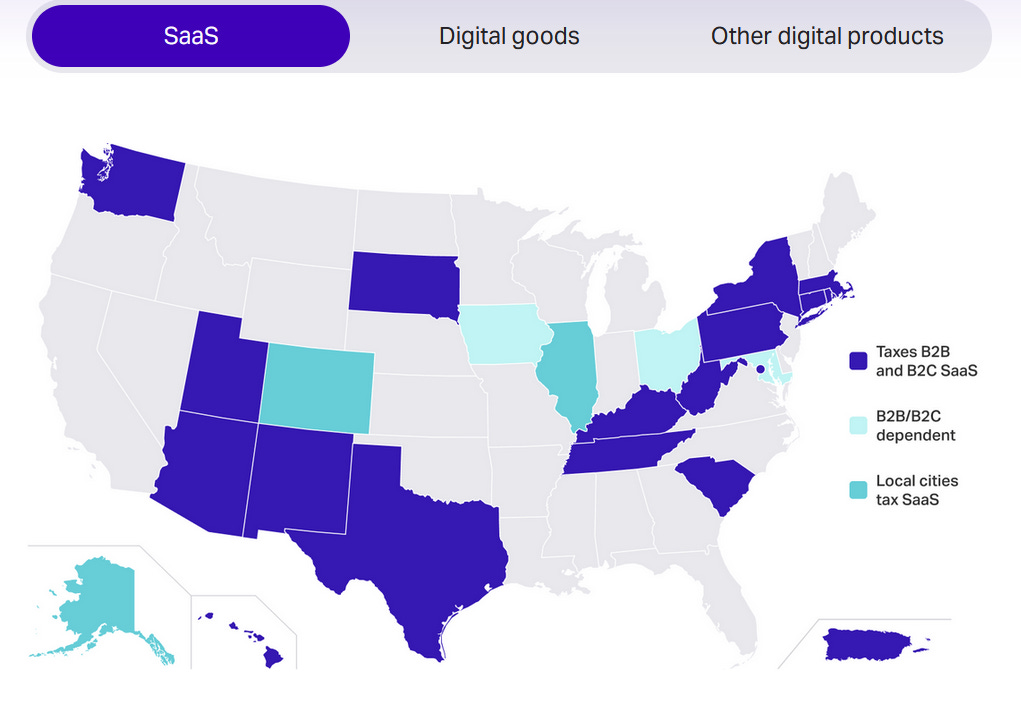
Today, there are over 20 states in the United States that tax software. Many countries also tax software and digital goods from the very first sale. States and jurisdictions are continually changing their stance (like California) so it’s important to stay up-to-date.
Below is a map of states that tax software (with California starting in 2027)
The Dirty Secret of Many Software Companies
Most tech companies put their California HQ address on all their software purchases. It’s true that they are HQ in California but a significant amount of usage happens outside of California (particularly remote companies). It was also very convenient since they paid $0 in sales taxes in California.
But now California is taxing software, we are going to see many companies update their contracts with vendors…
Companies are going to reach out to their vendors to update their address or they will provide a “multiple points of use” (MPU) certification which states that usage happens in multiple places so it shouldn’t all be taxed at one address (this shifts sales tax responsibility to the buyer).
What About International Sales?
Companies are selling internationally a lot sooner today. Other countries have other indirect taxes that are paid by the customer like the value-added tax (VAT) or Goods and Services Tax (GST).
170+ countries have a value-added tax (VAT) regime with more than 80 applying VAT to digital goods and services transactions.
To determine whether VAT applies on a sale of your product or service, there are three main factors to understand:
Your customer’s location
The taxability of your product in that country
Your customer’s VAT registration status.

Final Thoughts
California now taxing software will be a big deal for a lot of companies. Plan accordingly.
If you don’t have a good process for sales/use tax, then you could end up with a huge liability that can derail fundraising discussions, a potential acquisition, or an IPO.
When the seller has nexus, it is generally their responsibility to collect and pay sales tax. Going back to your customers 2 years later and asking for sales tax is very painful. Ask me how I know…
Don’t wait to figure out sales tax. It will be much more painful later.
Footnotes:
Email me at onlycfo@onlycfo.io for sponsorship opportunities.
Subscribe and tell your friends
*Nothing in this post should be considered tax, legal, or investment advice. Educational purposes only. Consult a sales tax advisor.
This is going to be painful
It's California. The only surprising part is that it's taken this long to levy this tax.
Important to note that it's possible for a CFO to have personal liability for unpaid sales or use tax, and D&O doesn't cover this. Usually it's only in a case of willful non payment so this is easily avoidable, but its worth being aware of potential pitfalls.