

Every board is asking how the company is leveraging AI. At first they just wanted to make sure the company was using AI, but now they want to know:
What are you doing that actually adds value for customers?
What are the best use cases for internal work?
Are you moving faster and/or more efficiently yet?
Brex’s The CFO Guide to AI Strategy is a great resource for CFOs to see where other finance teams are finding the best AI use cases right now. I have implemented most of this myself…
The $43.9B Acquisition Price 🤯
The largest cybersecurity deal ever was announced yesterday….CrowdStrike announced it’s acquiring Zscaler for $43.9B in an all-stock deal.
While the headline price is what everyone focuses on, how the deal is structured matters a lot for who (buyer or seller) bears risk between signing the agreement and actually closing the deal.
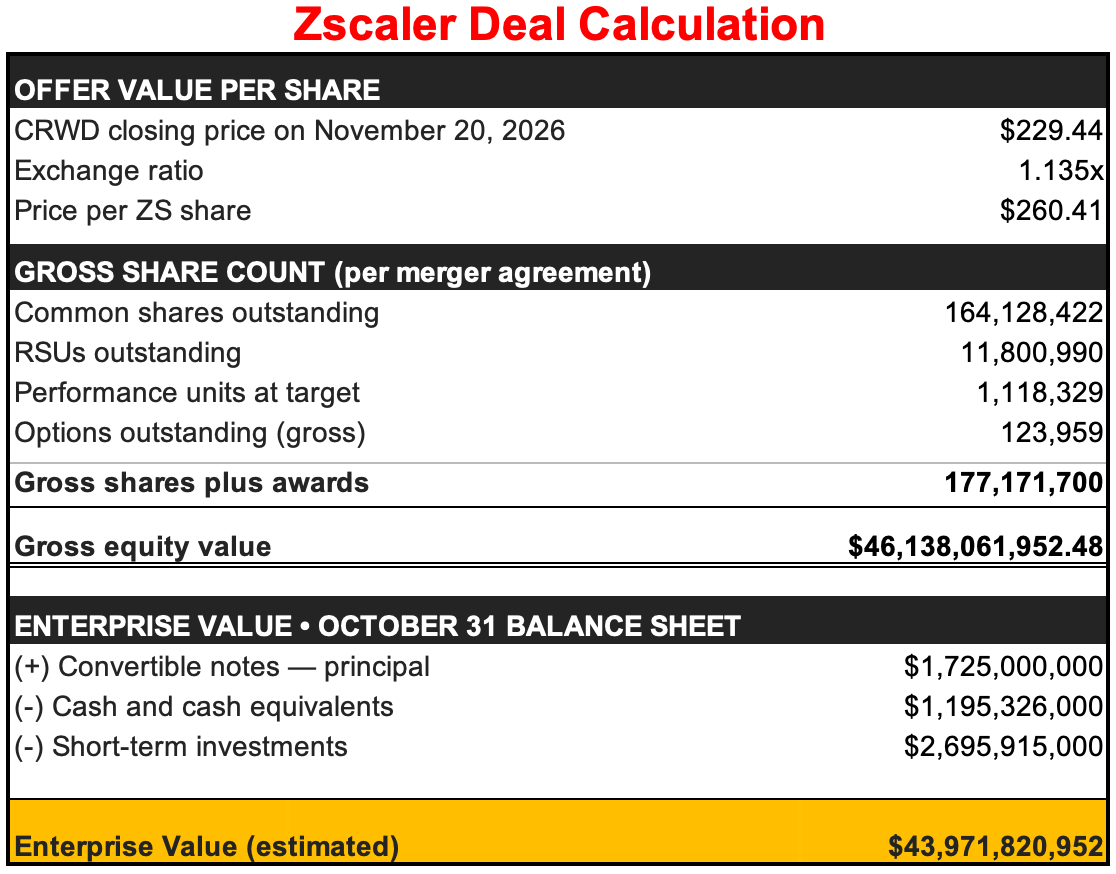
How is the $43.9B acquisition price calculated?
Price per share: Each share of Zscaler will convert into 1.135 CrowdStrike shares, which based on the closing price on November 20th of $229.44 would be $260.41 per share (a 34% premium to the prior closing price)
Number of Shares: The merger agreement details the current company capitalization.
Cash-free, debt-free: For enterprise value you add the debt and subtract the cash because CrowdStrike becomes responsible for Zscaler’s debt obligations while they get to keep Zscaler’s cash.
Why did Zscaler only pop 18% once the deal was announced?
There are two consideration types in an acquisition:
Cash
Buyer’s Stock
Cash is simple. It is what it is. Acquirer says they will pay $44B of cash for a company, that is what the seller gets (with potentially some relatively small adjustments)
Stock deals add a layer of complexity. Since closing the deal doesn’t happen when the merger agreement is signed for larger deals (primarily due to regulatory reviews), there are two ways to handle stock price changes between signing and closing a deal:
Fixed Exchange Ratio - The number of buyer shares is fixed, so the dollar value rises or falls with the buyer’s stock price. (Risk is on the seller)
Floating Exchange Ratio - The dollar value is fixed, so the number of buyer shares rises or falls with the buyer’s stock price. (Risk is on the buyer)
The Zscaler deal uses a fixed exchange ratio basis (ie fixed number of shares). This means CrowdStrike gets the same ~16% dilution regardless of what happens to the stock price, but if CrowdStrike’s stock price falls then so does the value of Zscaler stock.
The price of Zscaler is now directly tied to the price of CrowdStrike. And changes in the stock price of CrowdStrike are based on investors’ expectations of the combined company.
Zscaler wasn’t up 34% yesterday (like the deal announcement said) because CrowdStrike fell by 9% on the news. Since Zscaler is getting a fixed number of CrowdStrike shares, the stock price didn’t increase nearly as much.
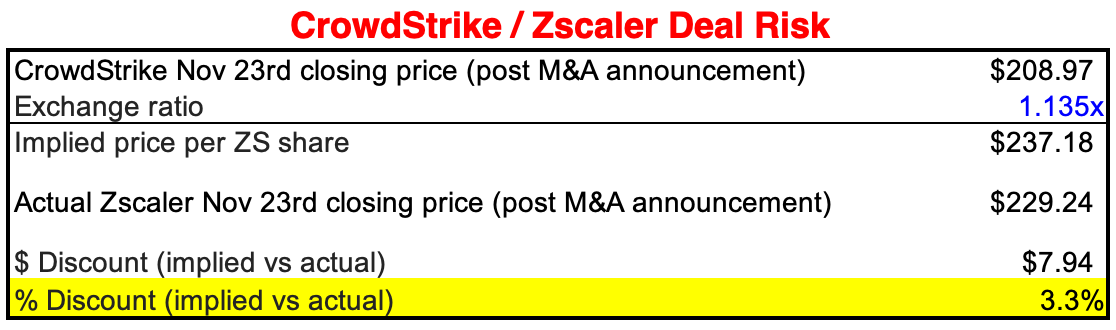
After yesterday’s price movements, both of these stocks will move in lockstep - CrowdStrike jumps by 5% then Zscaler will jump by ~5%. The main difference in how these stocks move in the future comes from risk of the deal closing (primary risk is regulatory). As of yesterday’s close, there is a 3.3% discount between Zscaler’s implied per share price and the actual.
So if the deal closes, buying Zscaler at these prices would leave an investor with ~3.5% more value than investing the same amount directly in CrowdStrike because the discount in Zscaler will go to zero. If you are 100% certain the deal will close, then you are better off buying Zscaler than CrowdStrike (not investment advice :)
Contrast this deal structure with the previously largest cybersecurity deal (Google/Wiz)…Google acquired Wiz in a fixed all-cash $32B deal. Wiz couldn’t care less what happened to Google’s stock price between signing the agreement and closing.
Ok, so why is CrowdStrike down so much on the news?
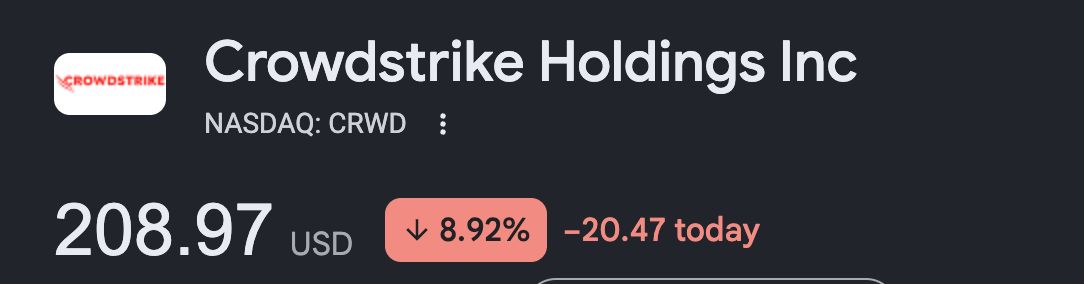
CrowdStrike falling 9% while the Nasdaq was up an historic 6.5% (thanks to Jensen’s return :) feels particularly negative on the announced deal.
CrowdStrike is by no means a “cheap” stock. It nearly doubled this year right before the acquisition announcement and has the highest revenue multiple of any public software company. There are plenty of risks and concerns with a deal like this:
Could take 12+ months to actually close
It’s a lot of dilution
There is a lot of integration risk with a deal this size
TLDR: It’s a risk on a highly valued stock so the immediate reaction was to sell the news.
Is Zscaler a Good Acquisition?
Expected Synergies:
The big question is how quickly CrowdStrike can make the deal accretive to revenue growth and free cash flow per share because that is what will drive the valuation of the combined company.
Below are the expected synergies after the deal closes:
CrowdStrike targets about $1B in yearly revenue synergies within 30 months
Plus $500M in yearly cost savings within 18 to 24 months
Expand TAM by $185B
8,000 Zscaler customers are not CrowdStrike customers
Valuation Multiples:
CrowdStrike has the highest public software revenue multiple, which means it’s a great time to use its stock as currency (when prices are high). CrowdStrike’s pre-announcement revenue multiple was 36.9x, which is 4.6 times Zscaler’s revenue multiple of 8.1x…
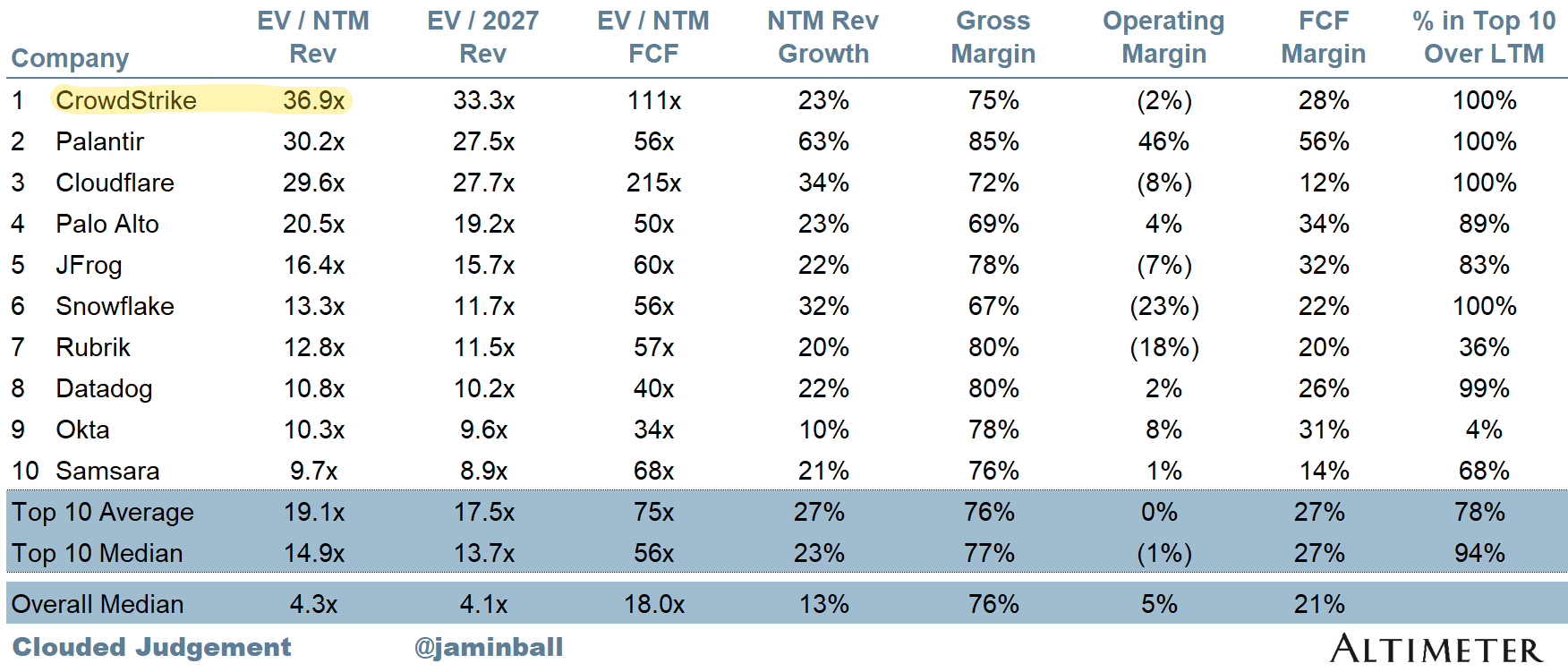
Based on the announced deal, CrowdStrike is paying an 11x revenue multiple, which is still far below their own revenue multiple.
An important part of M&A (like all investing and using stock as a currency) is to “buy low, sell high”. CrowdStrike is selling (ie issuing shares) at a relatively high multiple. If CrowdStrike’s management/board believes their stock price is high, then it’s a good time to use their stock as currency in M&A.
Combined ARR:
The combined company will be about $10B of ARR and $3.9B of that comes from Zscaler. So nearly 40% of the ARR but Zscaler will only get 15.9% of the combined company based on the acquisition terms that were announced….
If CrowdStrike can realize the synergies above and bring Zscaler’s standalone ARR multiple closer to its higher multiple then the deal will be accretive from a valuation standpoint.
Understanding Valuations
Let’s end with explaining the differences in valuation terminology that gets thrown around because a lot of people confuse them:
Market Cap = current price/share * number of shares outstanding
Fully diluted equity value = current price/share * number of fully diluted shares
Enterprise Value = equity value + Debt - Cash
Note that market cap measures basic equity value (outstanding shares). In M&A or banker models, equity values (and therefore enterprise value) almost always also account for outstanding equity awards.
An announced deal (like Zscaler) starts with fully diluted equity value so it includes both vested and unvested employee equity grants. Nothing changes with how Zscaler shareholders are paid out - that is based on the fixed ratio of 1.135x CrowdStrike shares. But the headline number is higher than using basic market cap in the calculation because including more shares (fully diluted and both vested/unvested) means a higher number.
In Zscaler’s case, the amount shareholders expect to receive based on announced price is $46.1B (fully diluted), which is higher than the enterprise value of $43.9B. Why? Because enterprise value is a financing calculation…it represents the amount you theoretically need to pay to acquire a company. Because Zscaler had $3.9B of cash and only $1.7B of debt (net cash position), its enterprise value is lower than its equity value. But also, the $46.1B includes some unvested awards (as mentioned above) that won’t get paid out at closing (in the form of CrowdStrike shares) but rather turn into equity award obligations of CrowdStrike.
Private Company Valuations: When a private company announces a new fundraising round at $[XX] billion that is almost always fully diluted equity value. Why? Because it’s almost always the largest number for VC-backed companies. *Side note: there are also valuation problems with applying the last preferred price (which has special liquidation rights and potentially other rights) to all fully diluted shares, but we can discuss that more another day.
*Congrats to the Zscaler team! I hope CrowdStrike’s stock price goes to the moon so your fixed share count doesn’t haunt you :)
Footnotes:
Talk to my friends at Brex for a true AI-native spend platform
Email onlycfo@onlycfo.io for sponsorship opportunities
Subscribe and share the OnlyCFO newsletter with your teams
*Nothing in this article constitutes legal, tax, or investment advice. Educational purposes only.
On nearly 40% of the ARR for 15.9% of the company: Zscaler also brings 750 billion network transactions a day, to be merged with Falcon's device data into one training set. ARR multiples miss that.