
Brought to you by... Numeral

Sales tax is coming to California (January 1, 2027)! This is bad news for all of us tech folks…
A high tax rate between 7.25 and 10%+ (depending on jurisdiction)
Your CA-based customers now get hit with sales tax
CA-based companies have a big increase to all their software spend
More than 3,000 businesses use Numeral to get sales tax right. Mess up sales tax and you will end up with a huge liability. Get a free sales tax analysis 👇
SpaceX Stock Price Tanks
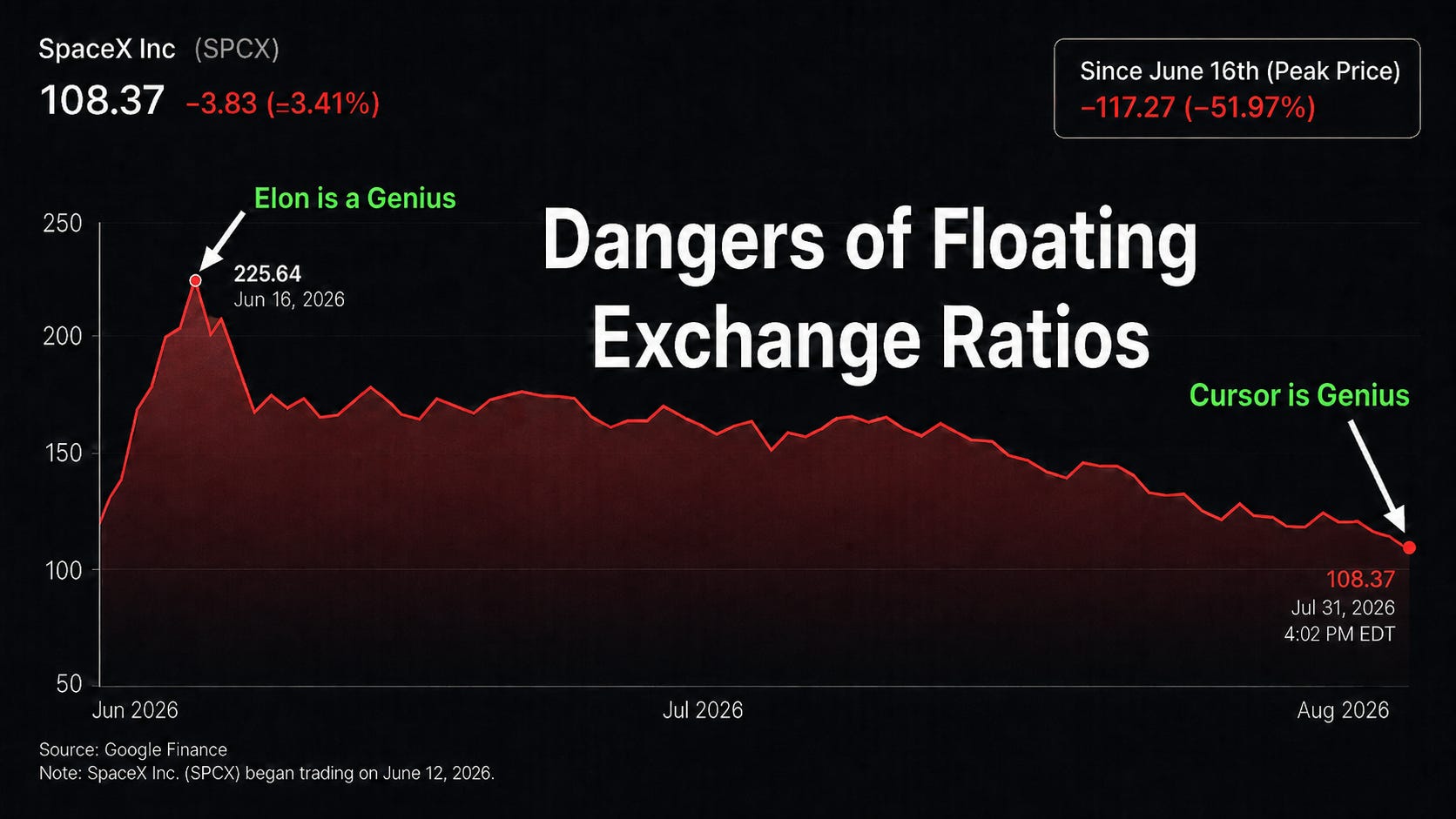
SpaceX IPO’d last month at a $1.7 trillion valuation ($135/share) and briefly touched $3 trillion ($226/share) a few days later on June 16th, which was the same day they announced their $60 billion acquisition of Cursor.
SpaceX stock has been falling ever since…down 50% in the past 45 days.
Guess who is cheering as SpaceX stock price crashes?
Cursor investors and employees…
Wait…but Cursor is being acquired by them. Why would they be happy?
Because the deal hasn’t officially closed yet (expected this quarter) and based on the deal terms, Cursor is benefiting as the stock price falls.
Why SpaceX’s $60B Acquisition of Cursor Is Getting A Lot More Expensive
April 2026: SpaceX’s Call Option to Buy Cursor:
A lot of the diligence and pricing was done prior to the acquisition being announced in June because SpaceX signed a call option agreement for the exclusive right to buy Cursor for $60B if they decide to move forward.
A call option agreement like this is pretty unusual. The option gave SpaceX time to complete its IPO and evaluate the acquisition before making its final decision.
The option wasn’t free for SpaceX. There was essentially a $10B breakup fee if SpaceX called it off…
June 16, 2026: Exercising the Call Option:
On June 16th, SpaceX announced the exercise of the option and entered into a definitive merger agreement with Cursor. At this point, a lot of the acquisition work was already done as part of the call option agreement.
But the deal doesn’t “close” when you enter into a definitive merger agreement. SpaceX said that they expect the deal to close in Q3’26 (so in the next couple of months). The primary reason for the gap between definitive merger agreement and close is the antitrust stuff (like HSR).
Buyer vs Seller Risk
The acquisition price wasn’t $60B in a suitcase full of cash. It was $60 billion of SpaceX stock.
But $60B of stock as of when? This point matters a lot…
There are two primary ways stock deals can be structured:
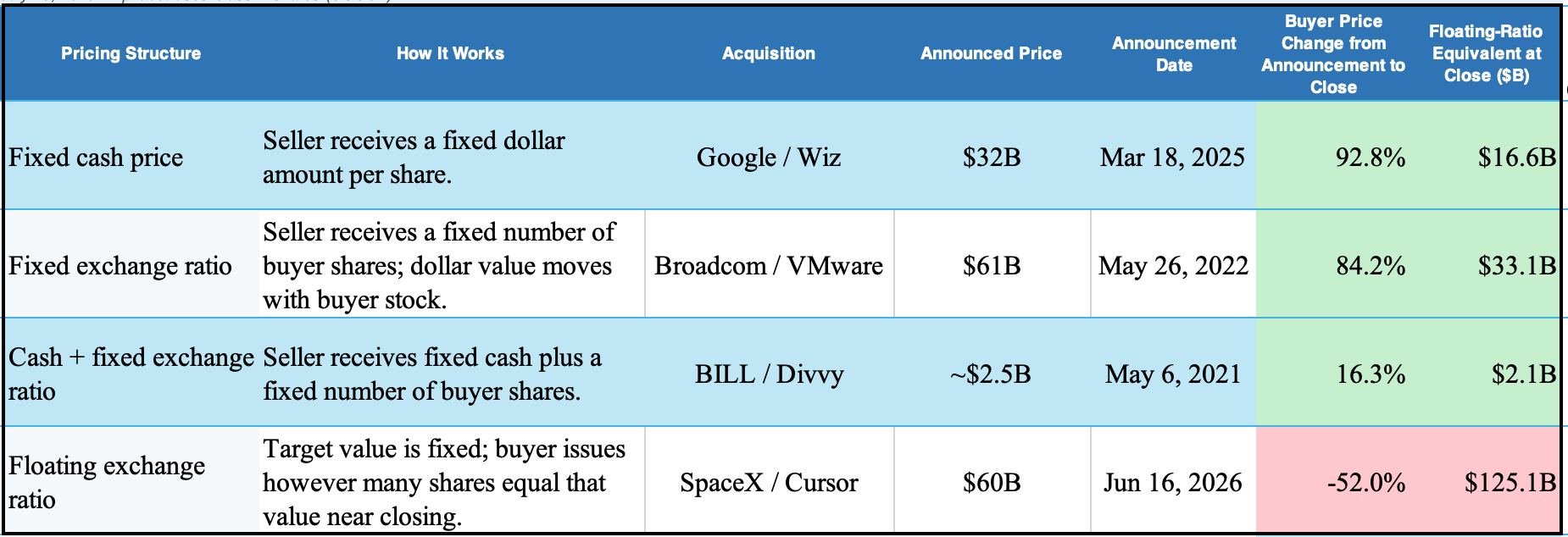
Fixed Exchange Ratio - The number of buyer shares is fixed, so the dollar value rises or falls with the buyer’s stock price. (Risk is on the seller)
Floating Exchange Ratio - The dollar value is fixed, so the number of buyer shares rises or falls with the buyer’s stock price. (Risk is on the buyer)
Fixed is by far the most common deal structure. In fact, floating exchange ratios make the most sense when the buyer is public with an actively traded stock.
Also, when floating exchange ratios are used, they rarely come without a “collar.” A collar limits how much the exchange ratio can adjust when the buyer’s stock price moves up or down. Without a collar, if the buyer’s stock price crashes, the buyer could have to create an unlimited amount of dilution to settle the acquisition.
SpaceX agreed to buy Cursor for $60B using an uncollared floating exchange ratio based on the volume-weighted average closing stock price of the seven days prior to the deal closing.
Remember, the deal was announced in June, but it isn’t expected to close until sometime this quarter (hopefully). While Cursor knows that they will be getting $60B worth of SpaceX stock at closing, SpaceX still doesn’t know how much dilution the acquisition will create for them…
Date TBD: Settling $60 Billion Acquisition Price
I actually got the transcripts from SpaceX’s recent board meeting…
Elon: Buying Cursor for $60B is a good bet. It will accelerate our AI vision.
Board: It’s a lot of money, but I guess a small % of your market cap
Elon: Exactly! This $80B acquisition will be the most important $100B we have ever spent.
Board: Wait…I thought it was $60B?
Elon: Look, if we don’t spend $125B buying Cursor then we will lose in AI
*Obviously the above is fictional, but it’s what I imagine everyone is thinking during SpaceX’s collapsing stock price.
SpaceX’s stock price has fallen by ~52% since the deal was announced at SpaceX’s peak valuation. So the floating exchange ratio for the $60B of stock is now 2x more expensive from a dilution standpoint since the deal was announced. And probably feels like they are now paying ~$125B for Cursor…
The acquisition still hasn’t closed yet so maybe the stock could recover a bit but it could also keep falling…
Here is the potential vicious cycle that can happen:
SpaceX stock price drops (for whatever reason)
SpaceX effectively pays more to acquire Cursor (more dilution)
Stock market drops (has been happening right now) so investors believe Cursor might be worth less than $60B
SpaceX stock price drops further because it is locked into overpaying for Cursor (or there is a huge breakup fee) so the valuation is dinged again
SpaceX pays even more to acquire Cursor as stock price falls
Repeat…
A floating exchange ratio creates buyer risk that could spin out of control.
Elon Hates It; Cursor Loves It
Elon and the SpaceX team hate that the stock price is falling for obvious reasons…but all else being equal, Cursor equity holders are silently cheering.
Why?
If nothing material has changed at SpaceX, then it is still the same company with grand ambitions to be “more valuable than Earth”. But Cursor would rather receive more shares at today’s much lower valuation. If the deal were priced today, Cursor would receive roughly twice as many shares as it would have at SpaceX’s June 16 peak.
Cursor folks are just praying that it doesn’t recover before the acquisition closes…
Fixed cash/exchange ratios are the most common, but as you can see below, if your stock price increases, then the fixed ratio works against you. If Google acquired Wiz in a similar structure as SpaceX<>Cursor, then they would have effectively paid $16B less because Google’s stock price rose 93% between announcement and the deal closing (so they would have had to issue almost half the number of shares than at the announcement date).
Buy Low. Sell High
Companies want to buy low and sell high with their own stock:
Use equity (e.g. employee equity and acquisitions) when the stock price is overvalued
Use cash when the stock price is undervalued
This applies when issuing stock-based comp to employees, performing buybacks, and buying companies. But that is hard to time right, especially when you have a floating exchange ratio and a volatile post-IPO stock…
So as long as nothing really changes with SpaceX’s business and its stock price remains deflated through the close, Cursor investors and employees are really happy since they would get a much better price with more room for upside.
Footnotes:
Get a Free Sales Tax Analysis - Sales tax on software is coming to California so use my friends (and sponsors :) from Numeral to get ready.
Want to sponsor? shoot an email to onlycfo@onlycfo.io
*Nothing in this post should be considered tax, legal, or investment advice. Educational purposes only. Consult an investment and/or tax advisor.