
👋 Join 37K tech leaders! I write about all things tech with a focus on the finance and operations of scaling companies.
Domo has been one of the worst performing software companies in the public markets for a long time. They have one of the lowest revenue multiples driven by zero revenue growth, breakeven FCF margins, and a long history of burning a lot of money.
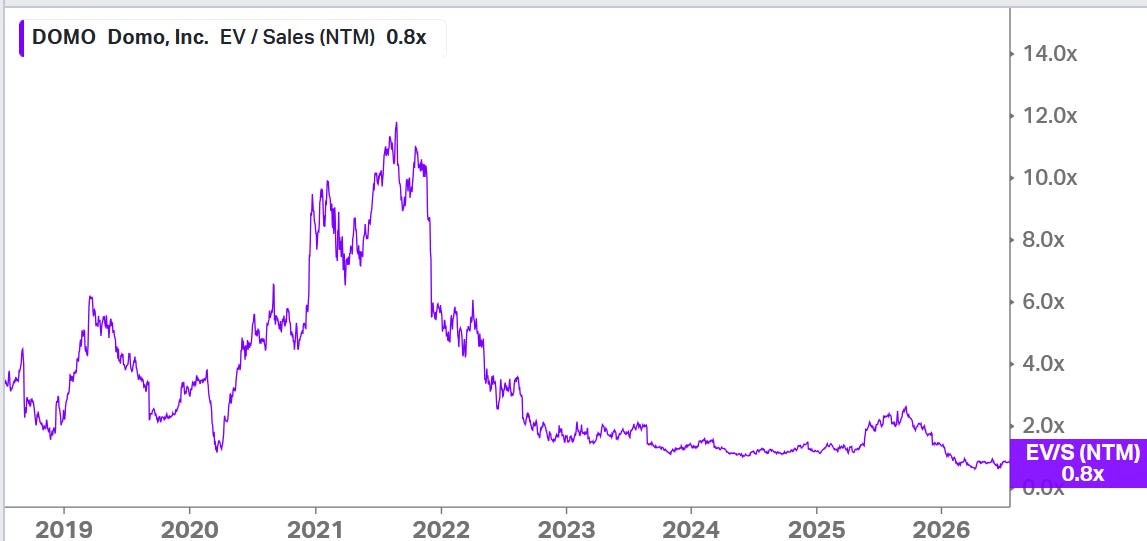
Domo has been contemplating a sale for a while given their broken economics, growing debt, and dwindling cash balance. They hired a banker earlier this year to formally find an acquirer. When they tripped their debt covenant last quarter the lender put a clock on them getting acquired. The lenders basically said, “Sign a purchase agreement by July 31st and close by November. Or else…”
Well, this week Domo finally convinced someone to acquire them (at least part of them). Progress Software, a public company, has agreed to pay $400M for Domo’s assets.
Unusual Acquisition
Domo is selling basically all of their assets (software, customers, IP, etc) in a $400M asset sale. Not a typical equity sale.
Why structure it this way?
Domo is essentially creating a SPAC-style holding company that will have ~$246M of cash (after repaying debt and transaction expenses) that they can use to buy companies with.
But also, there are some attractive tax benefits by structuring it this way…
Losing Money Was Actually Domo’s Plan All Along!
One of my all-time favorite tweets comes from investor Cathie Wood (CEO of ARK Invest) where she basically says, “due to our bad stock trading we have lots of losses that can offset capital gains for many years!”
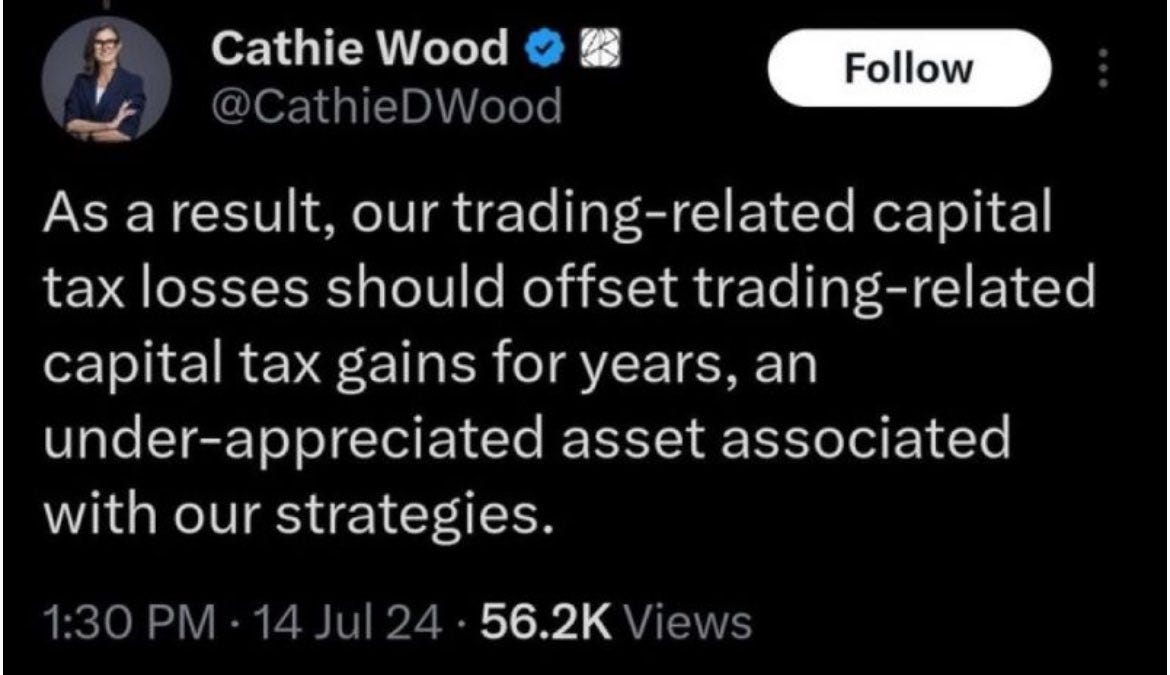
Tax loss harvesting can be part of a legit strategy, but it is a very funny thing to talk about when her funds were down so hard relative to the market.
Maybe losing lots of money was part of Domo’s grand plan?
Because it’s an asset sale, Domo will retain their net operating losses (NOLs). Domo expects to close the deal with ~$900M+ in NOLs that can offset future taxable income (if they ever have any). They currently have ~$1.3B in NOLs, but some of those will be used to offset gains from selling assets in this transaction.
So now Domo has a decent pile of cash (~$246M) and a public company shell to go acquire a company (similar to a SPAC).
The difference with a SPAC is that Domo will have a pretty massive NOL asset. In theory, they can go buy a profitable business and offset profits for a really long time.
What is $900M of NOLs worth?
Hint: Not $900M
That represents the total losses that can offset future profits.
With a 21% federal corporate tax rate, it is at most $189M (assuming a $900M NOL).

Domo also has state-level NOLs. Their state NOLs are a bit higher than federal NOLs with an implied average tax rate of ~5%. If we assume they have $1B of state NOLs after the transaction, then they potentially have up to $50M of tax savings.

There are two potential problems with the theoretical tax asset that Domo’s shell company owns:
Certain NOL rules, if triggered, could partially or completely eliminate NOLs (more on this below)
This one is important…the company must actually generate profits for it to matter.
NOL Expirations:
There are two types of NOLs that companies must track because when and how they can be used are very different:
Pre-2018: NOLs generated before 2018 expire after 20 years
Post-2017: NOLs generated after 2017 never expire, but can only offset 80% of income each year.
NOL Limitations (Section 382):
Section 382 establishes thresholds that can significantly limit NOLs. Domo’s structure is supposed to help preserve them.
Trigger? One or more 5% shareholders collectively increase their ownership by more than 50 percentage points over their lowest ownership levels during the prior 3 years. (remember these thresholds because it’s important to something else they implemented)
Limitation? If the trigger is met, then the amount of NOLs that can offset income each year is significantly limited. If another company bought control of Domo’s shell company (assumed value is $246M) then that company could only use $9.3M of its NOLs each year ($246M * 3.77%). In other words, it would take 97 years to use their NOLs. A lot of Domo’s NOLs were built pre-2018 so those will eventually expire and the remaining NOLs can eventually be used but the present value of them wouldn’t be worth nearly as much.

Cooking Up a “Poison Pill”
Domo announced a “Tax Benefits Preservation Plan” at the same time the asset sale was announced.
The purpose? To make sure no one blows up their NOLs and severely limits their usability.
What is it? It’s a type of “Poison Pill” that essentially stops investors from obtaining more than 4.9% of the shell company’s stock. This poison pill is a right given to every shareholder to purchase Domo stock worth $35 for $17.50. Everyone gets that right except the investor crossing 4.9%. So everyone benefits except them. In practice, once this is implemented, no investor would acquire 5% because they would essentially just be transferring money to all other shareholders. The board can grant an exemption to the poison pill, though.
While the poison pill was written up to protect NOLs (valid reason), it has the side benefit of preventing someone from buying it for the cash and/or public company shell.
What’s Next For “Domo”?
Domo is losing its name and will change its ticker on the stock exchange since all Domo branding is now owned by someone else.
Domo stock jumped 25% on the acquisition news…
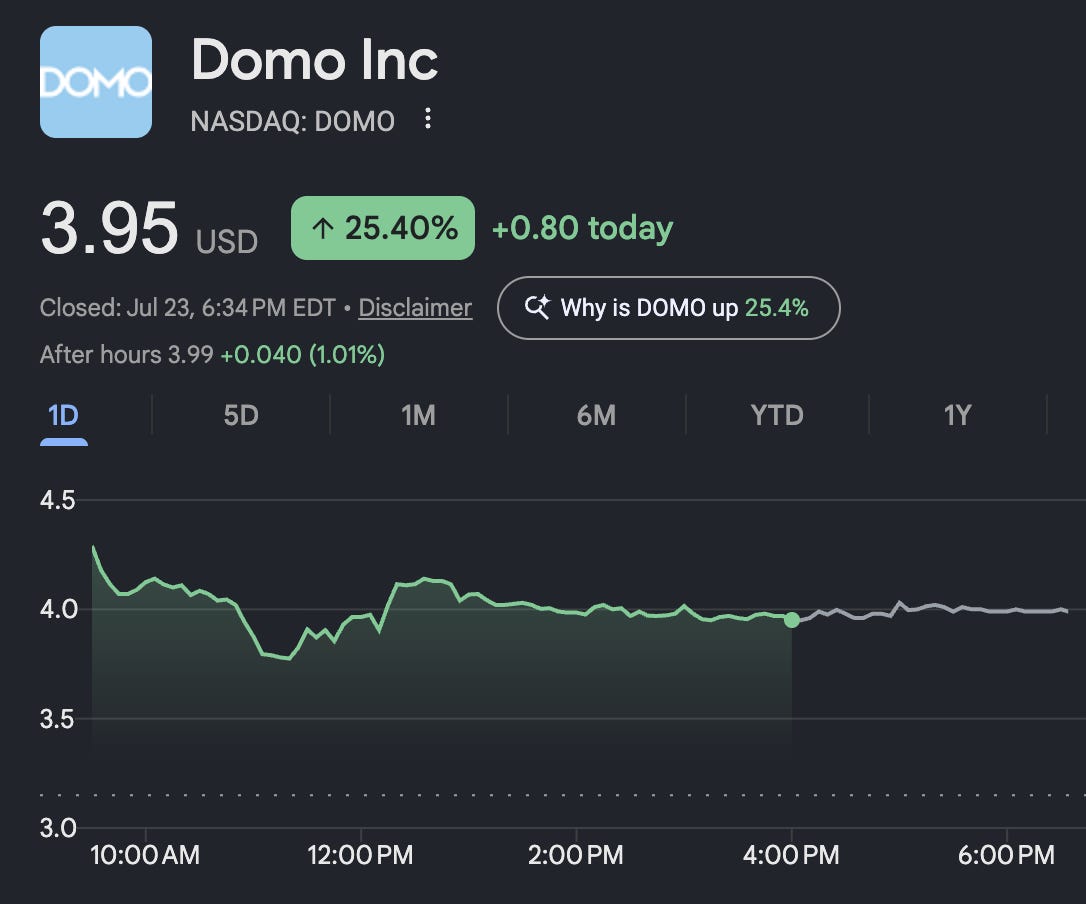
Wait…the company is just a shell holding cash and valuable NOLs. Why isn’t it trading at least at the cash per share of $4.84?
It is currently 18% below the expected cash per share (not even considering NOL potential).
It’s common for a transaction like this to trade below cash per share:
Management risk: Stockholders are relying on someone who burned through $1B of cash to build a bloated business that never made money so why should they expect them to be able to buy a business and run it well?
Actual cash per share is just an estimate and could change by the time of closing because of purchase price adjustments, transaction expenses, tax stuff, etc
Still public: Domo’s shell will still be public and will have operating costs of a shell company (legal, tax, management fees, etc) and will have expenses to try and find a company to buy.
Deal risk that it never actually closes. Risk here seems pretty small.
I don’t know what the Domo shell will buy, but it will have to be pretty small…What can you buy with $246M of cash on the balance sheet? The obvious answer is a broken company like Domo…so if you want something good (growing and/or profitable) it will have to be pretty small. Good chance they take on some debt to buy something bigger, but even so, they still won’t be able to buy something really worthy of the public markets right now with the leverage that a lender would give them.
And remember, they will still be operating as a public company with all the costs that go along with it, which is difficult for a very small company to absorb.
The deal won’t close for another few months, but in the meantime Josh James (Domo CEO) and the board will be on the hunt for what to do with the cash. Become the next MicroStrategy and go all-in on Bitcoin? Buy broken AI businesses and scale them (version of Bending Spoons)? Build data centers? Or just burn more cash and drive the stock price further down?
Goodbye Domo….And I look forward to writing about whatever the shell company does next :)
Footnotes:
Want to sponsor? shoot an email to onlycfo@onlycfo.io
Subscribe for more fun and share with your friends
*Nothing in this post should be considered tax, legal, or investment advice. Educational purposes only. Consult an investment and/or tax advisor.
Excellent write up