
Brought to you by…Paraglide

My teams have always spent way too much time on billing and collections...chasing customers, sending reminders, providing additional detail, etc. It’s high-volume, boring, and repetitive. Which makes it a perfect place to use AI agents.
Have my friends at Paraglide show you what AI agents can do in accounts receivable.
Paraglide helps businesses get paid on time with AI agents that automate billing and collections conversations in the finance inbox. AI agents respond to billing queries, send personalized payment reminders, track commitments, and manage disputes, removing the bottlenecks that delay payment.
How to Win Through Disruption
We knew that in the face of disruption, a force not new to tech in any way, the only way to have a place in the future is to destroy your past. — Eoghan McCabe (Intercom CEO)
Whatever your stance on the “SaaSocalypse”, we can all agree that AI is disrupting software companies. The level and speed of that disruption can vary a lot. But every single software company needs to disrupt themselves before they let someone else do it for them.
There will be a lot of SaaS casualties from moving too slowly…
There are two great recent examples of legacy software companies that disrupted themselves and are winning as a result:
Intercom - built an AI product
Wix - bought an AI startup
Intercom - Rising From The Dead
The CEO of Intercom ($400M ARR customer support software) recently wrote a post about their journey of disruption and how they went from near zero revenue growth (a SaaS death sentence) to being one of the fastest growing software companies at their scale.
He said that two things made the disruption decision a bit easier:
They were losing fast. “We were performing far worse than average, we had less to lose. That makes hard decisions less scary.”
Their category was a clear AI loser. Customer support was clearly going to be disrupted by AI so they needed to do something.
While an “easier decision” in many ways, disruption at Intercom was still hard:
Killed $60M ARR by reducing pricing on existing product
“Switched up our board, removing “mature and experienced” leaders for startup founders”
Immediately moved R&D focus to be nearly 80% on Fin (their new AI product)
Bought $1M domain (Fin.ai)
Moved all of marketing to their new AI product
Created a risky pricing model (outcome-based pricing)
This is a success story so it obviously worked out for Intercom. It completely changed Intercom’s growth trajectory…
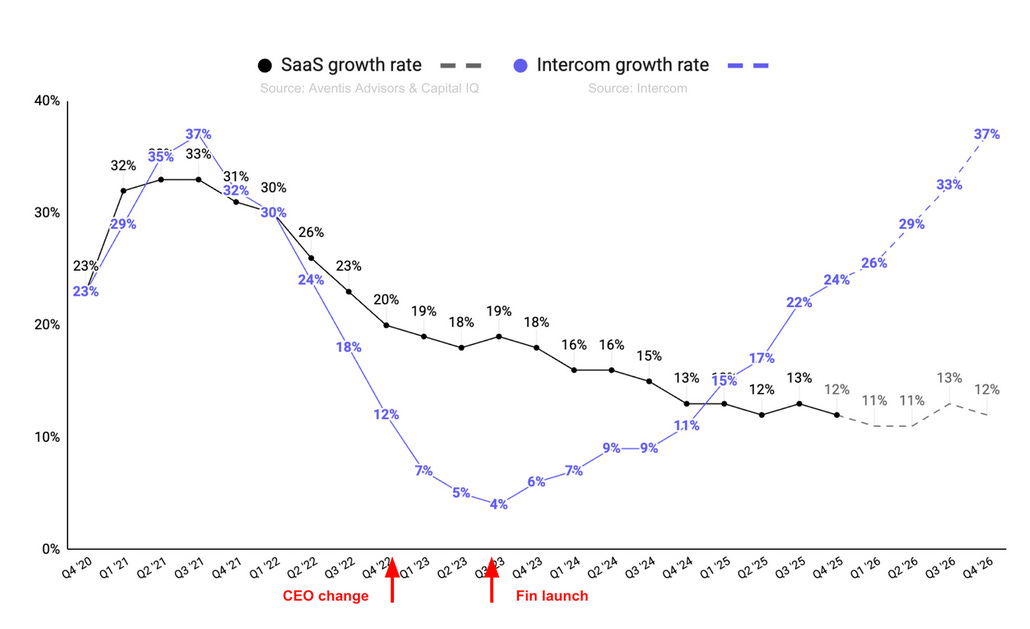
If Intercom had the wrong leaders (specifically the CEO and CFO) then this would never have happened. It was incredibly risky. And it’s hard to justify it on an Excel spreadsheet…
Below is a typical response from a company that is in a position similar to Intercom:
Revenue growth is only 4% so we need to aggressively cut costs and focus on what’s working to get to cash flow breakeven!
I see a lot of companies choosing this path. It might feel better for a few quarters, but they will just be creating a zombie that quickly gets axed.
Wix - Acquiring Disruption
Instead of building disruption internally, Wix bought disruption. Wix acquired a small startup (Base44) in June of last year for $80M.
Wix is a large company with over $1B in ARR, but revenue growth has been slow for several years and AI was clearly going to come after their revenue. Below is their ARR growth, excluding Base44…
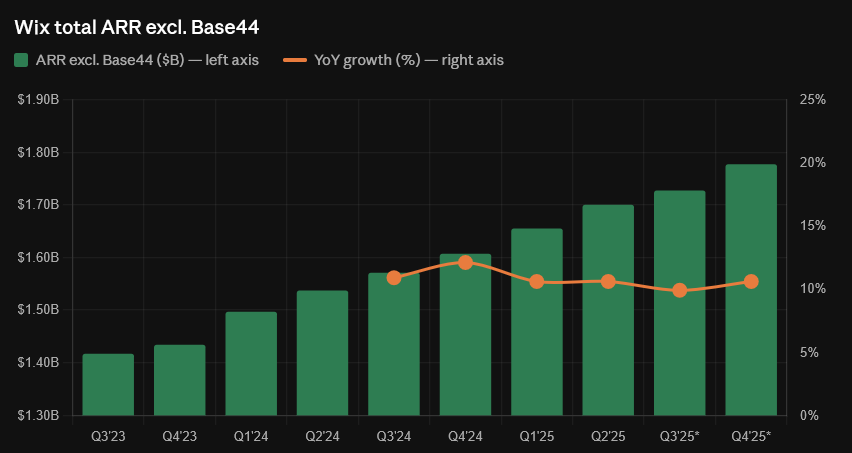
Wix had the distribution (~6M paying customers), but they needed disruption/innovation. As a public company with investors constantly watching, it can be a bit harder to do what Intercom did. It’s also much harder for a large company like Wix to build disruption (things move too slowly). So Wix took a bet and bought the disruption so they could move fast.
Did Wix overpay at $80M for Base44 when it just had ~$3.5M ARR?
In addition to the $80M upfront price, we now know that there was at least an additional ~$90M in earn-out consideration attached to the acquisition because Wix expensed an additional $90M in acquisition expenses in Q4 related to Base44 revenue milestones already being hit.
Base44 went from $3.5M ARR at acquisition to $100M ARR in ~9 months! 🤯
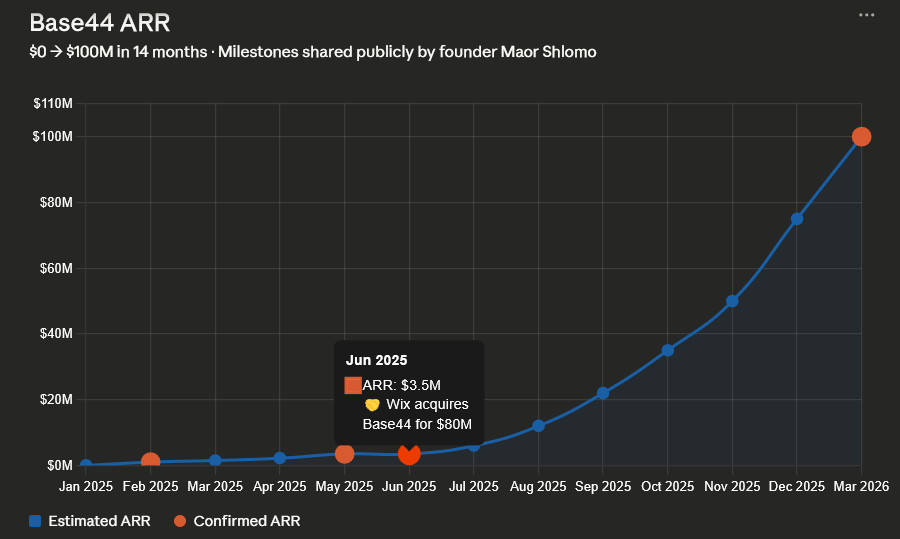
Base44 is growing similarly to other vibe coding platforms like Lovable and Replit. And it continues to have a distribution advantage because of Wix’s existing customers.
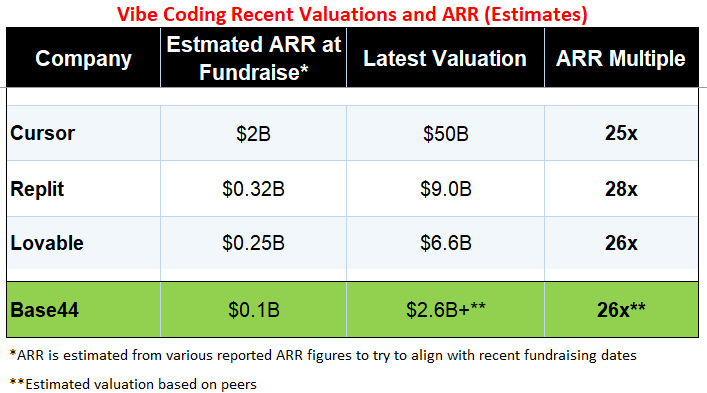
Below are the ARR estimates of similar platforms and their latest valuations. If we take the median ARR multiple of 26x from the companies below and apply that to Base44 then it would be at nearly a $2.6B valuation as a standalone company. Wix’s current enterprise value is just $5B…so that would mean Base44 accounts for nearly half of it! Not sure how true that is though. There are some weird things happening between private and public market valuations, but either way, Base44 is clearly a home run acquisition for Wix.
Paying $170M ($80M cash + $90M earn-out) for a 15x paper return in 9 months seems pretty good to me…
Wix’s recent acceleration in revenue growth is driven by Base44. This acquisition may be what allows Wix to continue to accelerate growth and become an even more valuable company in the future.
💡Fun fact: Base44 was bootstrapped and the founder was the sole shareholder. He built and sold his business in <6 months…
You Need The Right People To Disrupt
Below are a few things I have been thinking about as companies disrupt themselves and try to thrive in the new AI world. It’s mostly people related…
1. Fire The Wrong Leaders (and hire the right ones):
More companies will/should replace existing leaders (and this includes the CEO in many cases). The proven, experienced exec may not be the right person to move fast and disrupt in the new environment. Also, many leaders will be too anchored to their past decisions/bets to make the hard calls to change course.
You need leaders who understand AI and how the company should be building for an AI world.
If you are a leader, then make sure you become the right leader for this change before it’s too late…
2. Need A “Good” CFO:
Disrupting yourself often comes with really hard financial decisions.
So you want to destroy $50M of revenue on the hope this AI product takes off? And we will burn 2x the amount of cash we had planned?
You need a CFO who is growth-oriented, understands the impact of AI on your business, and can support the business through a period of massive disruption (which includes really hard short-term financial decisions).
Now more than ever, CFOs must truly understand the business. I have met many CFOs in the past who couldn’t even explain what their business did. They just knew the numbers….That’s not enough today.
3. More Layoffs Are Likely:
Similar to firing leaders, we built our teams in a very different environment. A lot has changed so people needs have likely changed as well.
There are a lot of potential reasons: 1) you need different skill sets, 2) need fewer people so you can move faster (bloated headcount slows things down), 3) you need to cut some costs to give you more runway/time to disrupt, or 4) AI efficiency means you need fewer people.
It’s not a fun topic, but I promise you that every board and management team is discussing layoffs right now.
4. Don’t Get Complacent Because Things Haven’t Broken Yet:
Many companies (public and private) are not disrupting themselves fast enough because they aren’t scared yet. They still haven’t really felt the pain of outside disruption. They have customers locked into long contracts or it’s currently difficult for customers to churn.
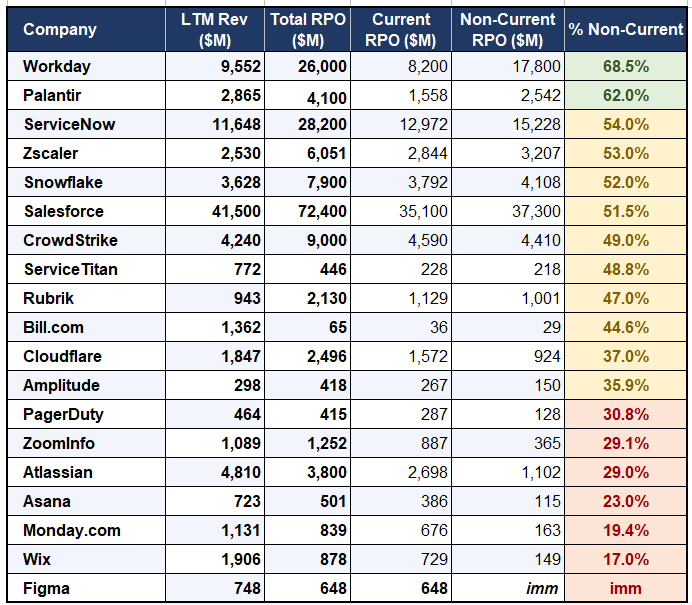
Remaining performance obligations (RPO) measures how much remaining revenue will be recognized under committed contracts. In other words, how much guaranteed revenue/cash do companies have contractually locked up.
A high “non-current RPO” means you have a lot of multi-year contracts (your customers are stuck with you). A company like Workday might be feeling pretty good still because of high RPO. A company like Wix, on the other hand, has more immediate pressure to adapt faster.
Regardless of your customer lock-in….if you don’t start disrupting now then churn is eventually going to hit you hard.
Final Thoughts
Disrupt yourself now. Act with urgency.
A lot of companies (and leaders) still haven’t really felt the urgency yet because: 1) their sector wasn’t as clearly impacted early on, 2) they benefit from multi-year contracts, 3) their software is complex and harder to move off, etc….
But someone else will disrupt you if you don’t do it first. You might get an extra ~12 months before really feeling the disruption pain, but if you are not prepared, then your business won’t be worth much in a couple of years when customers have the ability to churn and the competition disrupts you.
Revenue growth will halt (turn negative)
Margins will get compressed
Terminal value will vanish because you have been disrupted
The above scenario is happening to a lot of companies right now. Make everyone at your company understand that your company may not exist in 12 - 18 months if you fail to adapt.
Footnotes:
Check out this billing and collection AI agent. If you want to cut costs (everyone needs to) and collect more cash, then you should have an AI agent in accounts receivable. Paraglide is today’s sponsor.
Reply to this email if you want to sponsor OnlyCFO.
Interesting Things I Read:
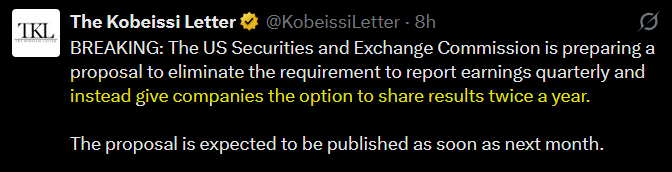
Semi-Annual Public Company Reporting?
I can see the pros and cons, but generally I don’t like this. But most companies will likely just continue to operate on a quarterly cadence and if a company doesn’t then investors will trust them less…
The 8 Moats in 2026
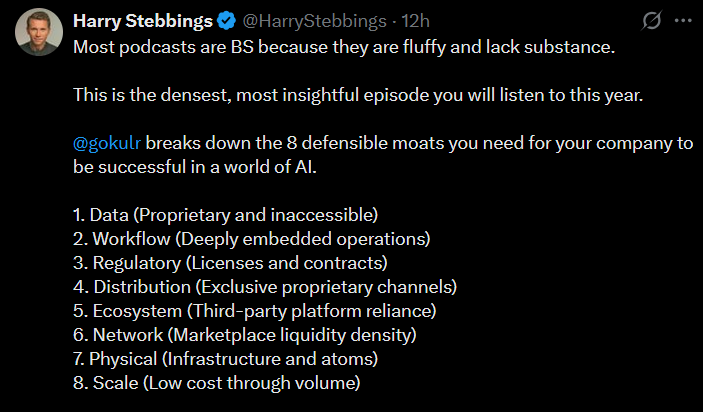
Gokul is a smart guy…and I agree with his list of moats that you need to survive in the world of AI. One moat that is noticeably missing in brand. Gokul responded to the uproar of brand not being on the list and one of his points resonated:
A strong brand is often the symptom of a real moat, not the moat itself. — Gokul Rajaram
I agree that you can’t build a brand moat without having another moat. But once a trusted brand is established (from another moat), then brand can become a moat itself.
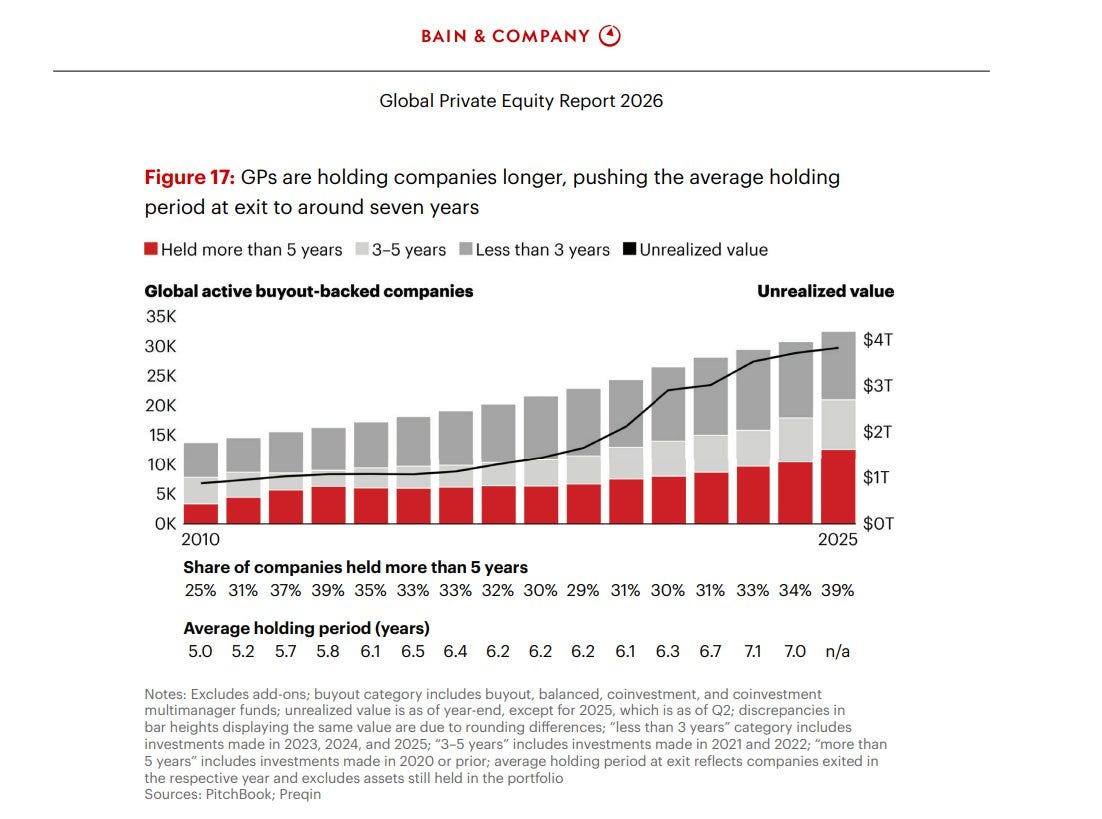
PE Holding Periods are Rising
Lots of acquisitions 5-7 years ago and a lot of those are going to have a tough time selling in 2026…
*Nothing in this post should be considered investment, tax, or legal advice. Educational purposes only.
The one thing I'd add: the companies that feel safest right now are probably the most at risk. High contract lock-in and complex integrations buy you time, but they also buy you complacency. The danger isn't that disruption hits suddenly. It's that by the time you feel the pain, the window to respond has already closed.
Have you considered that disruption is not just about moving faster—it’s about being willing to destroy revenue that still looks “good” on paper?
That’s where most companies hesitate.
The numbers don’t look broken yet, so the decision never feels justified—until it’s too late.