
Brought to you by…Brex

Every board is asking how the company is leveraging AI. At first they just wanted to make sure the company was using AI, but now they want to know:
What are you doing that actually adds value for customers?
What are the best use cases for internal work?
Are you moving faster and/or more efficiently yet?
Brex’s The CFO Guide to AI Strategy is a great resource for CFOs to see where other finance teams are finding the best AI use cases right now. I have implemented most of this myself…
Did We Pay a Fraudulent Invoice?
A few years ago, I woke up to a dozen texts from my AP team and Controller in absolute panic. Never a good sign…
We think there was fraud in a recent wire we sent
I have had a couple of scares like this in my career. Luckily, none of them resulted in a loss of money but a couple of them revealed some gaps in our controls and employee training.
I now walk through all our processes that touch cash and ask: “If I wanted to commit fraud, how would I do it?”
T&E Reimbursement Fraud
T&E fraud is one of the most common because every employee has access to do it, it’s harder to catch, and often employees can claim it was an accident.
The most common ones in my experience are:
Personal expenses: non-work meals, travel, gifts, entertainment, etc., submitted for T&E reimbursements.
Duplicate claims: same expense submitted more than once (same trip, same receipt, or same charge on card plus out-of-pocket).
Unused bookings: flights, rooms, or events that were reimbursed before they were cancelled. For example, an employee is reimbursed but hides the airline credit to use for their next vacation to Tahiti.
Almost every company with any decent employee count has these frauds (or undetected errors). Sometimes these are legitimate accidents, but I know a good number of these are fraud…
AI-Generated Fake Receipts
Back in my day…there were limited (or sketchy) options to submit a fabricated receipt. But now? Thanks to AI, you can make a VERY convincing receipt almost instantly for anything you want.
The fraud methods are the same, but AI has removed the friction of the evidence layer.
Here is a fake receipt I created in ChatGPT. The receipt on the left was just a quick attempt and then I asked ChatGPT to keep iterating and find what made the receipt look like it was AI-generated and correct it and keep doing that until it can’t tell it’s AI anymore. It’s pretty good…
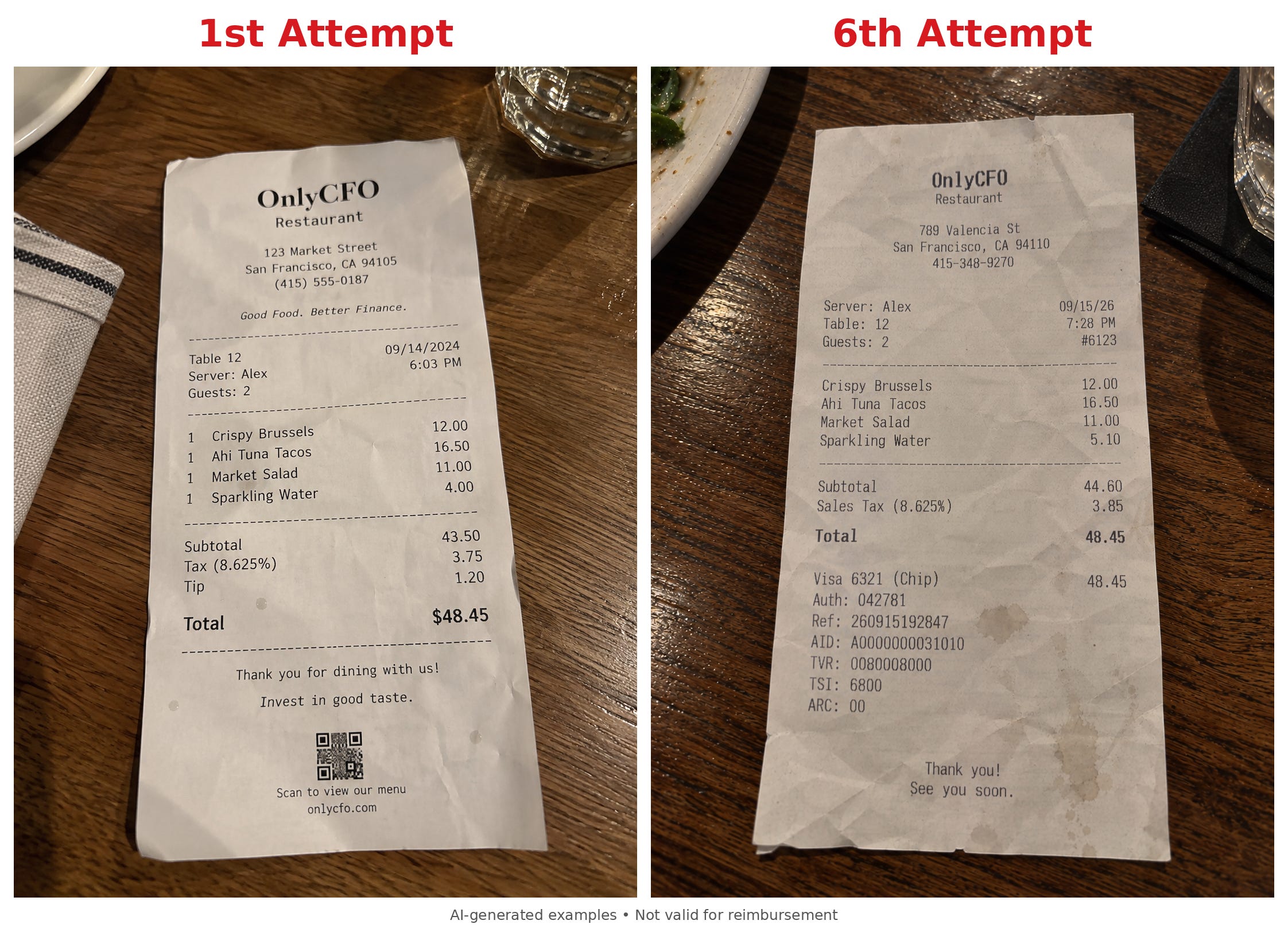
I ran the final fake receipt above through Claude and it concluded the receipt seemed real…Maybe if someone sits and stares at it there are a few potential clues, but if Claude thinks it’s real then I don’t think an accountant who is reviewing 200 reimbursements every week will catch it.

I probably wouldn’t risk my job (or soul) for $48 though. If you get caught submitting an AI-generated receipt then there is no excuse. But what if you are in IT or marketing and frequently put large expenses on your personal card for reimbursement? Maybe a few thousand dollars is worth it to some people?
AI-Powered Fraud in Accounts Payable
Employee expense reimbursements are generally small. The risk of T&E fraud is higher but materiality is usually pretty low. But the potential loss in AP fraud can be extremely high.
The Fraud Attempt That Almost Got This CFO
A couple of months ago my friend’s AP team almost fell for a pretty sophisticated attack:
They received a message from their vendor’s 3rd-party accounting firm that handled their vendor’s accounts receivable. The bookkeeping firm informed them that the vendor’s banking information had changed. The bookkeeping firm sent them a bank letter with the change, forwarded the email history with the vendor’s approval, cc’d two people from the vendor, and provided a phone number of one of the individuals from the vendor if they wanted to call and verify.
It all looked very legit.
The bookkeeping firm domain had a legit-looking, professional website
The bank letter had all the right things
The forwarded email was well written with company-specific context
The individuals that were cc’d from the actual vendor had the right domain (it wasn’t a fake domain)
Why would they assume it’s a fake request?
Well…one of their most important controls in AP is to verify any changes with a known/trusted contact. So when the AP team replied and added AR@[vendor].com for approval the fraud attempt was blown up.
Here is what the fraudsters did:
Created a fake bookkeeping website and domain (super easy with AI)
Likely used AI to create a fake email history that all seemed legit (no broken English and it had company-specific context)
Used AI to fake bank and other documents
Added fake vendor email addresses to make it look real. This part was actually really clever. The “@[company name]” was legit and they used names of real people on the vendor’s AR team. It was the vendor’s correct domain name. That built trust since the vendor was cc’d on the email. But while the domain of the email was accurate, the first part of the email was the fake part (so the email didn’t actually go to anyone at the vendor). For example, they used [firstname].[lastname] convention when the actual vendor used [first initial][last name]. They just wanted it to add legitimacy to the forwarded email.
Fake call verification - while they didn’t call the number in the forwarded email, I bet the fraudsters were ready either with an AI voice or someone with perfect English
Controls to Prevent AI-Powered Fraud
Below are a few controls every team that touches company cash should consider. Not an exhaustive list.
Banking Controls. I am continually shocked by the number of companies that don’t have appropriate banking controls in place. A VC wires them $25M and they just wing it…
ACH Debit Filters/Blocks - Prevent or restrict unauthorized ACH debits against your account by blocking them or allowing only approved originators.
Dual Administration - Enforces security controls by requiring setup and modifications to be approved by a second administrator. This mitigates the risk of internal fraud.
ACH/Wire Approvals - Set this up immediately. You should have all wires that are initiated by one person require approval by another person. You can also add a 2nd approver for wires over a certain limit (e.g. CEO approves everything over $100K).
Alerts: Banks offer a range of alerting options to help companies detect fraud.
Positive Pay - This is a control that provides detection of fraudulent, altered, or counterfeit checks through daily verification of checks presented for payment against a company’s check register.
2FA (2-factor authentication): Please please set this up for both your company bank account and your personal account. It’s easy and adds a lot more protection.
Training: Make sure that the folks who initiate or approve wires have received training on best practices and how to prevent fraud. Any “urgent” wire request from the CEO is extremely suspect.
Culture of Skepticism: Make sure the team knows it’s encouraged to question anything that seems odd or suspicious. AI-powered attacks are getting really good
Segregation of Duties: The same person should not be able to create/change vendor banking information and release the resulting payment. Important to make sure no fraud is happening internally.
Pay by Card: If you can, pay by card. It’s easier to dispute and card companies often have better fraud controls. Once an ACH or wire is sent, getting the money back is very hard (ACHs can be a bit easier though if you act fast).
Verify and Establish Trusted Vendor Contacts: Get explicit approval from the trusted contact that was previously verified. Verify bank details or changes independently. It’s always worth the small extra friction.
Bank-Change Reapproval: Any bank information changes should go through the same approval process as the first time (bank letter, verification, etc).
Authorization and Approval Matrix: Define who can approve purchases, new vendors, vendor bank changes, and payment releases. And what the thresholds are for each. The payment approver should review the actual beneficiary and amount. Changes after approval should require reapproval. No exceptions.
Spend Management Software: Brex (today’s sponsor), for example, has robust controls to help prevent and detect fraudulent/erroneous spend. Brex has seen everything so they built a simulated company full of expense abuse to train and test their AI audit agent.
Your corporate insurance won’t necessarily save you if you get duped. Two potential reasons why:
Insurance limits: A lot of insurance companies see increased risk here so the retention (aka deductible) is quite high and the maximum coverage per incident/aggregate is not that high. So one big fraud attempt may not be fully covered.
Callback verification condition: Even if you do have strong insurance, they can deny the claim if AP doesn’t independently verify payment instructions (such as calling a known/trusted number). Check your insurance policy and make sure your controls meet your insurance carrier’s requirements…
Scared Yet?
AI has removed the friction on the evidence layer for committing fraud. This is making fraud attempts really good. Your controls and systems need to keep up with the fraudsters.
We are going to see more companies fall for these frauds in the coming months. AI hasn’t changed the fraud methods, but it has made them much more believable.
Stay safe out there :)
Footnotes:
Talk to my friends at Brex for a true AI-native spend platform
Subscribe and share with your friends
*Disclaimer: Informational and educational purposes only. Does not constitute investment advice. The author may own positions in companies discussed. Do your own research. Don’t make investment decisions based on anon online characters please
A good expense management tool that flags unusual or duplicate transactions matters too, and so does centralizing payments: prepaid cards issued to employees (preferable to credit cards), where the company can review the statement directly, beat reimbursing employees for cash or personal card spend. On top of that, the segregation of duties point matters more than ever here, since AI shifts the weak point from detecting fakes to verifying through an independent channel that never touches the compromised one.