
Brought to you by…Brex

In the age of AI, finance teams need to move fast while staying in control.
Brex is the intelligent finance platform that gives you the AI-native workflows to move fast (handling receipts, memos, transaction monitoring, policy enforcement, etc) while staying in control and eliminating manual busy work.
Join companies like Anthropic and Zoom that are moving faster because of Brex.
Annual planning is much more than just the 3-statement model. It should create strategic alignment on the company’s most important priorities for the next year.
Creating alignment internally and with your board has never been more important than it is today because of disruption and the constantly evolving impact of AI.
Below are some of the key things I consider when building an annual plan and getting it approved, including how AI is changing what I present.
Annual Planning Calendar
Key: Start early and get alignment from key internal stakeholders.
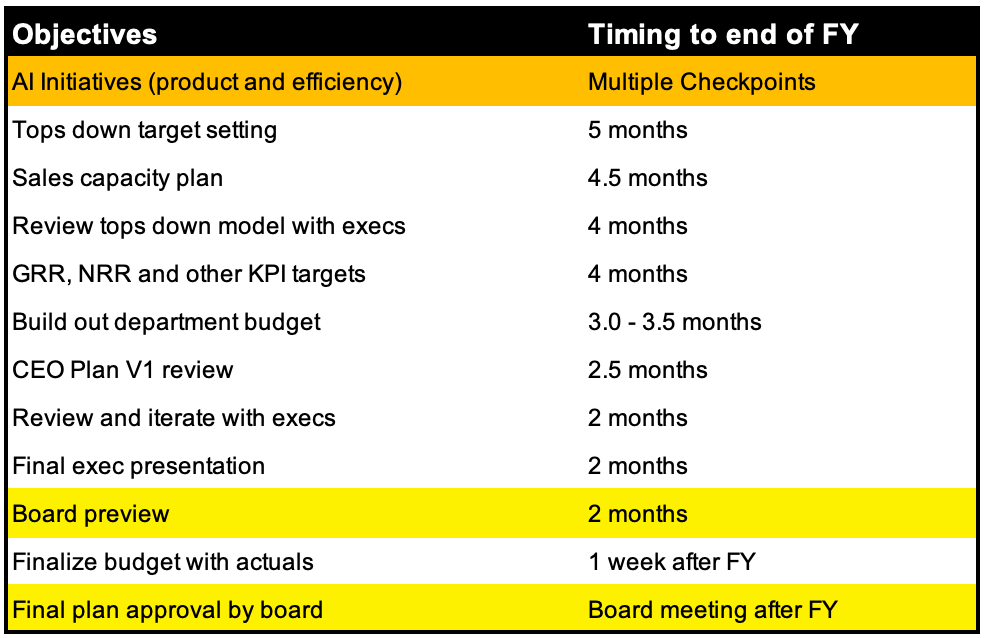
Below is my high-level annual planning calendar. This is generally for larger, more predictable companies. Smaller companies or companies that are less predictable (which is many of us right now!) might need to compress this timeline or at least revisit things multiple times before the plan is approved
Regardless, there should be at least two board touch points:
Preliminary board approval in the Q4 board meeting (happening now!)
Final plan approval in the meeting following year-end
I also added a new line in my agenda (orange row) for AI initiatives. This isn’t just one thing but rather should be wrapped into every part of the planning process.
Side note: I don’t always walk board members through the plan individually, but I will if there have been disagreements in the past or there is potentially something controversial in the plan. AI gross margins, how much is spent on AI, where we focus spend in 2027, etc could all be controversial with your board. There are strong opinions on AI so make sure you know where your board stands.
Presenting Financials
Below are some of my most important pieces of advice on presenting a financial plan:
Board members need context. They sit on several boards and they are not living in the financials like your exec team.
Start with what you want to achieve over the next 12-18 months. And describe the “tailwinds” and potential “headwinds”. The board wants to know how you are thinking about plan confidence level and potential risks.
The financial plan should map to your goals and key initiatives.
Boards care about the handful of assumptions that drive 80%+ of the model. Focus on those and not the hundreds of other small ones.
A good table of numbers usually provides better context and information than a pretty chart.
Define key metrics! Throw the definitions of ARR, GRR, NRR, etc in the appendix and highlight if you make any changes.
AI is not one topic in the board meeting. It should be discussed throughout the meeting with each function detailing AI’s impact.
ARR Targets
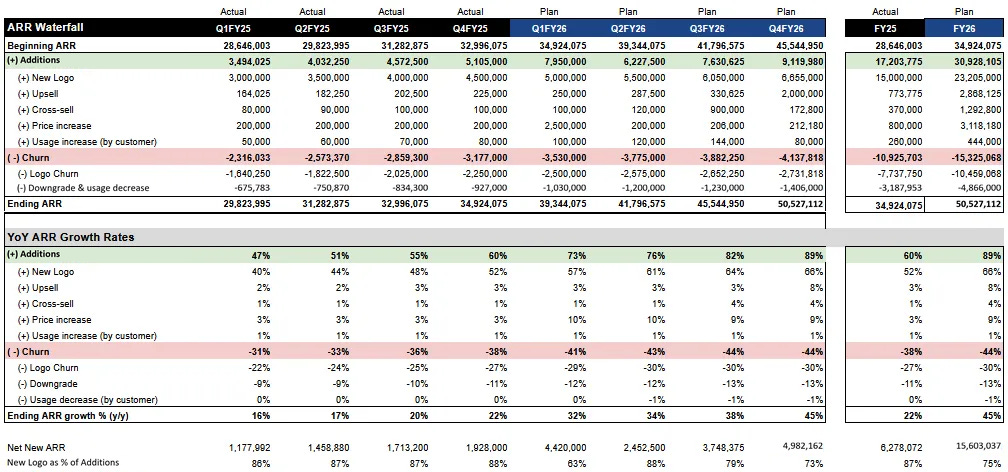
The ARR target (or whatever top-line metric you use) is the most important number to get alignment on.
I have found something like the below as one of the most useful ways to present an ARR waterfall that can be used to lead various discussions around top-line growth.
Changes from AI may require updating how you present ARR.
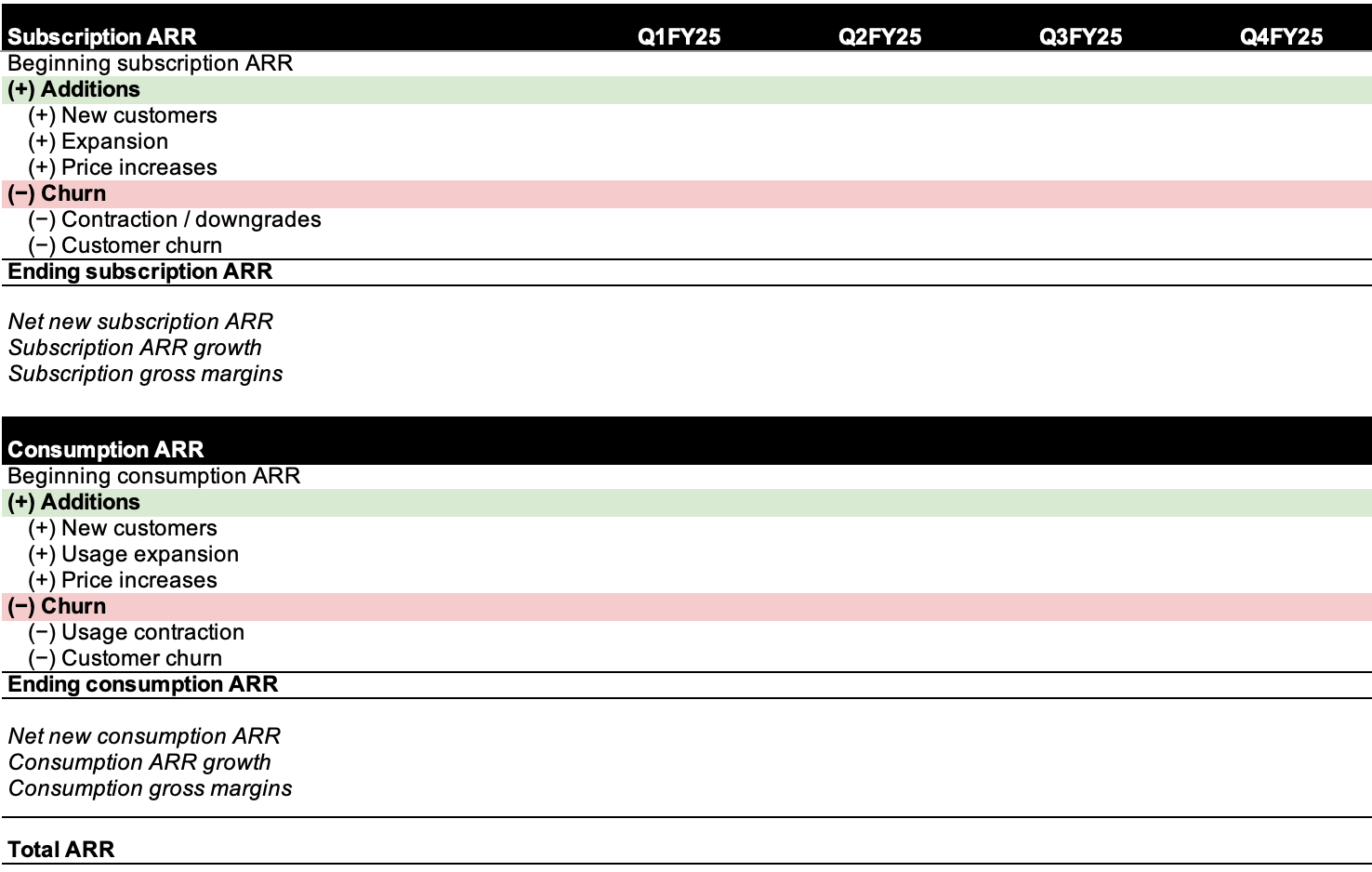
Your definition of ARR will likely change (or expand to include things like consumption-based pricing models). And you may also need to change how you present ARR to better represent AI products.
If all your AI products are consumption driven and that is where you are betting the company’s future growth, then of course you need to separate it out! The gross margin profile is also probably materially different so call that out here too. Pricing model and/or gross margin profile (which is usually tied to pricing model) is often a good way to present the revenue streams.
Below I show a more consolidated ARR waterfall but broken out by pricing model type:
Your Fastest Growing Expense: AI Spend
AI spend is (or will likely soon be) your biggest expense, so of course you need to break it down to the board. I promise the board is interested…
There are two categories:
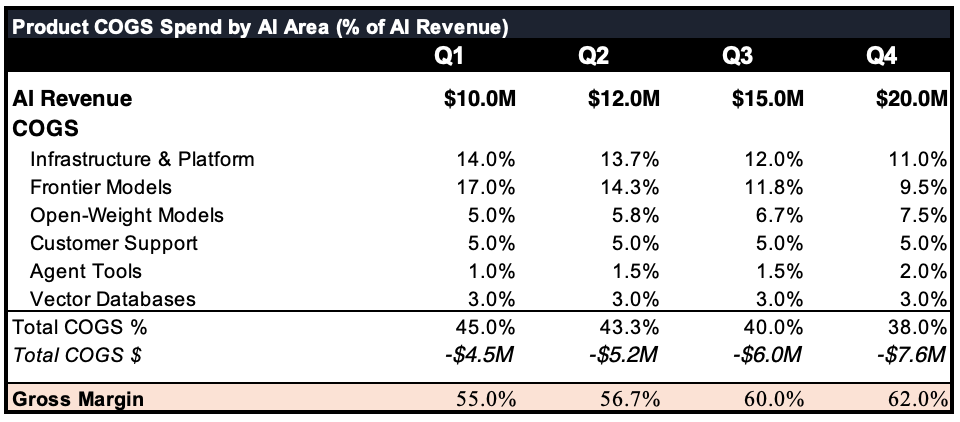
COGS (everything impacting gross margins)
Opex (S&M, R&D, G&A)
Break out the major components of COGS for your AI revenue, then explain what will drive improvements in gross margins.
I then might break out AI opex spend by department (based on accounting practices below).
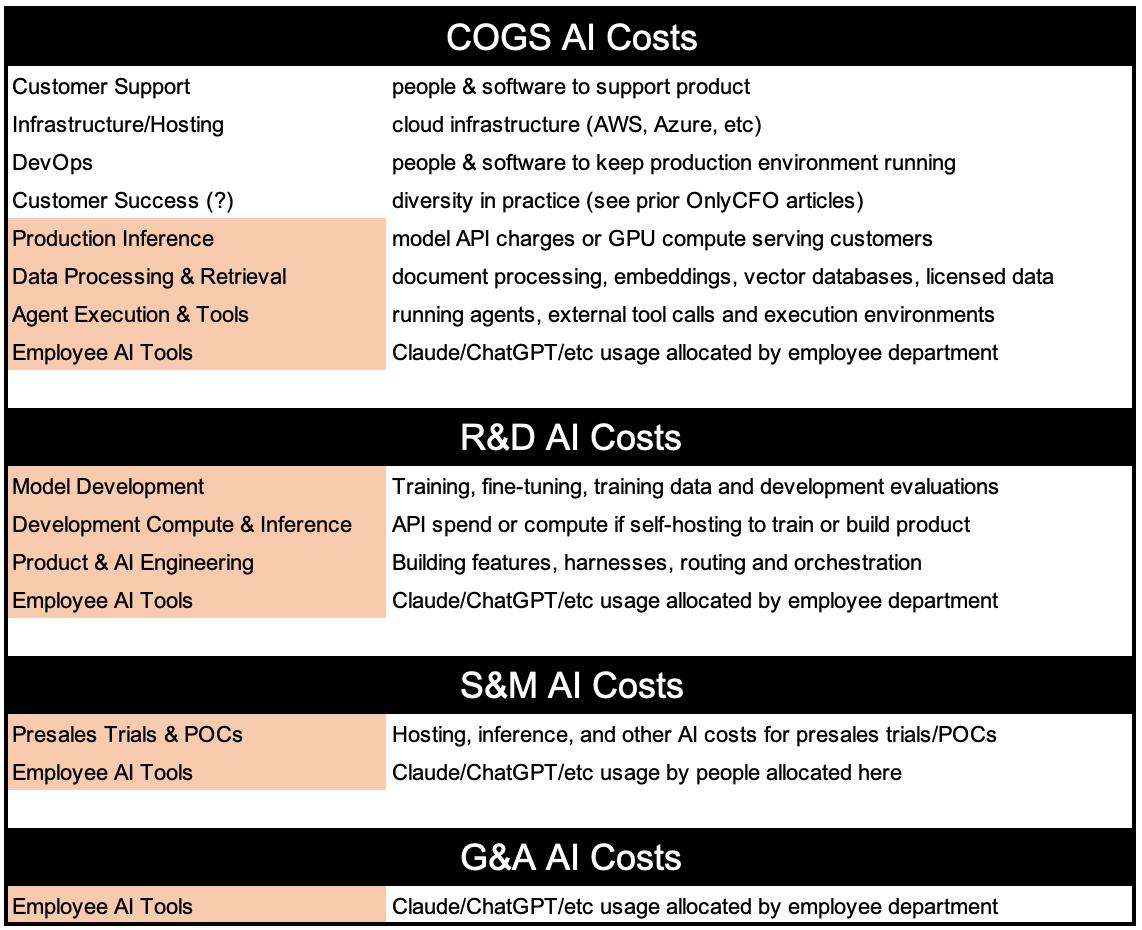
A few key highlights that I might show are:
R&D since it’s usually the largest AI operating expense category, including AI tools, usage, and the people building AI products.
The AI costs related to free trials/POCs, which can grow quickly
Overall Claude/ChatGPT usage by department can be an interesting metric to just show AI is being used but follow it up with how it’s actually saving time/resources.
Income Statement
Below is my P&L slide for the annual plan. It’s essentially the same format as audited financials with a few additional breakouts.
ARR Waterfall: I show a summary ARR waterfall here so you can easily see how it differs from GAAP revenue. If the difference is large, then answer why!
Sales & Marketing: GAAP financials always consolidate these lines but the individual breakouts are important.
Percentages of Revenue: It’s much easier to review costs as a percentage of revenue so I include these percentages at the bottom.
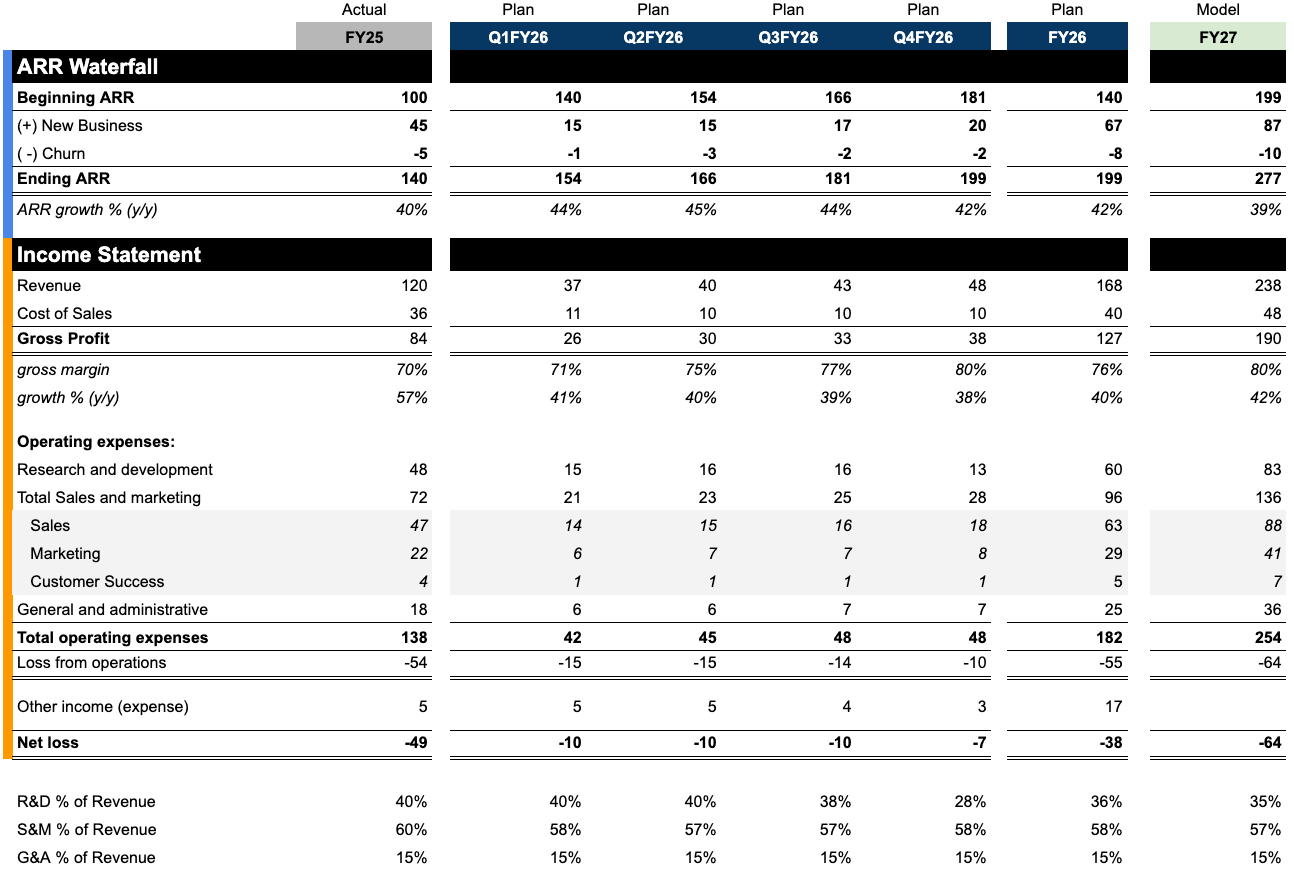
Few other things when presenting the plan:
Historical Context: Provide at least one year of historical financials.
Plan + 1 Year: Build a tops-down model for the year after the annual plan you are getting approved. This forces you to be honest about building capacity for the following year.
Show Quarterly Numbers: The linearity of growth and spend is important. If spend is front-end loaded while revenue growth is back-end loaded, the plan becomes less believable (and a lot more risky).
Cash Burn & Key Metrics
Cash (and related metrics) are important to the survival of the company. Mismanagement of cash can kill an otherwise good business. Make sure to present and discuss cash and runway in detail.
Also, present the other key metrics that are important for your business, which can be dependent on industry, segment, revenue scale, etc.
Below is an example of what you might present.
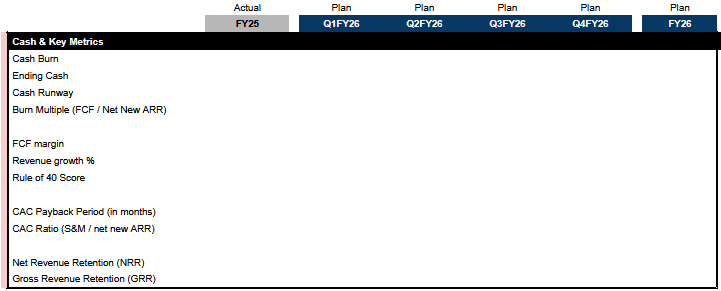
This is one of the areas where I might present a few pretty charts that visualize this trending data over time instead of just the numbers.
Headcount Plan
Make sure you show the board the key components in the headcount plan:
Key Hires - What executive (and key VP) hires are in the plan? List them out.
Trending Headcount Plan - Present quarterly headcount. Mostly summarized so there isn’t too much detail, but I break out sales in more detail. If there is another key function we are focusing on, then I might break that out as well.
AI spend relative to headcount - How are we spending on AI relative to headcount? What measurable benefit are we getting (lower costs, avoided hiring, greater output, etc) and when does it show up in the plan?
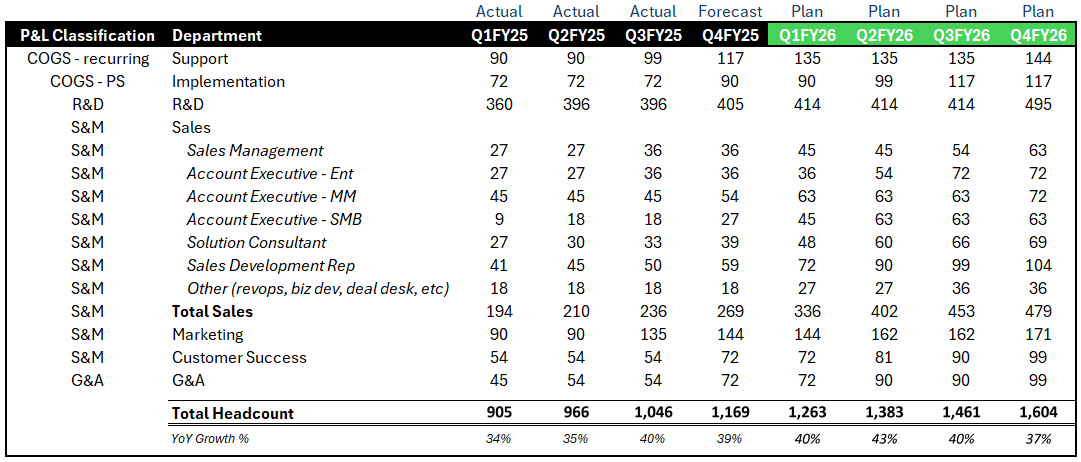
Boards get nervous (rightfully so) when the plan has 70%+ of the hiring in H1. Because if sales start to come in softer than expected, you have limited ability to adjust and offset the additional cash burn.
Investment Areas
What are the company’s key initiatives and investment areas?
If the company is taking on any costly initiatives like the below, then explain to the board the estimated costs and impact to the financials.
New large AI initiatives (new pricing model, new AI products, etc)
Expanding internationally
Building a big new product
Creating a channel partner program
IPO prep
FedRAMP compliance
Appendix Slides
Some slides can get thrown into the appendix and not discussed live, but can be important context for the board. Appendix slides such as:
Balance Sheet
Full statement of cash flow
Natural P&L
Sales pipeline stuff
Marketing data
Key metric definitions
Final Thoughts
The one thing that is true about every financial plan is that it is wrong on day 1. Hopefully the plan is pretty close to actual performance, but adjustments are usually necessary.
The plan should create guardrails for how you should adjust costs if the plan is missed. Don’t just blindly follow the plan. Adjust based on performance.
But also, AI is moving too fast to strictly hold to an annual plan for 12 months. Every company must be willing to tear it up completely if the underlying assumptions break.
Good luck with 2027 annual planning!
Footnotes:
Talk to my friends at Brex for a true AI-native spend platform
Email onlycfo@onlycfo.io for sponsorship opportunities
Subscribe and share with your friends
*Disclosure: Nothing discussed in this post is financial, tax, or investment advice.
The board-level challenge is separating measurable operating changes from speculative productivity promises. An AI-era plan should make the assumptions auditable: where cycle time falls, which costs actually leave the base, what new controls appear, and who owns adoption. Otherwise “AI impact” becomes a plug that improves the forecast without changing the operating model.