
Brought to you by…Brex

In the age of AI, finance teams need to move fast while staying in control.
Brex is the intelligent finance platform that gives you the AI-native workflows to move fast (handling receipts, memos, transaction monitoring, policy enforcement, etc) while staying in control and eliminating manual busywork.
Join companies like Anthropic and Zoom that are moving faster because of Brex.
Pulley (Carta Competitor) is Shutting Down
The founder of Pulley (cap table software) announced this week that they are “winding down operations”. No PE bailout, no fire sale acquisition to a competitor, Bending Spoons isn’t coming to the rescue, and not even an asset acquisition?
The biggest question on social media was “Why couldn’t Pulley get acquired?”. They seemed like a strong competitor to the 800-pound gorilla (Carta). They raised $50M from Founders Fund and Stripe. And had a decent amount of ARR - rumored to be ~$20M.
So what the heck happened?
The LinkedIn message from Yin Wu (Pulley founder) said a few interesting things:
They have been working with Carta for the “last few months” on the transition
Carta is honoring all Pulley contract terms
Implied that the majority (but not all team members) are gone and that she (and others?) will be building something new
Given the way she praised Carta and talked about how great they are, I think it’s safe to assume that they aren’t just “shutting down” with nothing. There is some sort of deal/incentive with Carta (more on this below) but also not really an acquisition.
So what happened to Pulley?
Obviously things didn’t go as planned…
I have been part of transactions like this from different sides, so let’s walk through how things led up to Pulley “winding down”, Pulley’s rumored deal with Carta, and why VCs are incentivized to choose speed over highest-value deal.
Revenue Growth Stalls:
Pulley raised a decent amount of money ($50M) so their mandate was to grow fast. Revenue growth obviously slowed significantly since their $40M Series B in 2022.
And when revenue growth is slow (like <30%) at anything near Pulley’s small ARR scale, it won’t be a venture scale outcome. So the VCs either want 1) a path to massive reacceleration or 2) get their money back as soon as possible.
I am going to guess that Pulley’s revenue growth has been slow for a couple of years. When they raised their Series B they probably had $5-10M of ARR and after ~4 years they are only at ~$20M. That’s way too slow for a VC-backed company at their last valuation - the exit waterfall math was broken.
The Search:
Below is typically what happens in a situation like Pulley:
Growth slows below an acceptable venture scale outcome
Management team tries different things to reaccelerate
#2 doesn’t work and they likely burn even more cash trying
Founders get tired and/or board doesn’t think they can turn the ship around. They suggest running an M&A process
Board and founder have quiet conversations with most likely acquirers
If #5 doesn’t work (or they do it in parallel), M&A advisors get hired to run a more formal process
At this point, everyone knows it’s not going to be a great outcome. VCs are ready to just get some (hopefully all) of their money back and move on. Founder is tired and doesn’t see a path toward a good outcome.
While M&A advisors are hired, a lot of these deals get done through the VCs network (like another portfolio company).
In Pulley’s case, Carta was clearly at the top of the list for a soft landing.
The Deal:
Pulley’s rumored $20M of ARR is definitely worth something so of course they aren’t just shutting down and telling their customers to move over to Carta out of the kindness of their hearts. Many believed that to be the case when they read the announcement…
According to Jesse Tinsley (CEO of MainStreet) who heard it from multiple sources, Pulley took an earn-out deal with Carta that might return up to 50% of the pref stack, which is $50M (so earn-out of ~$25M).
What’s an earn-out?
An earn-out is cash paid after closing that has to be “earned”. The seller “earns” the payments over time if the acquired business hits agreed-upon targets after the deal closes.
In Pulley’s case, this “earn-out” feels more like a commission. I am imagining something like “For every Pulley customer you get to migrate to Carta you get x% of the ARR”. Which would explain why they have been talking to Carta for months and the founder’s LinkedIn post was very complimentary of Carta and pushing everyone to move to Carta.
What about cash on the balance sheet?
The cash remaining after paying all liabilities and wind-down costs also gets distributed to shareholders.
So let’s say Pulley had $15M in the bank and got a $25M earn-out with Carta. That’s $40M of distributions. Not sure if this is accurate, but let’s assume it’s directionally right. This would mean that no one gets any money except for the investors since they have $50M worth of preferred shares.
We all know most startups fail, but always a tough pill to swallow when no common shareholders see a dime on exit.
So no one at Pulley will make any money?
Well…not necessarily. Often these deals come with carveouts or retention packages for a few key employees if they need some folks to stick around. Or in this case, encourage Pulley customers to migrate to Carta.
So founders often receive a small carve-out that’s separate from the deal consideration since all deal consideration gets eaten by the pref stack. The VCs want as much of their money back as possible so they want the founder to be motivated to help make that happen.
Could Pulley have gotten a better offer?
Maybe, but it’s hard to talk to every potential acquirer. And sometimes getting a deal done quickly is more important than a slightly higher acquisition price.
On Twitter/X, Jesse threw out a $70M acquisition offer to buy Pulley. But obviously this is non-binding since he doesn’t have any details of Pulley’s business.
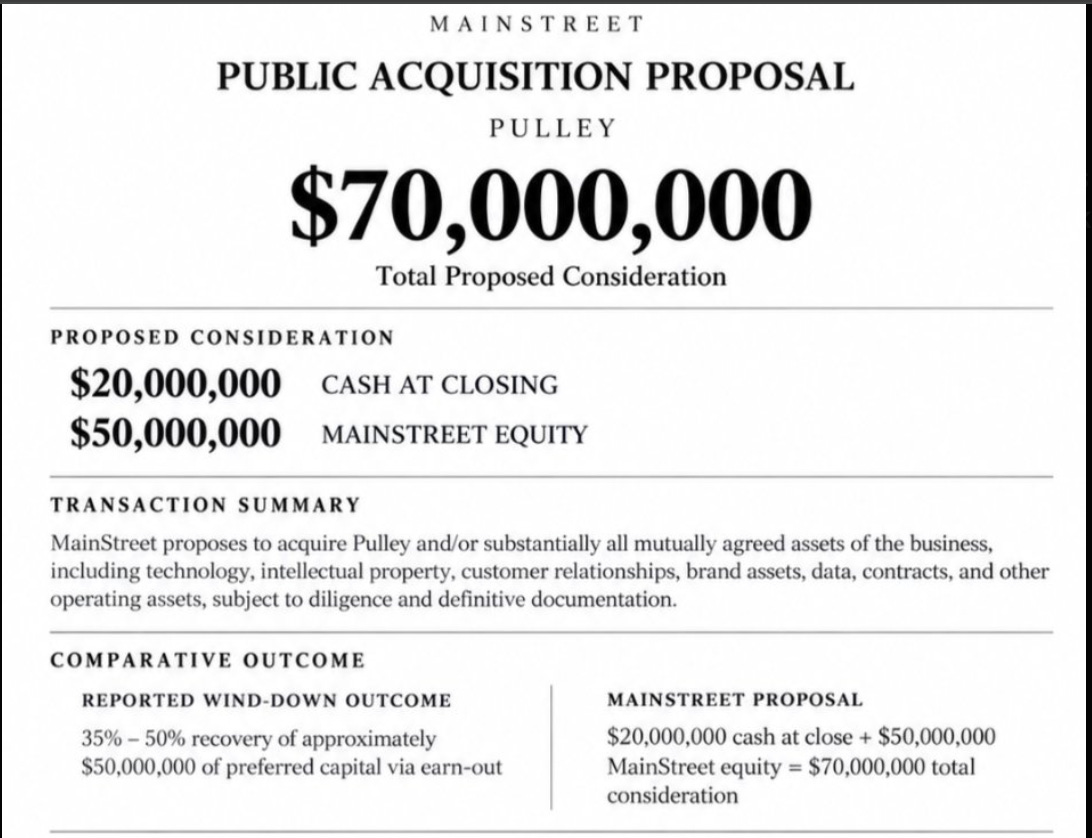
Take this offer with a big grain of salt. Jesse doesn’t have all the context (ARR, metrics, issues, etc) and he knows it’s likely too late anyways. Some of this is Jesse just marketing so other companies considering shutting down in the future will go to him first. But…he has pulled something similar like this before when he acquired Bench…
It is odd that Pulley didn’t reach out to Jesse at all though. He is a serial acquirer and Pulley fits almost perfectly for what he looks for.

Having said that, there is definitely more to the Pulley story than we know yet. Maybe there was time pressure, or the Carta deal is better than we think, or Pulley is in worse shape than we think, or founder/board believed no offer would materially beat Carta’s.
The Dead Zone’s Impact on M&A
The Pulley team isn’t stupid. Neither is their board. If there is a “soft landing” or decent outcome then they will try to find it.
In general, everyone would love to find the best deal possible. But sometimes speed or high confidence in a deal closing becomes more important to the decision makers.
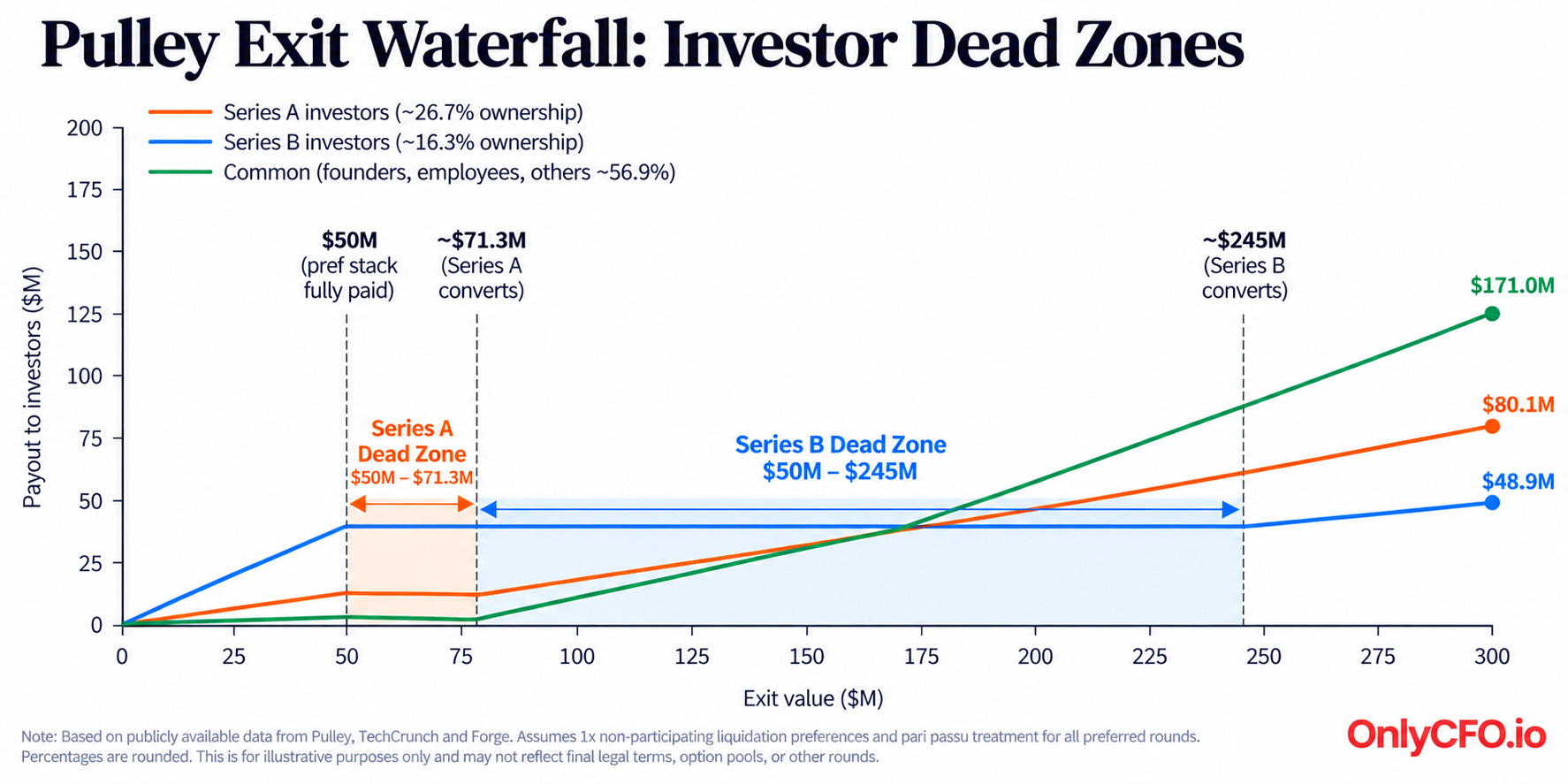
Not saying it was the case with Pulley, but folks should understand the “Dead Zones” in the exit waterfall where a VC’s payout doesn’t change as the valuation increases (even though others do benefit).
Pulley raised a total of $50M with the most recent round (Series B) of $40M at a $245M post-money valuation. For Founders Fund, there was no difference in their payout between a $50M acquisition and a $245M acquisition. Even the Series A wouldn’t see any benefit until it reached ~$71M. It sounds very unlikely that Pulley could have been acquired for more than $70M so investors were not financially motivated to optimize the deal for a few million dollars more. They are motivated by deal speed and making sure the deal gets done though…
Final Thoughts
There are a lot of founders getting tired right now. They raised and built in a pre-AI world. Things are a lot harder today and many want to build something else that they are excited about for a post-AI world.
I get it…building and selling cap table software probably feels A LOT different today than a few years ago.
On the other side though, this can be a big opportunity for many companies who are in a strong financial position. There are tons of Pulleys out there who are ready to move on.
Footnotes:
Talk to my friends at Brex for a true AI-native spend platform
Subscribe and share with your friends
*Disclaimer: Informational and educational purposes only. Does not constitute investment advice. Certain ARR, cash-balance, earn-out and transaction-value figures discussed above are estimates or third-party claims and have not been independently confirmed.