
Brought to you by... Numeral

Want to screw up a fundraising round, an acquisition, or an IPO?
Then don’t pay attention to indirect tax (sales tax, VAT, and GST). You will create a big liability that is hard to quantify without a ton of work. Ask me how I know…
It’s why one of the first things I do when starting a new job is 1) make sure we have good sales tax software and 2) a recent sales tax analysis has been performed.
With Numeral, you get both of these. That’s why Supabase, Character AI, and more than 3,000+ businesses have turned to Numeral’s global solution.
Joining [Hot Company] as an Advisor
I just signed my agreement to be an advisor at a pre-seed startup. I don’t normally take advisor roles because I stay pretty busy with my normal job, writing this newsletter, and spending time with my family (including my kids’ never-ending sporting events). But I made an exception for this company….
Will it make me rich? Or will it take a lot of my time with no treasure chest at the end of the rainbow?
Statistically, it is definitely the latter…
It’s the same as early-stage investing, but a much more concentrated bet since there is no way I can be an advisor to the same number of companies that early-stage investors bet on. Early-stage investing only works because of the power law…1-2 investments will return the entire fund and make up for the other 20+ losers that go to zero. This is why early-stage VC funds invest in ~20-30 companies.
So why be an advisor?
There are lots of good reasons to be an advisor:
Smart team that you are excited to work with (most important)
They are building in an interesting space
Opportunity to learn new things
Build your network and connect with new people
If they are successful, could set the stage for you joining full-time
Unlike a job where money is a driving factor, don’t become an advisor unless you will learn and enjoy it. And maaaybe (if you are lucky) you might make some money.
The company I am advising checks all of these boxes for me, but I also believe it has the potential to be a massive success (incredible founders, tackling a big problem, they have deep expertise with the problem, and they have me as an advisor :).
Since advisor stuff is top-of-mind…there are a few topics I want to cover:
How much are advisors paid?
Is the dilution from advisors worth it? What do advisors even do?
How to structure an advisor agreement?
How do I become an advisor?
Bonus content: Did a Cursor advisor make $384M in ~4 years?
Advisor Compensation & Dilution ROI
Hard Truth: 90%+ of advisors are not worth the dilution. Yes, I made up this stat but it’s definitely true based on my experience.
They take too much equity and provide little value. Common reasons include:
Failure to set proper scope/expectations
Misaligned compensation for scope
Wrong person and/or experience
The people and expertise you need can change quickly at early-stage companies.
Why don’t you just fire them as soon as you realize they aren’t providing value? They are on a vesting schedule so you can stop the dilution bleeding, right?
You would not be wrong for asking that question…but it rarely actually happens. I’ll explain why further below.
How much do advisors get paid?
Let’s start with the difference between an advisor and a consultant because that can create confusion:
Advisor:
Compensation: Usually equity.
Role: Review decks, discuss strategy, provide product feedback, make intros, etc. Advisors provide their perspective and feedback on work that is already created.
Consultant:
Compensation: Typically cash. But could be equity for cash-strapped startups.
Role: Produce work. Consultants create decks, perform analysis, write code, etc.
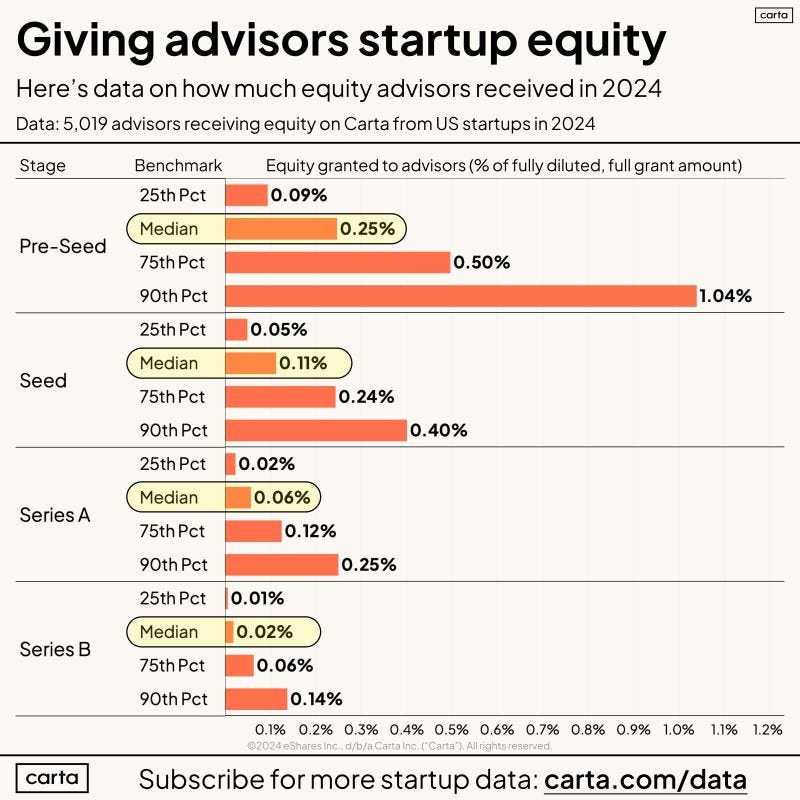
Carta has great benchmarks by fundraising stage that generally line up with my experience. But like most benchmarks…the “right” amount of equity for an advisor can vary a lot.
Equity percentages fall (just like employee equity packages) as a company scales because there is less risk and the equity is theoretically worth more. But also, as a company scales, the need for advisors decreases because a lot of the gaps that advisors fill are replaced by full-time hires.
So what is OnlyCFO’s compensation?
I obviously should charge a high premium for my time :), but like I said…you can’t just assume 1% ownership (90th percentile per Carta benchmarks) because I said it’s a pre-seed company.
Why? Two main reasons:
How hot is the company? Not every pre-seed company is the same. Some have zero traction and unproven founders while others have real traction and a proven team. We have seen examples of this with some AI companies that go and raise $100M+ pre-seed rounds at $1B+ valuations…
What are the hours and scope? Unlike full-time employees where there is clear scope/expectations (40+ hours per week), the scope and time commitment can vary wildly for advisors. This makes equity benchmarks less insightful for advisors compared to full-time employees.
Advisor Agreements & Scoping
1. What Do Advisors Do?
There are a few reasons a company may hire an advisor. Some reasons are better than others…Below are the main ones:
GTM advisors - People who have a large distribution in a company’s target audience, deep connections at important prospects, or someone who is an experienced GTM leader for your market/ICP.
Technical advisors: Help guide, shape, and recruit for the product. These folks often have good connections at partners or prospects.
Industry experts - Deep industry expertise to help guide the company
Network - Help recruit, intros to prospects, or intros to investors
Credibility boost: Looks cool to have a big, credible name as an advisor. Founders won’t admit that they do this, but they do. But this might be the worst reason to hire an advisor. They require the most equity and usually do very little. You might be surprised how little VCs actually care about your list of advisors…
2. Set Expectations and Scope
Often the problem is that companies bring on an advisor without any real expectations or scope of what that advisor will do.
What are you hiring an advisor for?
What are the expectations?
# of calls per month
Some kind of regular output
Providing regular network introductions
💡Tip - I don’t like setting specific hour requirements or being too descriptive of exactly what the advisors will do. They are not consultants paid by the hour. But you can/should be clear about general expectations from the relationship.
What does success look like? What are the targets?
Without proper scoping, you won’t really know how much equity they should be given. Someone doing weekly calls or providing important prospect connections should probably get more equity than someone just doing monthly calls (all else being equal).
3. Defining Advisor Equity Terms
Equity compensation for advisors looks different from equity compensation for employees. Advisors get much more favorable terms:
Vesting Period: Typically vests over 2 years (or shorter). Advisors are most helpful until the next level of scale is reached when more full-time folks are hired to fill gaps so a shorter vesting period than employees typically have (e.g., four years) usually makes sense.
Vesting Cliff: Unlike employees who almost always have a 1-year cliff, advisors typically have no cliff or it’s very short (like 3 months) because equity is their only form of compensation.
Early Exercise Provision: Most advisor grants have an early exercise provision since it can be very beneficial to exercise early and the price is usually very small at early company stages (where most advisors are hired).
Equity Type: Typically stock options (NSOs since they aren’t employees), but RSAs are sometimes done when the company is very early.
Single Trigger Acceleration: Advisor shares are often accelerated in a change of control event (single trigger). Company execs often get double trigger acceleration clauses - there is both 1) a change of control and 2) they are fired (without cause). Most other employees (non-execs) rarely get either of these acceleration triggers.
Post-Termination Exercise Period (PTEP): Often this is 90 days just like employees, but with one important caveat. Advisors are rarely actually terminated, even if they stop providing work, so their PTEP never actually starts so they effectively have until the grant expires (10 years).
The advisor is fully vested anyway so the company lets them stay active and the PTEP clock never starts
CEO forgets about actually terminating them
Company doesn’t want to create conflict
Founder is embarrassed to terminate an advisor when they discover they aren’t a fit. Most advisors are well-connected so it’s less friction to just stop talking to them. This is why you want to be REALLY sure you want the advisor first.
Advisors are like barnacles. They grow on your company and every once in a while they need to be scraped off. — Dave Kellogg
When I first got the keys to the cap table I was shocked how many “barnacles” we had. Still vesting, but not doing anything. Monthly/weekly calls stopped a long time ago.
Be generous with advisors, but set vesting terms and equity size relative to the time period you think you will need the advisor. Think carefully before hiring any advisors because terminating them won’t be easy.
How do I become an advisor?
Start with these two questions:
“Why would a company want you as an advisor and spend their precious equity to compensate you?”
“What can you solve as an advisor (working a few hours a month) that the current team can’t figure out by themselves (especially with AI)?”
A deep network is the most common reason I see for hiring advisors (especially today). Product expertise can also be very important when the early team doesn’t have deep product knowledge in some part of the product (can massively improve roadmap and building the right thing).
A startup isn’t typically searching LinkedIn or opening up a recruiting search to find an advisor. Advisors come through the network of the founder, exec team, VCs/board, etc.
Go network…pro tip: being great at what you do makes it easy to build a strong network
Bonus Content: Did a Cursor Advisor Make $384M?
SpaceX finalized its $60B acquisition of Cursor this month, a 4-year-old company.
If you were lucky enough to get an advisor role with Cursor by the pre-seed round, you might be taking home ~$384M for maybe a few hours of work a month for a few years…
Here is my quick math:
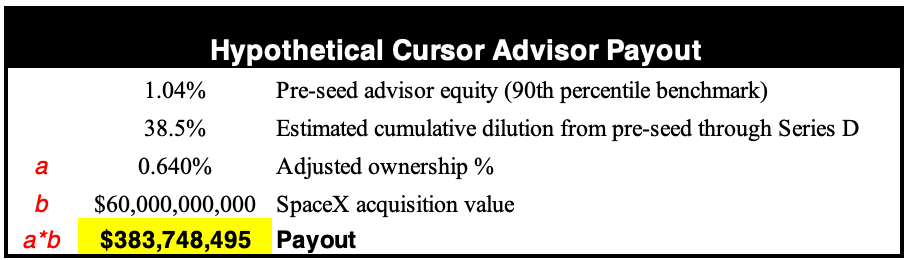
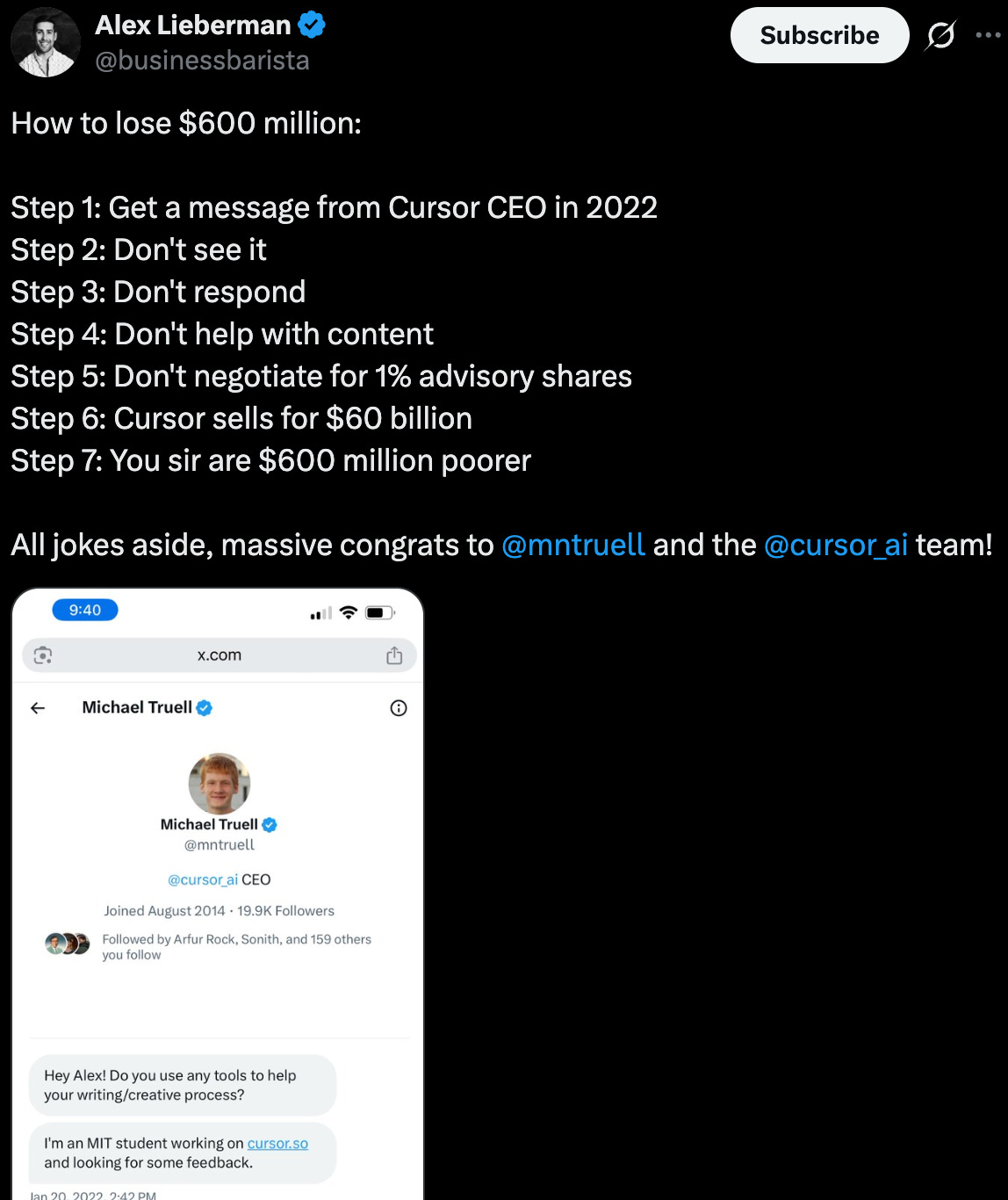
After the $60B acquisition was announced, several people posted DMs from Cursor’s CEO, who was asking for advice while he started Cursor as an MIT student…Alex’s $600M missed advisor payday is inflated because it doesn’t take into account fundraising dilution, and tbh, the 1% is probably high. But could he have gotten 0.5% and made ~$180M? Maybe…
There are VERY very few Cursor-level outcomes in the world.
Final Thoughts
If you are going to hire advisors, then make sure you carefully scope it, set expectations, have a good agreement, and provide an appropriate amount of equity based on all of this.
I look forward to becoming filthy rich from my advisor shares, but in the meantime I am excited to just have some fun and learn with great founders. I will be sharing some of the journey from this company in future posts (and will eventually name them).
Advisors (and employees) dreaming about Cursor-level outcomes…

Footnotes:
Get a Free Sales Tax Analysis - talk to my friends (and sponsor) Numeral so you don’t screw up fundraising or an acquisition because of sales tax.
Here is the FAST agreement for advisors. A lot of companies use this agreement and they just released version 3 last month that has some good updates.
*Disclosure: Nothing discussed in this post is financial, tax, or investment advice.
Great read, and landed at a perfect time for me as I'm helping a couple startups as an advisor/consultant at the moment.
The parts about setting expectations is especially on the nose as one startup has another advisor in the fold that is insightful but isnt responsive and inconsistent with follow-up. It's not working. I'm guilty of overthinking things but it's as simple as laying down simple expectations to make sure it's going to work for both parties.
Thank you! Through pure serendipity, I met someone who might be an outstanding advisor last week...all because I posted a comment in a Zoom chat! Not ready to go there but your article laid out a clear blueprint.