
Brought to you by…Remote

I’ve done a lot of international hiring, and it gets complicated fast…
Do we hire as contractors, employer of record (EOR), or set up an entity?
How do we handle compliance risk and all the potential tax issues?
What is this actually going to cost us? This year and in the future
Remote simplifies global hiring with the experts and solutions you need. Fewer surprises, better spend visibility, and less risk.
The Cognition vs Factory Battle
Last week I wrote about the Legal AI drama between Harvey and Legora, but that is nothing compared to the latest Twitter/X fight amongst competitors…
A fight on Twitter between Factory ($5B valuation) and Cognition ($48B valuation) started after Factory’s CEO publicly said he fired Chris Degnan for unethical conduct.

It was a long tweet, but he definitely had an excellent hook :)
Chris spent 11 years as Snowflake’s top sales leader (eventually with the CRO title). He stepped down as Snowflake’s CRO in March 2025 and has been advising a bunch of companies since. He has been a GTM advisor and board observer at Factory, a major competitor to Cognition, for over a year.
So what was Chris’ alleged “unethical conduct”?
Factory CEO Matan Grinberg said the following:
For weeks, while he sat in our board meetings and advised our leadership team, he was also confiding with executives of our largest competitor.
The allegation was that Chris was advising Factory on strategic decisions, attending board discussions, accessing confidential board materials, etc., while also talking with their largest competitor about a CRO role. And that doing both creates an obvious conflict of interest and breach of trust.
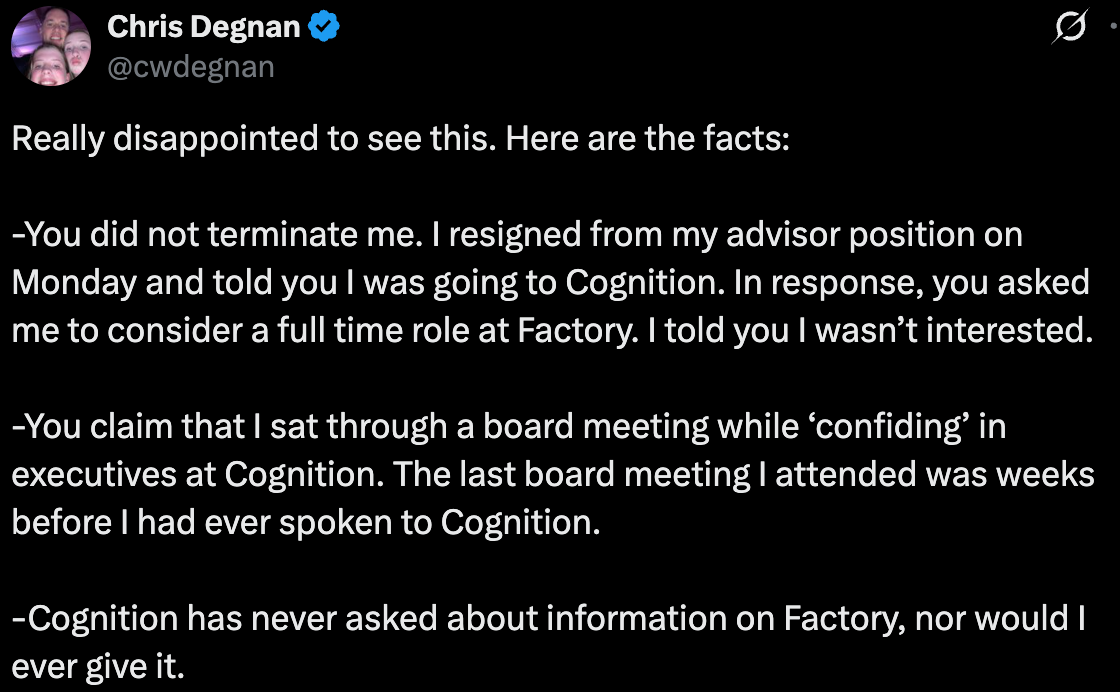
Chris denies any wrongdoing
Chris responded to Matan with the below. Implying that there was no wrongdoing.
Conflicts of Interest
People go to competitors all the time. What’s the big deal?
It’s true, especially with sales reps. They are interviewing while still employed at a competitor. It’s pretty common. You hate to see your people go to competitors, but it is what it is.
The problem in this situation is the position Chris was in. He wasn’t just an employee. He was a GTM Advisor and Board Observer so he had access to confidential and strategic information. The argument is that because of those positions, Chris had a “fiduciary duty” to Factory that should have stopped him from having any conversations with Cognition while in those roles (more below on why the “fiduciary” part isn’t exactly true).
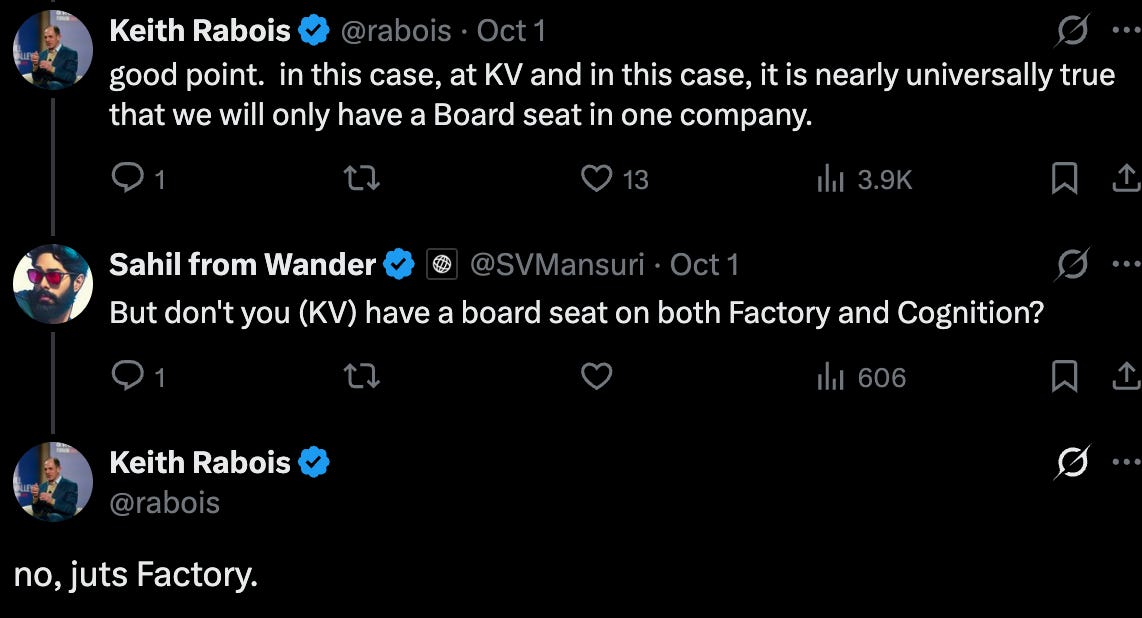
Keith Rabois (GP at Khosla Ventures) is an investor in Factory and he said the following:

I don’t disagree with Keith and it sounds like Chris may not disagree either
Chris refuted this implication by saying in his tweet that the last Factory board meeting he attended was weeks before the Cognition discussions started. But Factory also claims he had access to confidential board-level information and participated in strategic conversations while interviewing with Cognition, which Factory also argues was unethical.
Board Member vs Board Observer
Chris was a “board observer”, not a board member. The difference is important.
Like the name states, board observers mainly just “observe”.
They don’t get a vote in board matters (like M&A approval)
Aren’t technically held to “fiduciary duty” standards like board members
Have limited liability exposure (because of the above 2 points)
Don’t sit on committees (like audit or compensation committees)
My general rule for observers in board meetings - “Shouldn’t speak unless spoken to”. Potential exception is if they are an expert on a topic you are discussing.
Observers often just call into the meeting if it’s in-person
Observers are not “fiduciaries” with the same responsibilities as directors, but that doesn’t eliminate ethical responsibilities or an observer’s contractual confidentiality obligations.
There are typically two board meeting sessions:
General: Directors, observers, and often most of the exec team.
Closed: Just the directors, which includes the CEO. Sometimes the CFO for part of it (approval of financial plan, option grants, etc)
Optional: Board of Directors (excluded CEO): And then sometimes the board will kick out the CEO after the closed session so they can talk openly about management and how things are going.
Chris would likely have only been attending the open session because of his non-director status so he would have had access to most but potentially not all board materials and conversations.
What’s The Point of a Board Observer?
If they don’t get to vote and aren’t supposed to really say anything, what’s the point of a board observer?
It’s for people who don’t make the cut of being a board member (or they don’t want a director seat), but they have some leverage to negotiate an observer seat. Board member seats are typically reserved for:
Founder/s of the company
VCs leading fundraising rounds
Independent directors (usually only appointed after the company is larger)
Common ways someone gets a board observer seat:
Strategic investor: Often they don’t want a board seat because of potential conflict of interest problems that may arise in the future and/or to reduce liability exposure from being a Director
Lead VC: Negotiates observer rights when it doesn’t receive a voting board seat. Not every lead VC will get a board seat (especially when there are many rounds of financing)
Lenders: Large lenders may negotiate an observer seat in financing agreements
2nd person from lead investor: Sometimes a more junior person from a big investor will get a board observer seat so they can attend and learn
In our Factory vs Cognition story, Chris was a partner at RPT Partners, which invested in Factory so he likely got his observer seat from that, but Chris was also a GTM advisor for Factory.
VC Conflicts of Interest
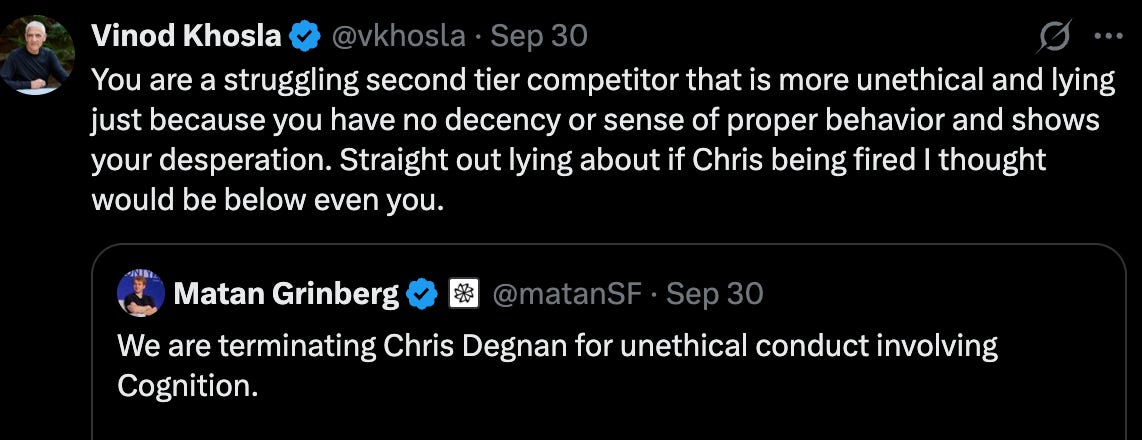
Both Factory and Cognition had VCs coming to their defense. Two of the most prominent voices (Keith Rabois defending Factory and Vinod Khosla defending Cognition) both work for the same VC firm - Khosla Ventures.
Doesn’t a VC firm that invests in competing companies create a conflict of interest?
Yes, obviously investing in direct competitors can create conflicts of interest. The competing companies would be presented in portfolio review meetings, everyone could see the latest valuations, potential new fundraising participation, etc.
It can be really hard to be a good fiduciary if your VC firm invested in two very competitive companies like Cognition and Factory.
Keith said Khosla Ventures’ general practice is to only take a board seat at one company if they are invested in direct competitors. And in this case that is Factory.
This reduces some conflict, but still doesn’t eliminate it. The information sharing/visibility within the firm is still there for most VC firms. If the VC firm only has one board seat between the competing investments, that potentially means that the company with a director gets an unfair advantage from that director’s access to competitor intel that may circulate at the firm. I actually don’t think Keith or Vinod would purposely cross that line, but it’s hard to completely ignore what you hear about your biggest competitor when you hear/see stuff based on your VC firm’s relationship.
Many VCs have this problem. Investing in direct competitors on purpose is more rare, but many early VC portfolio companies pivot or expand to be highly competitive with other portfolio companies. When this happens, sometimes the appropriate answer is for one of the directors to step down.
Did Chris or the VCs act unethically?
If Chris was a “board member” (which includes fiduciary duties) and he was attending meetings and strategic discussions while actively interviewing at Cognition, it probably would be unethical.
But Chris was a “board observer” and he says he didn’t attend any board meetings when discussions with Cognition started and that he would never share confidential information. But the accusation is that merely attending important strategic meetings and advising the company while planning on going to a competitor is unethical.
I don’t think Chris was intentionally attempting some corporate espionage or to act unethically. Just like I don’t think Keith or Vinod are intentionally doing anything nefarious when they are both investing in competitors while at the same VC firm. But good intentions don’t create an information firewall…
Whether intentional or not, having confidential strategic information about a competitor is going to influence your decisions. Although, in theory, it’s easier for VCs in this situation to control the conflict of interest since they don’t have to be involved in strategic decision making at both companies. CROs can’t really do that because part of their job is being strategic.
The Front Page Newspaper Test
Neither company is coming out a winner from this Twitter fight.
But it is a good reminder that everything we say or do could be made public, which reminds me of the old “front-page newspaper” ethics test:
Would you be comfortable with your decision if it was printed on the front page of the newspaper? If your colleagues, your board, your mom, etc. all knew about it?
Just replace newspaper with Twitter/X in this situation since that seems to be where all this stuff surfaces now…
I don’t have all the facts and details of this situation so I am not going to try to say who is wrong or who is right. That’s not the point of this article. But if you find yourself with a potential conflict of interest, the most important thing to do is to disclose it early and then figure out how to handle it.
Footnotes:
Remote can help you hire globally while remaining compliant and providing transparent pricing (today’s sponsor)
Subscribe and share with your friends
*Disclaimer: Informational and educational purposes only. Nothing here is investment, legal, or tax advice.