
Today’s Sponsor: Deel

Global payroll costs extend far beyond salaries. This guide breaks down international payroll expenses, compliance costs, and hidden fees so you can forecast accurately, reduce risk, and improve cost efficiency as you scale. Built for finance leaders managing multi-country operations.
Why Are Software Valuations Tanking?
Before figuring out how software companies survive in a world of AI, it’s important to understand why the software market is tanking right now.
Investors are scared. AI continues to create uncertainty.
“Is AI going to eat SaaS?”
“Will gross margins get crushed?”
“Can legacy SaaS make the AI transition and innovate fast enough?”
Based on tanking SaaS stocks and sentiment on social media, you might conclude that the entire industry is going to zero.
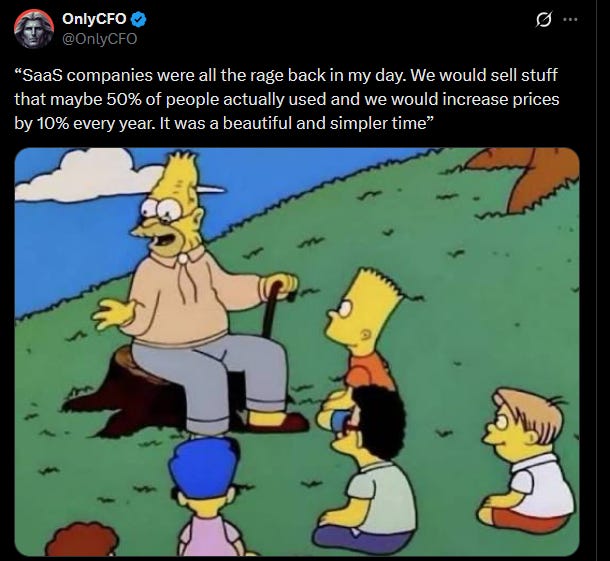
Me in 2027 explaining the SaaS business model to college students👇
So why are all software valuations getting crushed? Where is the bottom?
From a pure numbers perspective, the discounted cash flow model is theoretically a perfect way to value a company:
Future cash flows (higher = better)
WACC (lower = better)
Terminal value (higher = better)
The problem SaaS companies are facing is that the uncertainty caused by AI is 1) driving up the WACC and 2) destroying the terminal value. Both are very bad for valuations.
Terminal values: SaaS companies have relied on huge terminal values to justify premium valuations. I have reviewed a lot of DCFs…the terminal value is often ~80%+ of the total valuation (remaining being cash flows from the period before the terminal value calculation). We previously treated SaaS like a bond that would spit off endless FCF for decades. Uncertainty is destroying that belief.
So is SaaS dead?
Nope…
Yes, many will probably die. And to be honest, boards/VCs should accelerate the death of many private legacy SaaS companies so people can move on from those zombie companies. And I think we have some public SaaS companies that will die as well because they are too slow to innovate with AI despite their massive head start in scale.
But many SaaS companies will adapt and be just fine.
The SaaS Survival Guide
All companies that go out of business do so for the same reason – they run out of money. -Don Valentine
What causes a company to run out of money?
They never find or don’t maintain product-market fit (PMF)
They fail to maintain strong moats
They don’t properly manage expenses and cash runway
There is going to be a massive graveyard of SaaS companies over the next 12 months because they failed at one (or more) of the above things. But…there is an opportunity for “SaaS” companies to adapt and still win. Many won’t though.
The rest of this post is my thoughts on what SaaS companies (not AI-native) should be doing right now.
1. Fix The Team Death Spiral
There is a people problem brewing at SaaS companies. SaaS sentiment is terrible and valuations are tanking.
Public company employee RSUs have lost significant value and a lot of private company stock options are underwater (even if that isn’t reflected yet in your 409A that you do once per year).
Your best people (who can actually find jobs) are going to leave to join hot AI companies. While your mediocre/poor employees who can’t find another job are staying put. This creates a company-wide death spiral. Everything will slow down and efficiency will plummet.
Priority #1 is to retain your top performers. Here are a few suggestions:
Fix broken equity compensation packages:
Update 409As (and be honest with them): Way too many 409A valuations are fiction derived from an outrageous prior fundraising valuation and only incrementally adjusted. Might be time to refresh it now…
Reprice stock options. If your stock has dropped >25% then reprice stock options. Most boards will quickly approve it.
Give more equity: Give your best people more options or RSUs. A leaner team (see below) may open up more equity to grant.
Layoffs. Sorry, but more are probably necessary. Your AI-native competitors have ~50% of your headcount and are shipping faster. Make the math work so you can treat your best people really well. Not only are you probably inefficient, but too many low performers will make high performers leave.
Build cool stuff and innovate. Raise the bar on product expectations. People get excited about building innovative, cool AI stuff. If your roadmap has halted because of cost cutting then good folks will leave, which will…slow things down even more. Death spiral.
2. Roadmap Expansion (Not Just Cost Cutting)
Many SaaS companies are dying by a thousand budget cuts. Budget cuts won’t save you. It will just delay your fate. Being efficient is important (see next point), but it’s not enough.
If our engineers can 10x-100x their output with AI, then what does that mean?
There are two different approaches companies are taking:
Significantly cut costs (fewer engineers) but same product roadmap
Save some costs but materially expand the product roadmap
The right answer is #2.
Most larger, public companies are taking path #1. LOTS of private companies are doing the same…they are beholden to their existing 2020 SaaS product. Whatever your product roadmap, it probably isn’t aggressive or innovative enough.
Multi-product companies have a competitive advantage in the world of AI. If you don’t expand your roadmap, your competitors will. And they will crush you. They will add much more value with AI by expanding surface area.
3. Get Fit (Efficient). Now.
AI is deflationary for software. AI also causes customer expectations to rise. Folks want more for less. You will need to figure out how to be more competitive on pricing and that likely means shrinking gross margins.
There are two ways to make the new gross margin math work:
Build strong moats (next section) so you have more pricing power
Be more efficient elsewhere (OpEx)
You should work on both now. The historically high gross margins have hidden a lot of inefficiency sins. And lots of those sins are going to reveal themselves as gross margins fall. Fix those sins now.
Plus, you die by running out of cash. Don’t waste your limited oxygen.
💡Speaking of improving efficiency…
Check out Deel’s International Payroll Costs Guide that breaks down country-specific costs. If you plan on offshoring to get more efficient then you should check this out.
4. Maintaining and Building Moats
Jensen Huang (CEO of NVIDIA) recently gave a potential bull-case for software:
Software is a tool. The notion that AI is somehow going to replace software companies is the most illogical thing in the world and time will prove itself. If you were the ultimate AI (artificial general robotics), would you use a hammer or invent a new hammer? You would just use one.
The answer is obviously to just use the existing tools. Not reinvent them.
—Jensen Huang (CEO of NVIDIA) February 2, 2026
I agree with Jensen, but I also think some folks are taking Jensen’s statements as more bullish than they should. Sure, AI will likely use existing tools. But….only if the cost and ROI analysis makes sense.
What does this mean?
Pricing pressure. Those juicy 75%+ SaaS gross margins are going to get squeezed hard in the coming years (months).
Lots of people are creating slightly different hammers, but they all do the same basic thing…hit nails. Similarly, if software is commoditized and it all does basically the same thing, pricing pressure is coming if you don’t have some very unique moat.
How do you protect margins and revenue durability?
Continually build and expand your moats. AI will magnify the difference between companies with strong moats and everyone else.
Below are the primary moats in 2026 that you should be focusing on:
Distribution
Trust/Brand
Proprietary data
Scale
Network effects
5. Re-Imagine The Solution From AI Perspective
Incremental AI changes aren’t the answer. Your startup competitors are re-imagining the solution from an AI-first perspective while you are thinking about small AI features to just throw on top of your old-school SaaS product.
SaaS companies have SaaS tech debt. Trying to unwind the mess and creating an AI-native first application will be really hard.
Sunk Cost: money, time, or effort you’ve already spent that can’t be recovered, no matter what you do next
Not saying it’s always the right answer, but scrapping what you previously did and building new is increasingly a better option than incremental changes.
Bonus #6 - Throw Away Benchmarks
Stop basing your decisions on financial benchmarks. Seriously. Stop.
We are in a massive technology shift and you think using benchmarks of what companies achieved last year based on their decisions made 2 years ago should guide your company in 2026?
Pro Tip: While I like looking at benchmarks, you don’t actually need them to create a successful business. Sometimes they do more harm than good.
Final Thoughts
AI is shaking up the software world and that has created broad uncertainty.
Right now it seems like every software company is getting punished equally because there are too many unanswered questions about long-term outcomes.
So which companies will survive?
Not all SaaS is the same. Some will be disrupted less by AI (product/market luck)
Not everyone will adapt. Hopefully, doing some of the things I mentioned above will help you survive. (execution problem)
Good luck my SaaSy friends and I hope you don’t die!
Footnotes:
Want to know the cost of offshoring? Check out this International Payroll Guide that breaks down all the costs you should be considering.
Share this post with your software friends so they can survive, but hide it from your competitors so they don’t :)
Not sure they need a full rewrite but they do need to find fast growth, whether it's use cases driven by agents over their proprietary data or something else. This is just a skill that legacy SaaS companies seem to have lost, and they're being shown up by these AI companies growing 100% YoY. And they may have to move to outcome and task-based pricing and put some skin in the game, another skill that doesn't come naturally!
Your point about terminal values getting destroyed by AI uncertainty is the thing nobody else is saying clearly enough. I just wrote up the Klarna case, the company that was supposed to prove AI kills SaaS, and they literally replaced Workday with Deel. They swapped one per-seat model for another and used AI as glue.