
Brought to you by…Tropic

Forecasting AI spend for 2027 is hard. I know I’m struggling with it.…Things are changing every couple of weeks.
My friends at Tropic help their customers manage and forecast AI spend every day. Check out their on-demand webinar (Forecasting AI Spend Won’t Sit Still) to hear their CEO and Head of Procurement share how CFOs are budgeting for and managing AI spend.
Bad Procurement is VERY Costly
Speed of execution (combined with the right strategy) matters more than ever. AI has enabled everyone to move faster so if you don’t move fast, your competitors are going to eat your lunch…
The software and tools your employees use are one of the critical things to get right to gain an advantage over your competitors. Not just to save money (although I love that), but to move faster.
I asked the smartest procurement guy I know, Michael Shields, to discuss how he is managing renewals in the age of AI. Love his insights here and you should definitely forward it to everyone at your company who touches procurement (CFO, FP&A, Controller, broader exec team, etc)
Stop Using The Term “Renewal”
A few years ago I was working late in the office. My boss (CFO) walked past on his way out. “EOQ volume pretty high?” “yeah”, I replied. “We are working on over 40 renewals this quarter.”
Back then, we prided ourselves on engaging early. As a team, we met twice a month to review contracts that were expiring. We took actions to meet with stakeholders to determine our sourcing strategy.
Did we want to kick off an RFP?
What did utilization look like?
How happy were our stakeholders with the provider?
Sure we worked on “new spend” requests as well but as a procurement team, the majority of our work was managing renewals. And our goal was to engage at least 90 days out….giving us plenty of time to casually look at other sources, but then in most scenarios, negotiate an optimal contract with the incumbent (even if a few went to the last minute to secure optimal pricing).
At the time, this worked great. Engaging 90 days out vs 30 days out led to meaningful results.
The problem is that this model doesn’t work in this ‘exciting’ era of AI.
Renewal Rates Are Way Too High
My anonymous CFO friend wrote an article last month called I’m Churning. It was one of those things where I read it and I suddenly felt very validated.
Do I believe we should all send emails to our supply base with cancellation notices?
No.
Did OnlyCFO showcase a bunch of compelling reasons why our processes need to be adjusted?
Absolutely.
OnlyCFO listed 10 reasons to churn. My top 3 from that list were:
Exponential growth in competition
Decline in switching costs
AI has changed what I value.
Perhaps unsurprisingly, software renewal rates are finally coming down. Median gross revenue retention has slid from 90% in 2022 to 84% today, and 4 of those points came in the last year alone (Source: Benchmarkit). Even the top quartile fell from 95% to 91%. This seems to be proof that buyers are waking up.
Sort of.
Folks, I’m here to tell you that 84% is still waaaaaay too high.
This isn’t meant to be a hot take. Nor am I advocating for the downfall of SaaS. Before you break out the pitchforks, hear me out.
In 2008, a much younger Michael Shields was sitting in his first ever procurement class at BYU. The professor had a slide up with Martin Christopher’s famous idea, “Companies don’t compete against companies. Supply chains compete against supply chains.”
Then it was inspiring. Now I basically hold that idea as scripture. Here’s why:
Just like good employees can be a competitive differentiator for the companies they work for, an optimized supply base (delivering strong ROI) can be a competitive advantage for companies. That’s the whole point of spending money to begin with. Companies spend money to achieve business objectives. Said another way, if you can spend money better than your competitors, you have a leg up.
However, the assumption that the supplier that you chose 3 years ago (or 2 years ago, or even 12 months ago) is still the best one is very dangerous given how much has changed in such a short period of time.
I’ll add to / reinforce OnlyCFO’s list:
The competitive landscape has changed. Legit (and not so legit) competitors have popped up. Some of the newcomers are having quite a bit of success. Disruption is real - even for sticky solutions like ERPs.
The product you’ve been using has likely evolved significantly (and if it hasn’t, that might be another problem altogether). Some of these changes mean broader capabilities. Instead of 2 or 3 providers, you might be able to consolidate to one.
Needs have likely changed. Buyers might think they need the same thing but if the problem has shifted, then the needs have shifted and the decision criteria has shifted.
The pricing has likely changed. And I’m not just implying a 5% uplift either. We’re talking big changes (especially as everyone races to move to consumption models). This isn’t always a bad thing but needs to be factored in.
Buyer expectations have changed. I’m not saying our expectations are always based in sound reason (because it’s often not) but AI has made it so we want more…. for less.
Build vs buy is center stage. Build doesn’t always make sense (in fact, it often doesn’t). But it’s worth considering. More on that in a moment.
I could go on but if you still need more proof, listen to this stat I heard at Gartner’s procurement conference (September 2026):
“79% of buyers regret their technology purchase within the first year.”
That’s not just a mic drop moment. That stat is damning.
Here is what it means:
We are getting purchases wrong the (vast) majority of the time.
And remember that competitive advantage I talked about earlier (optimizing the supply base)? If we are getting our purchase decisions wrong 79% of the time and our competitors are doing better than we are, they have a massive advantage.
A Few Recommendations
The first step is the easiest.
STEP 1: STOP USING THE TERM “RENEWALS”
Instead of “I’m working on 40 renewals this quarter.”
Try, “I have 40 expiring contracts this quarter.”
This isn’t just replacing terminology. It’s a mindset shift. The word ‘renewal’, by definition, implies that you will renew. And while there still is a chance you’ll renew (more on that in a moment), it should be an option, not the default. Especially in this world of crazy change.
Expiring contracts, on the other hand, means your contract is ending and you need to figure out the best course of action.
STEP 2: DON’T JUST TRACK CONTRACT END DATES
Admittedly this is a bit of a process change. It certainly was for me.
Prior to the world of AI, the bottleneck was limited data. Even if you had data, you might not be able to leverage it all. It wasn’t actionable because of constraints such as time and processing.
AI has blown all that up. Now the limiting factor is accessing the right data.
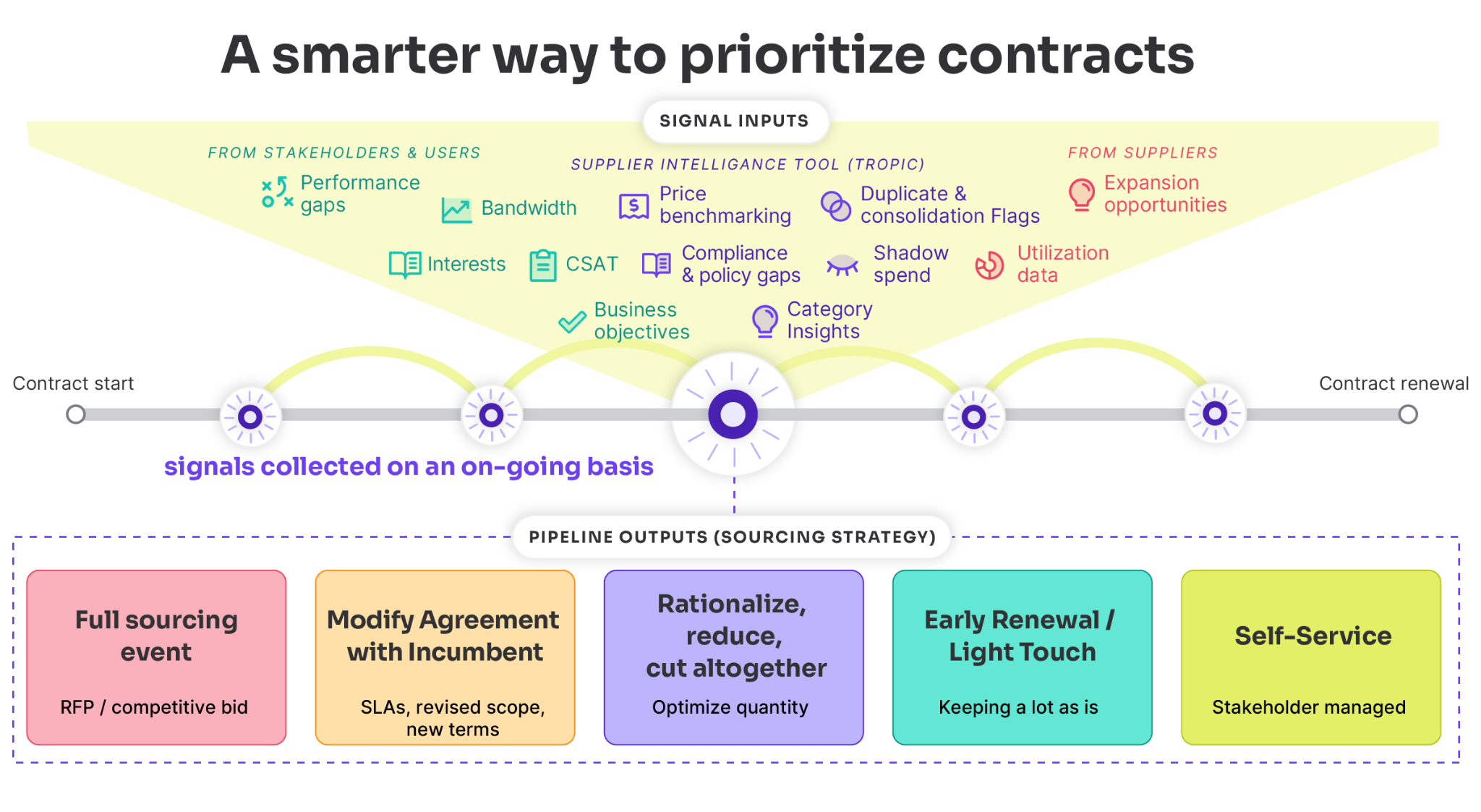
Instead of reviewing contract end dates, I have my system set up (in my case Tropic) where signals are pushed to me. The graphic below illustrates but essentially I’m hooked up to internal systems for relevant data, as well as other data relevant to my suppliers (and the associated landscape). This is what drives my actions.
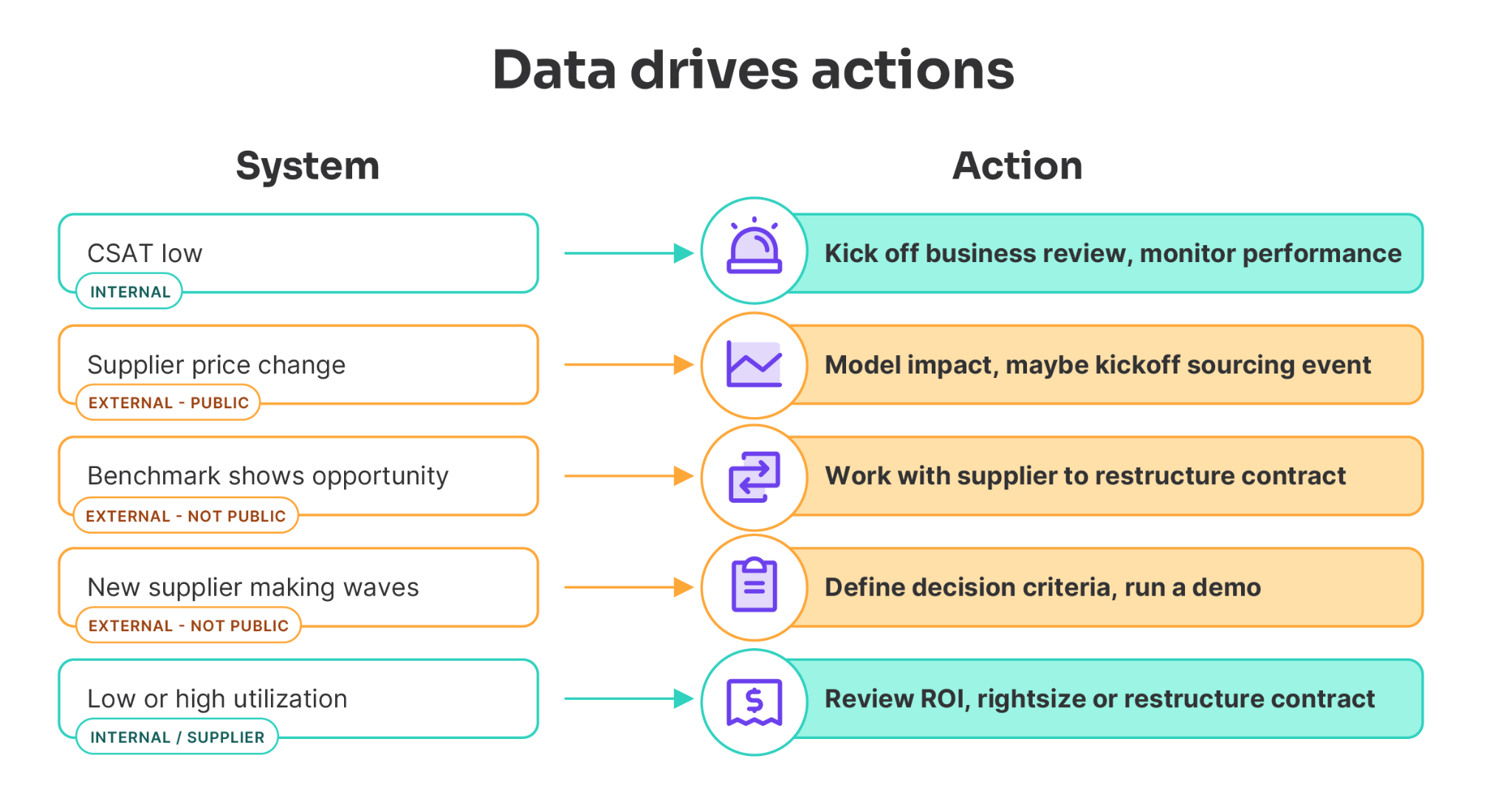
These are all signals that can be actioned regardless of when the contract is expiring. That being said, while many of these signals are being pushed to me, I love pulling relevant data at strategic points. A good example would be at the midpoint of the contract. This is a great time to send off a pulse survey to collect CSAT, do a quick survey of the competitive space, and pull a quick benchmark.
STEP 3: CHALLENGE ASSUMPTIONS AND BIAS
I imagine that at this point in the article, I’ve offended a host of CS leaders and Account management leaders (the ones who typically own the renewals). Perhaps this is where I redeem myself a bit.
Remember that stat from earlier? The one where companies are regretting the vast majority of their purchasing decisions?
(Who am I kidding, of course you remember, it’s probably haunting you like it’s haunted me for the past few weeks)
Here are common mistakes I’m seeing:
Assuming the existing supply base is optimized
We’ve now discussed this at length. “If it ain’t broke, don’t fix it” might mean you are using your BlackBerry when others have the latest smartphones (did I just date myself?)
Assuming the existing supplier is outdated or the wrong supplier
The opposite mistake is just as expensive. Every week there’s a new AI-native tool promising to replace your incumbent, and it’s easy to assume newer means better. Sometimes it is. And while some switching costs have come down (like switching between tools), the switching costs associated with a bad decision are as high as ever. Think of the lost productivity when you switch and then 6 months later you realize you made a mistake (and then perhaps boomerang back). Six months of unoptimized usage… possibly at scale.
True, some companies are getting displaced. But plenty of companies - those ones we’ve been using for years - are turning the corner, investing in their product, and maintaining their status as a market leader. So the answer might be a better contract for the proven incumbent rather than a new vendor.
A related note, will some of these hot start ups last or burn out? Not gonna lie, the news about Pulley (Carta alternative) shook me. I’ve seen a few demos and even talked to their customers. They seemed like a VERY viable alternative. Everything about them seemed legit. And it was nice to have a strong competitor in the space. And then, almost overnight they were gone. Thankfully they “exited” in a way that didn’t leave customers stranded.
But it could have been worse.
Buying when you should build.
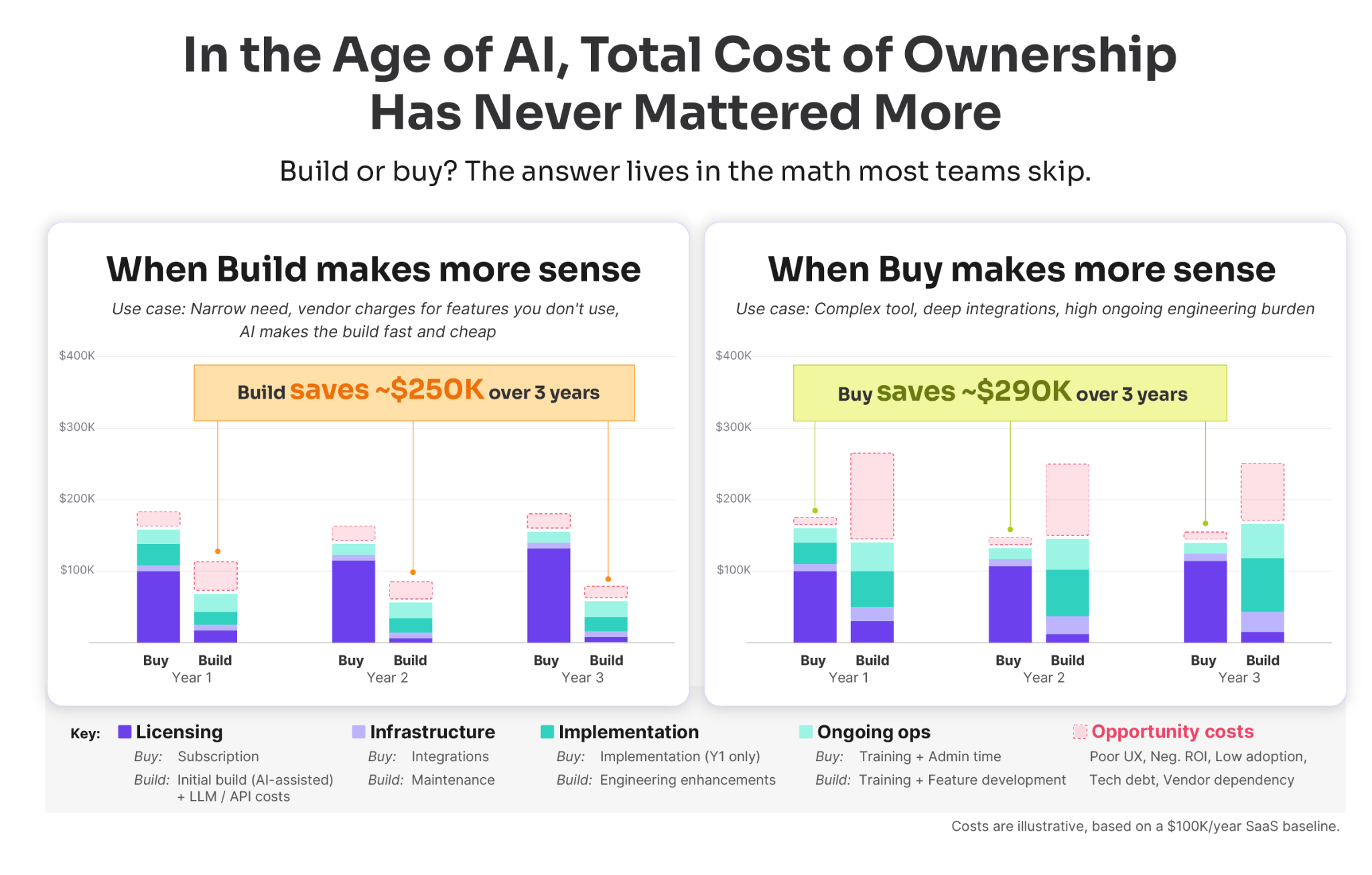
The build math changed. A lot of buying habits haven’t. According to McKinsey, 32% of companies have already passed on at least one software purchase because they could build it with AI coding tools. The thing you’re about to renew might be a few weeks of work for someone on your team. Just vibe code it!
Building when you should buy.
Woah, hold your horses, you vibe-coding vigilante.
Building is often cheap. Owning is often expensive. Retool found 60% of builders shipped software outside IT oversight in the past year (talk about a governance problem waiting to happen…) The old iceberg analogy is grossly overused but I honestly can’t think of a better analogy in this situation. So many of the costs are not visible and sometimes really hard to measure. Some of the less obvious costs are often understated or forgotten all together. Things like maintenance costs, engineering enhancements and training costs. But let’s not forget the impact and trade-off costs. Forcing users to utilize a subpar tool can dramatically affect the intended results. Sure you might save a few bucks (or maybe not) but if the results you were looking to achieve also dropped, your total cost of ownership can easily skyrocket.
Case in point:
Earlier this year, I attended a conference and felt like I was falling behind because I didn’t have nearly enough agents. So I spent the whole flight home (cross country) building one. I was so proud. But looking back, my baby was ugly. I dealt with it for 5 months before looking at the market. Someone had built a tool that did what my agent did. Except their tool was WAAY better. And when I measured the costs, it was WAAAY cheaper. I killed my agent and bought the tool.
Assuming your needs are the same.
Turns out business needs are often changing faster than pricing models for Claude (okay maybe that’s a bit of an exaggeration but the point still holds). You have a renewal expiring contract and the default is to leverage a tool (like Tropic!) to find out who the competitors are. Be careful, you just skipped a couple steps. First you need to go back to the business and ask the question: “What is the business problem we are trying to solve?” Then define decision criteria that will help you solve for the problem in an objective way ( otherwise you are essentially doing the same thing as going grocery shopping without a list… except with a 5,6 or 7- figure budget). Then, and only then, do you determine which suppliers are well suited to solve the problem.
Assuming your contract length should be long (or short).
Everyone has a default. Some teams lock in three years because that’s how they get the discount. Others are pushing everything month-to-month because “the market’s moving too fast.” You are guessing. On one hand, you are paying a premium for flexibility that you’ll never use and you’re eating uplifts and running the same negotiation over and over (ask me how I know). In other situations, you go long on a tool in a category that’s changing every quarter and you might be stuck with something obsolete in eighteen months.
Term length should not be a policy. It’s a strategic decision based on….Data.
Assess Your Data
To be successful here you need strong data. Seriously, this is the foundation. And it’s more important than ever. Do a quick analysis of your data:
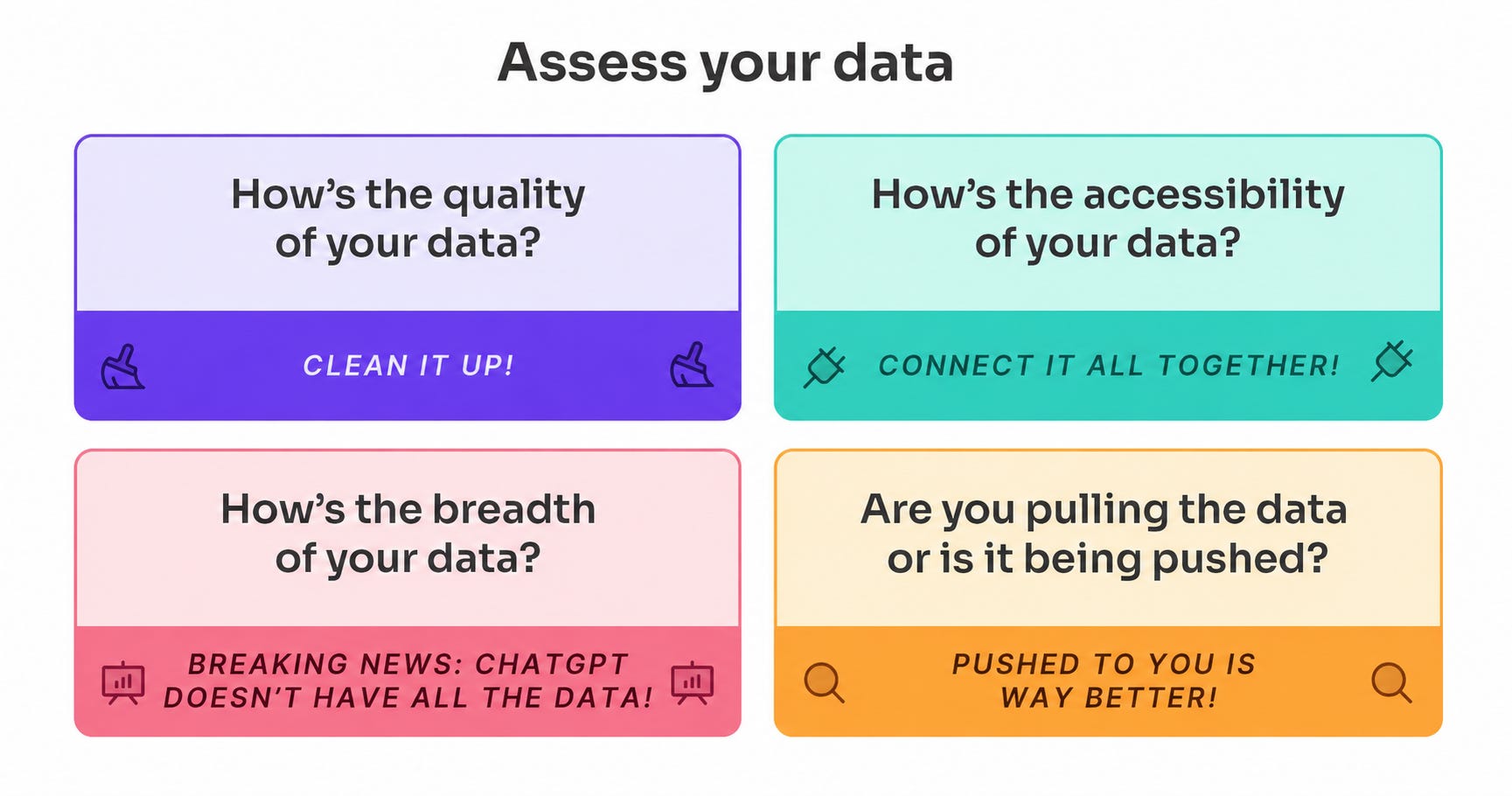
I know I’ll offend a few people, but ChatGPT doesn’t have all of the information. When I’m working on my spend strategy I’m pulling in data from internal sources and external sources. Sure you can give Chat access to your internal data. Yes, you want it pulling in publicly available data. But you also need data that is not publicly available (and yes, you might need to pay for this).
Full disclosure, I run procurement at Tropic (the sponsor of this newsletter). Which means I’m customer zero. And the thing it gives me that I couldn’t get anywhere else is that third bucket. The data that isn’t public. Benchmarks on what other companies are actually paying. Negotiation playbooks built on billions in spend and thousands of contracts. Plus the real life experience of a services team that’s been in the room for these negotiations. That’s not something you can just google (but you can access it through an MCP). And it gets pushed to me alongside my internal signals, so I’m not stitching it all together myself.
Cool right? So let’s wrap things up.
Things are changing quickly and I’ll be honest, sometimes I think it’s a scary situation to be in.
But I’m doing my best to pivot and see this as a massive opportunity. The ones that do it right will not only have a strategic advantage, but they’re more likely to adapt and survive.
And when my CFO slacks me, I can say, “I’ve got 40 expiring contracts this quarter. No surprises. I’ve been watching the signals on all of them for months. And I already know which ones need real work.”
Footnotes:
Talk to my friends at Tropic to uplevel your procurement function (move faster and spend less)
Thanks, Michael for the masterclass on procurement in the age of AI! He even wrote a book on procurement that just came out! check it out
Subscribe and share the OnlyCFO newsletter with your teams
*Nothing in this article constitutes legal, tax, or investment advice.