
Today’s Sponsor: Deel

Payroll is entering a new era with AI-driven compliance, real-time visibility, and higher expectations from the board.
Deel’s Payroll Strategy Toolkit gives finance leaders a step-by-step roadmap to modernize payroll, reduce manual risk, and build a scalable strategy with confidence.
Snowflake CFO Retires a Billionaire
Michael Scarpelli joined Snowflake as CFO shortly before their IPO and had stock options worth ~$1.5 billion (at least on paper) just a couple of months after they went public.
It’s rare that CFOs join the “Three Comma Club” (billionaire), but CFOs and other executives are definitely not underpaid…

In this post:
Breakdown of all the public information on exec compensation
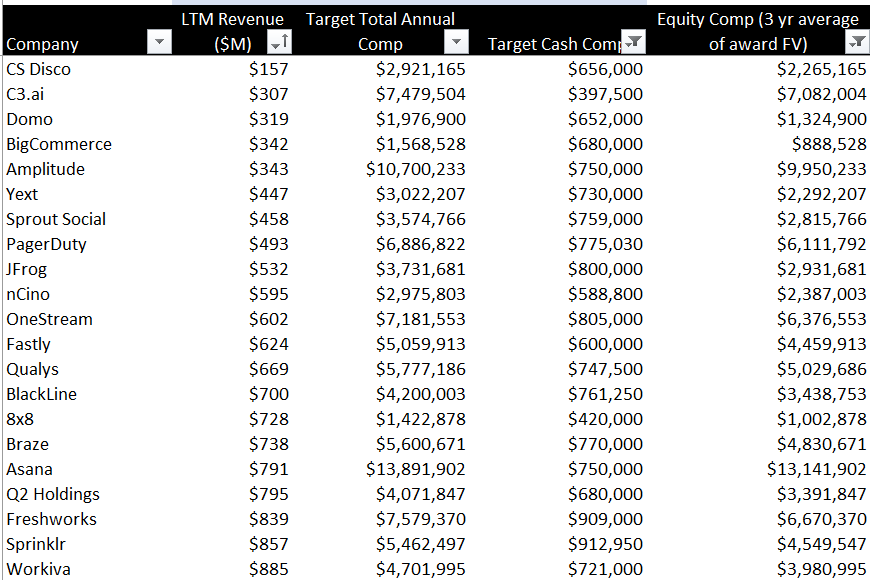
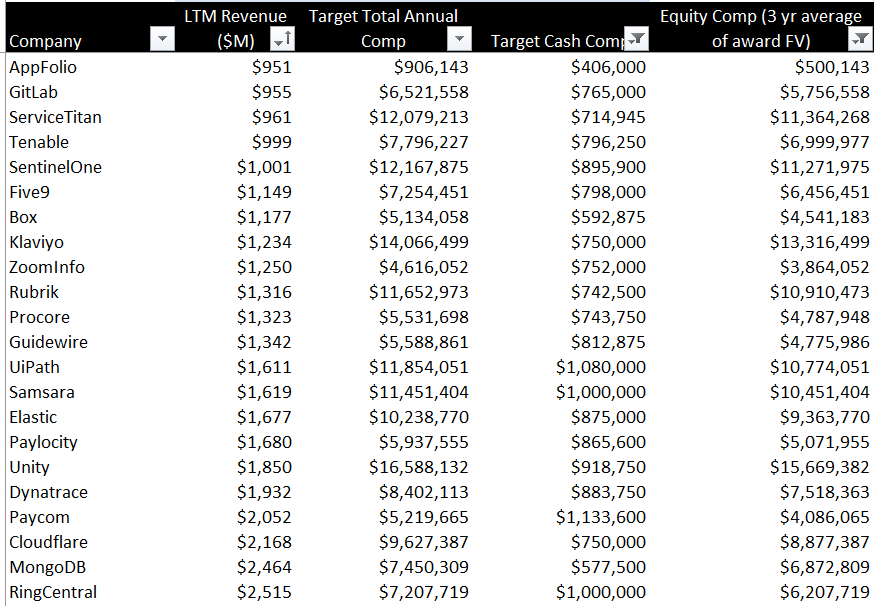
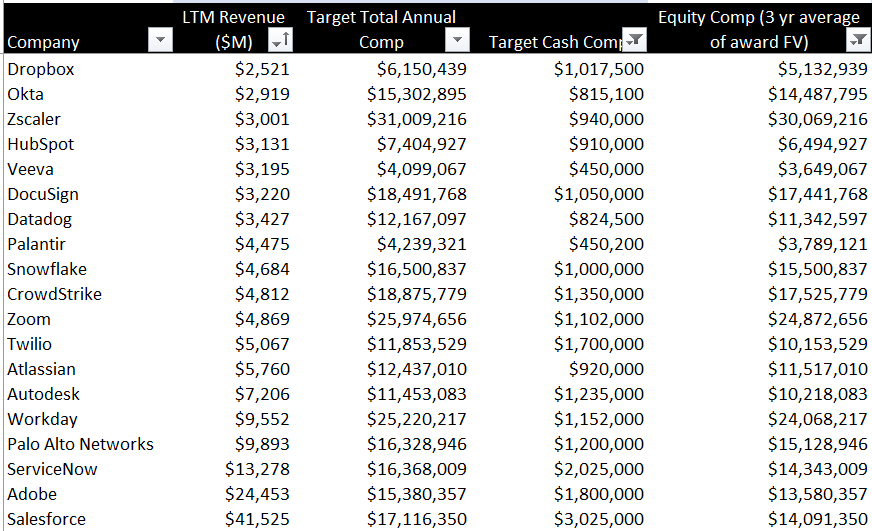
CFO compensation data across all public software companies
Filings and Proxy Statements
If you are a named officer (or board member) of a public company, you kiss privacy goodbye. We get to see a lot of your finances (at least with respect to a significant part of your net worth).
Everyone Gets Your Offer Letter
When a company goes public, they must file the offer letters of the named officers (at least a total of 5). As such, we have Scarpelli’s original offer letter…
Base salary: $300K
Target bonus: $300K
Equity (stock options): 1.25% of fully diluted with early exercise rights
Right to invest in Series F: Right to purchase up to 0.25% of fully diluted shares
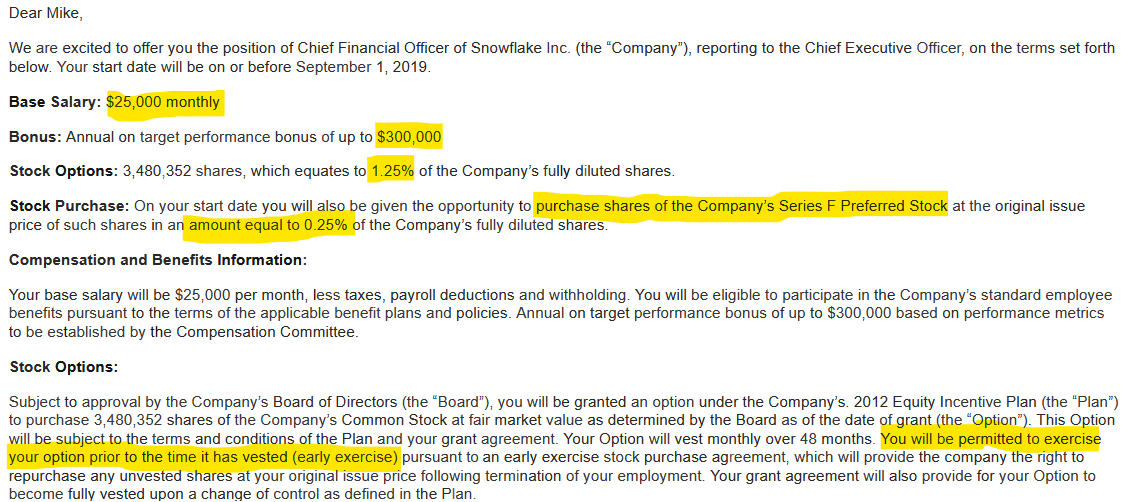
The cash comp was certainly on the low side given Snowflake’s scale and growth. Equity at 1.25% was on the high side for a CFO joining at the scale Snowflake was at. Not crazy, but high side. The options had a grant date fair value of $20.2M.
The right to invest in the next round is interesting. This isn’t unheard of, but isn’t included for most private company CFOs. More common when near an IPO like in this case.
The offer letter provides helpful context to the next piece of compensation information we get when a company is public…
💡 Check out Deel’s payroll guide to learn more about compensation strategies. They also have great compensation benchmarks.
Form 3 - What You Got?
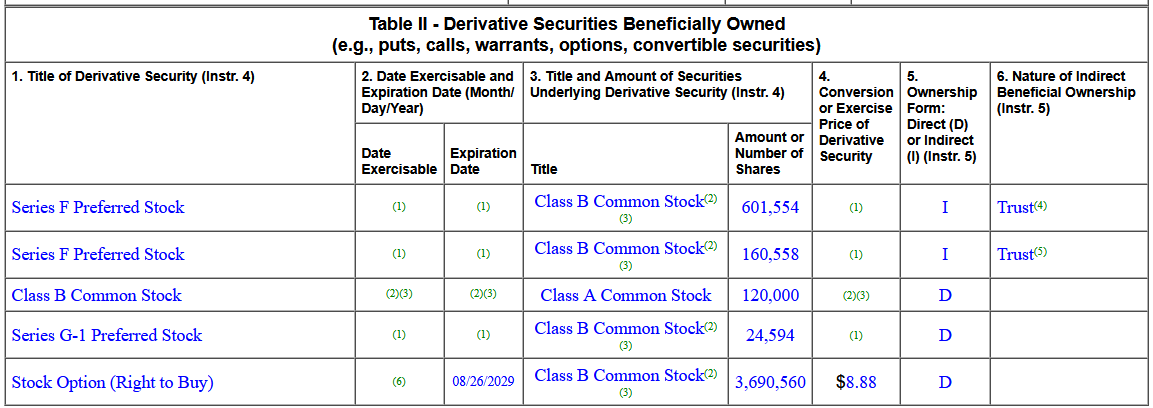
When going public or when someone gets promoted into a named officer position they must file form 3. It lists the type of equity, the amount, and nature of indirect relationships.
Preferred Stock: We know Scarpelli had the right to buy Series F shares based on his offer letter and now we know he did invest (he also invested in the Series G). He spent ~$15M of his own money investing alongside those two rounds.
Common Stock: Scarpelli has an early exercise provision (common for all execs) so he probably early exercised to get those shares.
Stock Options: This is the equity compensation he got that we saw in his offer letter. Looks like he got another ~330K stock options between his signed offer letter and his initial grant.
Form 4 - What You Doing?
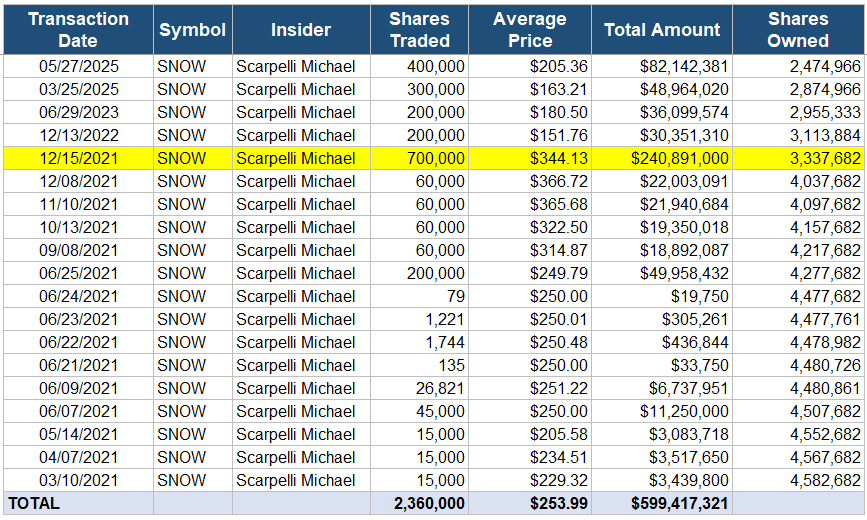
Officers and directors also must report all their equity activity (buys, sells, exercises, etc) on Form 4.
Typically officers sell stock in one of two ways:
Net-share withholding: Public companies typically issue RSUs so there is a tax event each time RSUs vest. It’s common to sell (or company withholds) enough RSUs to cover the tax liability. These are automatic and don’t signal anything about an officer’s belief about the company.
10b5-1 planned sales (scheduled sales): Almost all officer stock sales go through this so they have a solid defense against insider trading. These scheduled sales are predetermined (at least 90 days after adoption).
Scarpelli had both of these because he also got PRSUs after they went public and those vested over time after they met the performance conditions. Scarpelli wasn’t shy about selling Snowflake stock….he has sold $600M worth of stock since the IPO.
And he did pretty well timing the top with his largest block. He sold the biggest block of shares ($240M worth) near the peak of Snowflake’s stock price (the golden era of SaaS).
Proxy Statement - How Much We Paying You?
Few people actually read proxy statements, but there is some interesting information in them…particularly around officer and director compensation.
Scarpelli announced he was retiring last year (following Slootman again). Scarpelli was Slootman’s CFO at ServiceNow and Data Domain before joining him at Snowflake. Just a reminder that if you are a good leader, then your bosses will bring you to the best companies.
Base salary: $500K
Target bonus: $500K
Snowflake’s bonus plan is paid out quarterly based on revenue. It had a minimum target of 85% (i.e. <85% got zero) and then paid out linearly through 100%.
A total of 110% bonus pool over-achievement was possible if they met the targets of three “gate” metrics:
Non-GAAP gross margin
Non-GAAP operating margin
Revenue growth of a specific product
New equity awards: $29M
Equity comp is obviously where the money is at…
100% of Scarpelli’s equity comp was in the form of PRSUs (had to hit certain targets to vest). This is somewhat unusual. Most have a combination of regular service-based RSUs and PRSUs, which is what the rest of the officers at Snowflake got.
His target PRSU grant was based on a minimum achievement of 80%, otherwise, 0% would vest (they hit 89% in FY25).
PRSU targets:
50% revenue
25% FCF
25% non-GAAP operating margin
The grant date value of the award (assuming 100% achievement) was $29M. This is based on the stock price at the time of grant of $163 so obviously, if the stock price increases/decreases, his realized value will change. Also, he could overachieve and get up to 120% of the target PRSU. So his grant could be worth up to $36M.
He vests in the PRSUs as follows: 33% upon achievement and then quarterly over the next 2 years.
Still Vesting
The big money potential is often made by joining a pre-IPO company so you can get a large grant and a much smaller valuation before the IPO (like Scarpelli did). But executives can make decent money after going public as well…
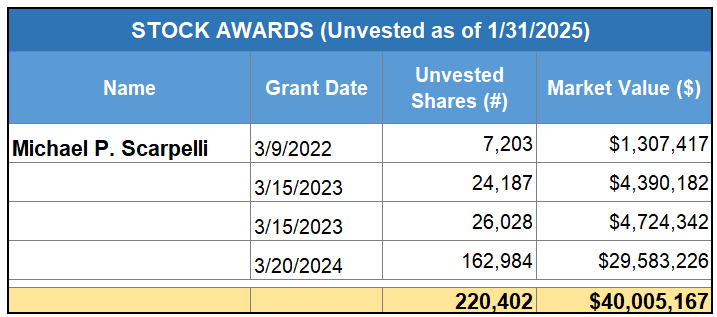
A closely tracked number is the market value of unvested awards. How much is the executive getting paid to stick around?
Most of the below is vesting over the next 2 years.
How Much Equity Does Scarpelli Have Today?
Scarpelli officially stepped down as CFO in September of last year. At the time he left, he had $518M net value in Snowflake stock (vested stock options and all of his common stock).
While we don’t know if/when he sold that, since after stepping down as CFO he doesn’t have to report it, based on the last known amount…Scarpelli made over $1B at Snowflake. He actually realized $600M (by selling) and had $518M worth remaining. Also, Scarpelli continues to vest in his previously outstanding awards because he entered into a 12-month advisor contract after stepping down as CFO in September. So he will make another ~$20M as a very part-time advisor. Not bad…
Seeking the Tres Comma Club
Usually you only join the Tres Comma Club by being a founder, but some lucky executives can also become billionaires. Scarpelli certainly did well. There might be a couple of other CFOs that realized more (like the Nvidia CFO), but relative to company size and length of time, I am not sure anyone can beat Scarpelli…
Below is a list of all public software company CFO compensation. Couple of notes:
I worked with Claude to get all the details. Took several iterations but there could still be some mistakes
Equity comp is based on grant date FV, averaged over 3 years
Footnotes:
Great read: Payroll Strategy Toolkit. My friends (and today’s sponsor :) at Deel wrote the playbook for how payroll should work in 2026.
Want to Sponsor? I am opening up the rest of the year now so email me at onlycfo@onlycfo.io to have your wildest marketing dreams come true.
*nothing should be considered investment, legal, tax, or any other kind of advice
The breakdown of Scarpelli’s PRSU targets is a masterclass in alignment. Seeing a 50/25/25 split between Revenue, FCF, and Operating Margin shows that even at a billion-dollar scale, the focus remains on balanced growth. For those of us building toward an exit or acquisition, these gate metrics are exactly what we should be tracking to prove our business's health to potential buyers.
The real takeaway isn’t comp size it’s how equity aligns incentives with long-term outcomes. That’s where real value is built.